Showing posts with label 1965. Show all posts

27 December, 2018

To Your Scattered Bodies Go by Philip José Farmer


Scattered is probably a fair way to describe what’s happening here. Two novellas build this book. And I think that split nature is a part of the problem: because the first novella deals with nudity, surprise, human savagery, and history, some of the more interesting aspects of the world as a whole are ignored or glossed over. These may lead to future stories, I see that there is a series following this book, yet when they come up in the second novella, they feel tacked on. While fixups are not inherently bad, Farmer puts the two novellas together poorly. The seeming lack of a shared theme further damages this book as a novel.
Know a man's faith, and you knew at least half the man. Know his wife, and you knew the other half.

The biggest problem lies in Farmer’s inability to clearly communicate conclusions to his themes. He’s dealing with some interesting issues: death, love, humanity as humanity, morality, religion, political science, history—Farmer brings up a ton of themes. Too many to adequately deal with all of the ideas he brings up. Scattered. And themes that would have been important to explain plot points—wanderlust, egalitarianism, warfare—are skipped over and implied instead of explored. That said, the theme of humanity as humanity is really well done, and I wish the rest of the book lived up to it. In short, Farmer states that humanity never really changes that much. From pre-homo sapiens to 21st century people, these resurrected characters are all given a second chance, and the first night is an orgy of rape and fear and murder. Humanity’s selfishness survives a second chance, in a way that reflects humanity as it seems to be.


The second biggest problem I see is that Farmer keeps talking in asides. Eventually plot points are dropped—Farmer spends pages dealing with the tension between Alice and Burton, but then they get together seemingly randomly, and the whole sub-plot is dropped from then on. The discussions of the characters create info-dumps, and their continuations are scattered throughout the novel. For instance, a 20th century Jew from America confronts Burton about a book he wrote that seems anti-semitic. They agree to discuss this later, but it’s a long time later when they finally do. And the weak payoff satisfies the buildup not at all. In short, the book rambles and trips over itself in the way the plot is paced and dialogue functions. Scattered.
The fortune of the man who sits also sits.

Farmer creates a couple of interesting characters, drawing heavily from historical figures. It’s uncomfortable, reading fictional representations of historical figures, as the archetype writes itself, and I’ve no idea how honest Farmer is being with these historical figures. I don’t need historical accuracy, but who is the intended audience? If it’s other Burton fanboys, then what does this book offer that I am missing, as a non-Burton fanboy? If it’s people who have never studied Burton, then a niggling question arises of who the historical figure was and how he is related to this fictional portrayal. There is an opportunity here, I think, but I’m not sure if Farmer’s method is the best or not. It works, because I don’t know Burton from Adam, but it’s a dangerous tactic.

The writing is pretty plain, but I want to lay the blame for that on the situation within the book. Namely, millions of people suddenly arise from the dead on a world constructed to observe their society and lives. Their newfound immortality and cosmopolitan situation—in both place and time—means that they have to teach each other to communicate, to get along. So, perhaps a plain language helps communicate this back-to-basics premise of the novel. Yet it doesn’t come off as strong wordplay.
Purgatory is hell with hope.

What can I take away from this novel, as a writer. First, the importance of some focus, some obstruction to the creative process, seems necessary to writing a better book than this. The scattered themes, conversations, and plots leave me unattached and largely uncaring. Second, the writing of plain language may be important to the premise, but the lack of beauty in the writing irks me. I wish Farmer had written better, while still retaining a plain diction—he pushed too far to one side in writing, and his writing ends up boring. Third, unnatural dialogue bores. These characters give five paragraph speeches like five paragraph college papers. No thanks—info-dumping substitutes for dialogue poorly. Fourth, the use of historical characters contains potential, but executing it requires great care. The redemption arc of Herman Goring plays as an aside to the main story, whatever that main story might be—and I’m not sure trying to redeem Herman Goring in the afterlife is the best move for any author. I will not be looking for other Riverworld books to read.

25 January, 2016

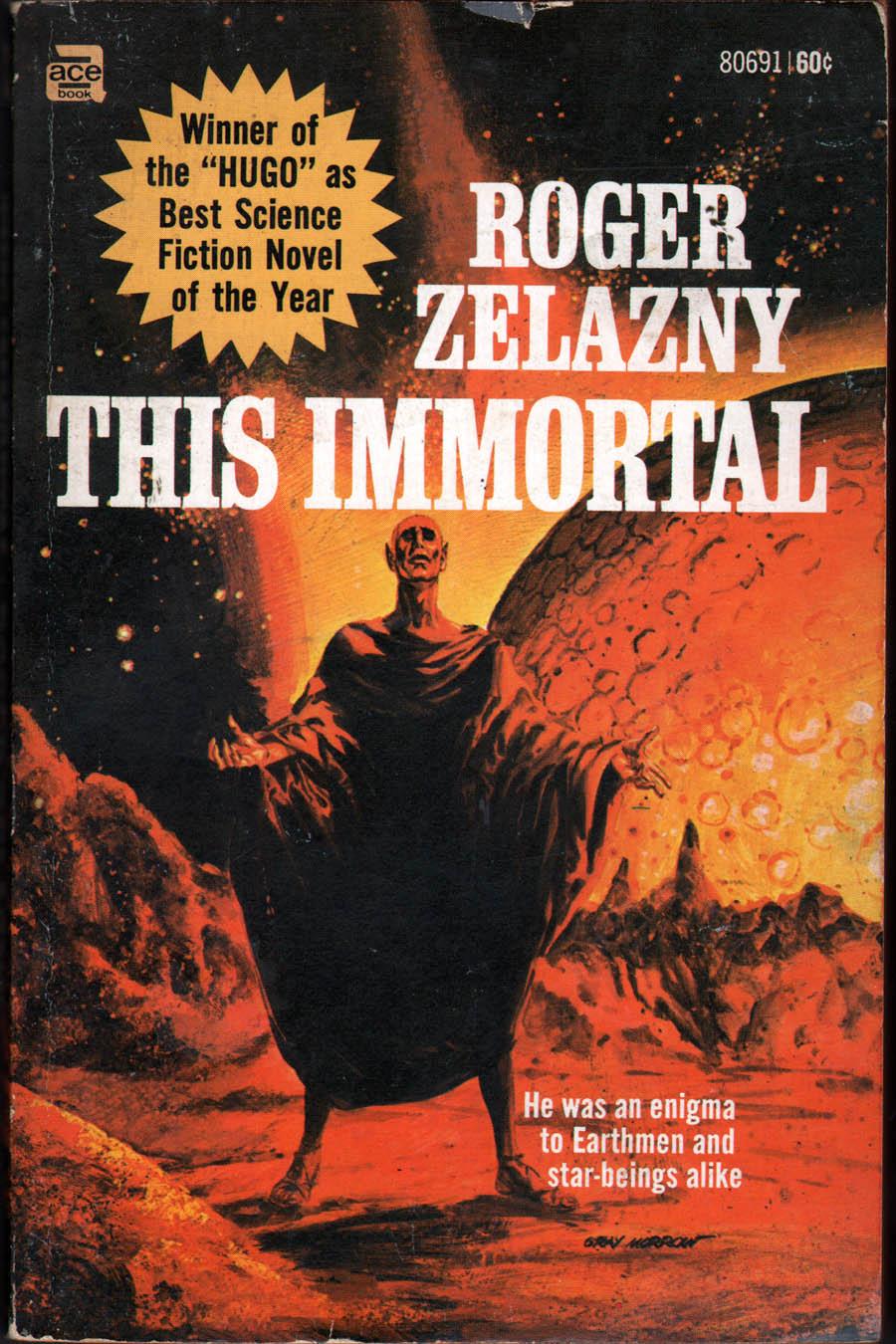
This Immortal (aka ...And Call Me Conrad) by Roger Zelazny


1. This book has a problem: it is referential to a fault. A lot of paragraphs draw parallels to a wide array of references—ancient Greek myth, contemporary 1960s culture, and pop cultural references timed between the ancients and the 1960s. These references are so thick that it easily loses the reader at times. But never for too long. Zelazny always shows what the references mean, rather than telling, yet the references are still too much. They bog the reader down with questions of what the references mean: there are simply too many of them to allow any reader to know all of them. This fault moderately reduces my enjoyment of the book.


2. The other problem is major and can be stated more simply: Zelazny is concise to a fault. The plot is threadbare and the wonderfully witty dialogue almost too fast. Things happen quickly with little or no set-up or rise in tension. This makes everything seem quick and perhaps unplanned. Of course, the last three events—the dead man, the hot spot, and the black beast—are foretold by Conrad’s son Jason. But Jason shows up out of nowhere, the cannibals show up suddenly, and the black beast appears and is beaten before it has any real impact on the story or characters. This fault massively reduces my enjoyment in the book. I wanted to really explore some of the plot points, exist in them for a time, and contemplate some of their ramifications. Instead, I’m left wondering what effect the hot spot had on Hasan; the black beast is a quick, simple battle and I’ve no idea as to its significance to the world at large; the pipe playing happens so fast with no real transition to allow me to properly place the characters. In other words, things happen so quickly I’m still a bit unsure what is dream and what is plot. There is a balance to grasp here, that Zelazny doesn’t: too slow and the reader gets bored, too quick and the reader gets lost, though between too quick and too slow exists a wide gray area of pacing that I enjoy. Zelazny moves too quickly and this book doesn’t hold me the way Lord of Light, Zelazny’s later book, did. This quickness also makes events seem like deus ex machina at times, which is a negative. If he adds something to the reader’s knowledge of the world, you can bet that within ten pages, that new element will come by to save the day.


3. Now that those two unpleasantnesses are dealt with, I can move on to why I enjoyed this book. First, the writing is superb. Zelazny strikes a perfect balance here between beautiful and efficient language that kept me engrossed and enjoying even the referential sentences I didn't understand at all. I loved Zelazny’s writing here, full of consonance and internal rhyme, but not over the top. He also uses a lot of analogy to say things. One example is that the two shots of the elephant gun at the end are likened to the thunderbolts of Zeus. This analogy wonderfully keeps the mood of myth and mystery, while being a worthwhile description of what actually occurred.


4. Second, the characters are engrossing and distinct. Though the book tends towards quickness, ending up more a novella than a novel, the characters are well developed mostly through dialogue, but also through sparse use of Conrad’s psychic power. Zelazny uses dialogue to build the characters, rather than extensive backstory or an omniscient narrator’s description. The book takes the form of Conrad looking back on these experiences, telling them to the reader from his point of view. This let’s Conrad’s exposition of the characters really focus on the dialogue and actions of the others.


5. Third is the plot—it’s both a post-apocalyptic tale and a post-contact story. This combination seems odd conceptually, but Zelazny ties them together enough that my imagination runs wild. Again, the quickness steals some of the satisfaction I should feel at these two tales being woven together well, but there is enough in there that I greatly enjoyed the plot and the implications for planet Earth.


6. The main character is Earth, not Conrad. That’s really the whole gist of the book—what happened to Earth, what it’s like in the book, and the potentials it's left with at the end. This ties into the theme of adaptation. I don’t mean that in the ecological sense too deeply—to me the theme centers around Conrad adapting his tactics to fulfil his goals, and modifying his goals as a necessity. For instance, in the past Hasan, Phil, and Conrad bombed islands and killed the alien invaders in an attempt to galvanize a return to Earth by ex-patriots. However, they both realize that will never work and change their tactics. Phil becomes the consummate socialite, helping to establish and preserve a reason for some to stay on Earth. Conrad becomes a governmental official, helping to distinguish Earth as a unique entity—Earth for Earth’s sake, with all the warts and boils inherent in it. They both have changed to continue attempting to accomplish their goals of making the world better for humans. Their goals also change by abandoning the naive hope to work against the aliens, realizing instead that alien power and influence necessitates working with them. This adaptation requires a realistic appraisal of the situation and some deep changes in the characters. But they end up being successful only by subduing their earlier impulses for bloodshed: they destroy their earlier efforts in order to create a new balance.


7. This book is a wonderful read, partly because it is so short. Any longer and the quickness with which it dispatches plot points would’ve been overly trivial. The characters are strong: Conrad is a superhuman anti-hero, as is Hasan; Earth is a vibrant and damaged, the damage adding to the diversity and vibrancy; George the single-minded scientist; Ellen the socialite flitterer; Red the neophyte of a past iteration of Conrad. What little plot there is grips the reader and provides abundant space for the reader to fill in the blanks and spin their imagination to fantastic places. It’s all a single chapter, start to finish, and Conrad follows the action pretty closely. A worthy read, but not great. This shared the Hugo for best novel in 1966 with Dune, which is a better novel to me. But for a novella, this book is fun—especially the writing; for that writing I will forgive a lot. The novella category was added to the Hugo awards in 1968.

07 August, 2015

Dune by Frank Herbert

For Rebecca and Garrett


1. A common trait of science fiction is to push a contemporary idea or thread of thought to a logical extreme, then examine it through an extreme situation. This can be both a strength—as it is here—and a weakness—as it is in the work of Ayn Rand. It's a strength here because oil is not the sole topic—he examines many other topics: mono-crop agriculture, nature vs. nurture, the influence of blood, public vs. private life, cultural aspirations, tribalism vs. empire, mysticism vs. science, and there's probably a bunch I'm forgetting. Yes, it is all about oil; but it is not 100% oil, and the rest of these themes tie into oil and start to explore a deepness to the subject that is fascinating. Though these other topics may not be explored to the depth that oil is, their breadth and variety pull the book out of pulp fiction and into literature.

2. The question I still struggle with the most is this: is he esoteric to a fault? I think the pace of information is appropriate in the book, as is the scope of it. And, at some level Dune really works, so perhaps that should prove that he does not over do his esoteric revelations. But I wonder at the things brushed over, revealed and forgotten, and think I may have liked Dune better if some of these were illuminated more—Alia and the raid that captured her, Leto II and the raid that killed him, Guild Navigators, the Sardaukur. Explaining these in-depth would have been too much for one book, but a little more might've been nice. I think what I'm trying to say is he is not esoteric to a fault here, but as later books in the series show, this is a difficult line to draw.


3. The two main criticisms consistently level at Dune from a storytelling perspective, involve the Bene Geserit and Leto II.
—The Bene Geserit are powerful female characters, but they're witch-like and their ultimate goal is to meddle in others' affairs long enough to use their sexuality to create a man worthy of entering their ranks and lead them to glory. I cannot argue against this point: the Bene Geserit here are laughable and ridiculous when distilled. However, I do think that there are three female characters that do not fit into this oversimplification: Chani, Alia, and Harah. I further think that the Bene Geserit fit exactly what Frank Herbert was wanting from that part of the story. But I do share a wish for strong, non-Bene Geserit females in the novel.
—As to Leto II dying forgotten off screen, I believe this is used to show Paul's biggest flaw—the single mindedness and preference for thinking about the future that deny him mourning for either Leto. But I don't think that is enough of a justification for what is a startling and disorienting moment for the reader. I still wish that the raid that killed him was illuminated on scene in a chapter.

4. My main criticism would simply be that the dialog is not great. Characters often sound too similar throughout. Of course this complements the premise that actions speak louder than words, but more distinction between character voices could've been a positive addition to the book without subverting this premise.


5. There is a revelatory aspect missed by people reading it for the first time today. Herbert was on the cutting edge of radical ecological research for five years before writing this. But today these ecological ideas are widely accepted: desertification, de-desertification, hippie water collection techniques, green power, and living with the land rather than on it or off it. These are commonplace today, stealing some of Dune's thunder for new readers.

6. I think this is one of the greatest works of science fiction: it straddles the line between a pulp page turner and literary rumination in an accessible, important, and exciting way. It has wide appeal in its political intrigues, conflicts, and coming of age messiah plot. It does not bog down in over detailed world building. It does science fiction well. It also came out in the right place, at the right time: this messianic, anti-government, ecological health novel about oil released in 1965, when the baby boomer hippies were hitting their stride, and that really solidified Dune as an import and influential novel. And lucky for us, it's a well told story that is also well written.


7. So many works today are written for a sequel, leaving too much unsaid in favor of hooks open for a series of novels, or leaving too many lose threads for further investigation in later novels. Here he seems to mostly leave out what is not important to the story being told in this novel. The explanation for these things becomes future sequels, but in a way that doesn't ruin Dune. And I think this is the real enduring secret of Dune: he manages to find that balance in everything—all of the contradictory themes, esoteric and exoteric revelations, plot action and character introspection, contemporary problems and eternal human concerns. He brilliantly balances so many contradictory ideas and characteristics that the novel ends up working well for a wide variety of readers.