Showing posts with label 1983. Show all posts

10 February, 2017

The Colour of Magic by Terry Pratchett


0. I’ve read a few Discworld novels, but decided recently to read them all, rereading some along the way. I respect Pratchett over most other authors in my lifetime, and I want to read his novels to see if that’s still something I think; to see why, exactly; because I’m busier at work than ever and Pratchett is funny. Also, when asked who we will still be talking about in one hundred years, a medieval literature professor I had in college, named Richard Fehrenbacher, stated without hesitation that we’ll still be talking about Pratchett. I agreed with him at the time, and I still do. So, as I move into reading through all of Pratchett’s Discworld novels, I hope to discover more proof for why this is. Before getting into specifics, let me explain why I think Discworld is one of the most important groups of novels of our time.
—The Discworld novels are fantasy books, but the novels satirize culture today, as well as fantasy literature. In 2005 Pratchett stated:
“Now, how did I start out? It was to have fun with some of the cliches. It was as simple as that.”
And on one level, that’s really a lot of what there is to Pratchett, and it actually is as simple as that. But there is more to him, and he had already explained what he means by ‘fun with cliches’ in 1985, during his speech at Novacon 15. This speech was given between the publishing of the first and second Discworld novels. He begins by laying out the basic premise of both his work and his speech:
“I want to talk about magic, how magic is portrayed in fantasy, how fantasy literature has in fact contributed to a very distinct image of magic, and perhaps most importantly how the Western world in general has come to accept a very precise and extremely suspect image of magic users.”
In other words, magic and fantasy novels have become standardized. The novels of Fritz Leiber and Ursula Le Guin contribute to the same world. Not just in their use of tropes—you know, dragons, barbarian heroes, witches, exotic environments, questing to save the world, magical objects, etc—but also in their use of them. Pratchett continues his speech by laying out his basic task with those standardized tropes:
“But a couple of years ago I wrote a book called The Colour of Magic. It had some boffo laughs. It was an attempt to do for the classical fantasy universe what Blazing Saddles did for Westerns. It was also my tribute to twenty-five years of fantasy reading, which started when I was thirteen and read Lord of the Rings in 25 hours.”
And that tribute/comedic-sendup interplay is what’s most important here, that’s what makes Pratchett so astounding. He writes what I define as the post-modern tribute, in 1983. I think it’s a tactic definitional for many artists and writers. For instance, Quentin Tarantino and Wes Anderson do this now in cinema: they make movies that critique culture and deal with specific genres—comedically sending up the tropes of those genres, while at the same time crafting a loving homage to them and a good example of them. Pratchett predates these directors’ first movies by nine years and thirteen years, respectively. He’s doing the same thing, though more couched in comedy, much earlier.
—And Blazing Saddles itself? Well, it only makes fun of—it doesn’t simultaneously craft the loving, actually good Western that Tarantino made. It just pokes holes. Pratchett and Anderson and Tarantino actively attempt to change the genre, build it up, make it better, point out the power that is it’s raison d’etre—where Blazing Saddles just tears down.
—But what sets Pratchett a cut above is his breadth and depth of cultural criticism. He’s as wide reaching as discussing serious topics like religion, politics, and money; while also discussing frivolous ones such as taste, rock music, and fantasy. All in the same novel, all at the same time. If you want a snapshot of late twentieth century culture, I would point you to Pratchett without qualification.


1. This first Discworld novel is a strong start, but also shows places where Pratchett can improve as a writer. This first novel focuses on simply playing with tropes and critiquing culture. And the tropes play runs away with the whole. When he brought up Blazing Saddles in 1985, he obviously meant it for this book—this book almost exclusively pokes holes. He does not craft a superb plot, everything isn’t intricately connected together, and the gags run the show towards inconsistent pacing. They don’t ruin the show, but they obscure Pratchett’s genius too often. The novel is split up into four novellas, all connected by characters. It comes off like a fix-up novel, but each novella seems to attempt a different topic without finding a cohesive uniting element. The first burns down urban fantasy, the second dismantles wizards, the third makes fun of dragons and barbarian heroes, the fourth pushes exotic locales and customs over the edge. This novel ends on a cliffhanger, or three waterfall-fallers, and is picked up in media res in the next. But what this novel forgets to do is craft a good plot with solid pacing. Portions run long, other bits fly by too fast. He gets better, this I already know. But if you weren’t one of the five hundred and six who bought this first book in 1983, you’ve already been influenced by a lot of similar things that came later, and it’s hard to see just how groundbreaking and exciting this was.


2. Throughout the novel, he clearly critiques the tourism culture of the late twentieth century. The Luggage is a sapient, silent box with legs—and the tourist, Twoflower, never quite knows where it is, but it follows him around. Twoflower’s ignorance and naivety get him into terrible scrapes and stupid situations. Pratchett is consistently insightful, and this novel’s theme questions tourism and tourists. It shows the positives and negatives both. And often, both are funny.


3. But the novel’s theme is also in questioning the tropes of fantasy literature. RPG games like Dungeons & Dragons don’t get a pass—nothing does in Pratchett’s novels. They’re served up to show how ridiculous they are. But he also shows the strengths of why they are popular: at the most basic level, he populates this fantasy world with believable people, people we know and love, beside the ridiculously overblown fantasy characters from the rest of the genre. Bravd and Weasel may be Fafhrd and the Gray Mouser, yet Rincewind and Twoflower are normal people who probably work the next cubicle over. And the combination is often funny, insightful, and biting.


4. But because the novel mainly plays these tropes up for laughs, it doesn’t click, it doesn’t sing. This isn’t close to the greatest novel ever written. It’s great for what it is, but if you’re not interested in wry humor about tourists, insurance, or fantasy, this isn’t the novel for you. I don’t suggest you start exploring Discworld here, though some of the worldbuilding done here does help contextualize later novels, it's not needed as most of the later novels are standalone. It’s disjointed, but funny. It’s wandering, but poignant. It’s delightfully realistic, but fantastic beyond the usual fantasy genre.


5. One of two parts where this book really sings is in playing with some of the tropes when it comes to worldbuilding. The Thieves Guild and Assassin’s Guild are the primary crime-fighting guilds in the city. They’re a bureaucratic arm of the city and, in exchange for a certain level of licensed crime, fight “with the full force of injustice” to keep the crime for themselves. Because they have skin in the game, they root out other players in order to keep their monopoly. Some of this is explained in more detail in later novels, but the seeds are laid here. And what wonderful seeds they are. He builds this world through brief mentions, followed up by specific scenes of examples, or explanations to the usefully ignorant character, the tourist Twoflower.


6. The other part where it really sings is in playing with some of the tropes when it comes to characters. I say ‘some’ because he adheres to enough of the tropes to still make this a fantasy novel, but he looks at enough of them with fresh eyes that it’s also its own thing.
—The ignorant Twoflower exemplifies this: most ignorant characters fight to be knowledgable. That’s usually how the author talks to the reader and explains his world. But Twoflower fights to maintain his ignorance, and that makes a world of difference when compared to a Jason Bourne character. I’m not a big fan of the amnesiac or ignorant character used to explain things to the reader, but here it’s played up for laughs, and that makes it work for me as a worldbuilding tactic and a character trait.
—Rincewind is a wizard. A failed wizard. He can’t use a single spell. Rincewind bemoans excitement and longs for boredom. He runs away from danger. This isn’t the typical conception of a powerful, confident magus. This isn’t Gandalf.
—At the same time, Pratchett uses the tropes of barbarian heroes by pushing the pre-existing ones to their limits, instead of flipping them:
No, what he didn't like about heroes was that they were usually suicidally gloomy when sober and homicidally insane when drunk.
This quote illustrates how some of Pratchett’s work here even starts to make fun of post-modern, gritty, realism—what the comics genre was about to embrace in the 1980s, and what some cinema and literature had already gotten to. This is where Pratchett’s genius comes through, and his importance as an early example of these traits that were to take over in the 1990s and continue even today.


7. His writing itself is fine. It’s not the best I’ve read, but he allows himself a few moments to play with language the same ways he plays with tropes, and those moments are gold. Often, he takes phrases literally for humorous effect:
Some pirates achieved immortality by great deeds of cruelty or derring-do. Some achieved immortality by amassing great wealth. But the captain had long ago decided that he would, on the whole, prefer to achieve immortality by not dying.
At other points, he applies human rational and emotional traits to inanimate objects and ideas. This relating of two things that aren’t often related works wonderfully and shows his usual insight:
Rincewind tried to force the memory out of his mind, but it was rather enjoying itself there, terrorizing the other occupants and kicking over the furniture.
He also tends towards surprise, by stating something new that he hadn’t hinted at earlier, in a nonchalant way:
‘We've strayed into a zone with a high magical index,' he said. 'Don't ask me how. Once upon a time a really powerful magic field must have been generated here, and we're feeling the after-effects.'
‘Precisely,' said a passing bush.
These four traits of his writing are where it really shines. And that’s perhaps the most unifying thing in this novel—that nothing is sacred and everything is to be played with. Even language. Especially language.


8. So in all, this first novel is one I’ve read a couple of times, but I never feel like I need to go back to it because it lacks a focus that helps it remain memorable. I wouldn’t suggest it as a first novel, but fans of Pratchett do like it. It doesn’t show the genius of Pratchett often enough, and it isn’t quite as funny as later books because it takes the fantasy tropes angle too seriously, but it’s a worthwhile read and I enjoy reading it every time I do. It discerns what makes tourists so odd and somewhat endearing, and does a great job making fun of fantasy, but doesn’t quite pay enough homage to really get to a level of satire higher than Blazing Saddles. The 2008 film adaptation of this novel does a better job of telling this plot than the book did.

14 July, 2016

Forty Thousand in Gehenna by CJ Cherryh


1. Unlike Cherryh’s typical character focus, this novel discusses a situation over a long time-span of 305 years. The situation is a new colony on a habitable nut little understood planet. The book starts with it being founded, flourishing, and collapsing. Then being rediscovered, studied, and collapsing again. Then, between the on-screen scenes, being rebuilt and thriving. In Cherryh's universe, the science fiction theme clearly test-runs theories of first contact, and studies how azi and humans react to collapse. In this way, I think this is the most space operatic novel I’ve read by Cherryh, though her whole Alliance-Union universe tends towards this sub-genre as all the books are so interlocked.
From Section D: Mission Report by Dr. Cina Kendrick

Intelligence is not, as indicated above, a scientific term. [...]

Two considerations must be made. First, that an organism’s behaviors may be survival-positive in one environment and not in another, and second that its perceptive apparatus, its input devices, may be efficient for one environment but not for another. The quality imprecisely described as intelligence is commonly understood to describe the generalization of an organism, ie, its capacity to adapt by the use of analogy to a variety of situations and environments.

On the contrary, even the concept of analog is anthropocentric. Logic is another anthropocentric imprecision, the attempt to impose an order (binary, for instance, or sequential) on observations which themselves have been filtered through imprecise perceptive organs.

The only claim which may be made for generalization as a desirable trait is that it seems to permit survival in a multitude of environments. The same may be said of generalization as part of the definition of intelligence, particularly when intelligence is used as a criterion of the inherent value of an organism or its right to life or territory when faced with human intrusion. Generalization permits migration in the face of encroachment; and it permit one species to encroach on another, which adds another dimension to natural selection. But when extended to intrusion not over another mountain ridge within the same planetary ecology and the same genetic heritage, but instead to intrusion of one genetic heritage upon another across the boundaries of hitherto uncrossable space, this value judgment loses some credibility.

2. However, this novel isn’t all situational—well-developed characters still fill the pages. But it’s character by mindset more than specific individuals. Characters who take a non-interventionist policy oppose those who take a more helpful role, and both camps contain exploitative characters. These ideas are spread through the novel: from Union’s first contact with the Calibans, to Alliance's first contact with the Gehennans, to Gehenna's first contact with the Unioners, to Farsider’s first contact with a Gehennan.
—First, the Union colonists’ ignorance leads them to assume that the Calibans are stupid. This allows catastrophic destruction of the Union mission—both in the slow trickle of children away from their control, and the base being physically undermined and collapsing.
—Second, the Alliance comes in slow and indecisive—non-interventionist in word, but not so much in deed. Their base is way too close for comfort and their observation post changes what they observe. Their confidence in their space-based surveillance is similarly poorly placed—they can see the whole, but no details and are just as ignorant as to the meaning of the whole. Like when McGee heals Elai’s leg, it’s half-assed through indecision: in her own misplaced confidence and self-conflicted desire to save a child’s life, she doesn’t search for or get out the near-fatal bone-spur. This fumble sets her mission back fifteen years, until Elai’s mother dies. The Alliance's indecision as a whole leads to war, death, and the destruction of half the Gehennan culture. Finally, both the Alliance and Gehennans decide to educate and put their pride aside enough to be educated, and that seems the right track. (I read McGee’s pattern as a clear step in this direction.)
—Third, the Union comes in hungry for knowledge and offering trade. Elai rightly recognizes that the Union needs nothing from her, and calls their bluff. This is entirely the wrong foot to start out on for the Union: the wary reaction of the Calibans—leading to the Unioners further fear-based reaction—illustrates this. The Union is still ignorant to the point of not knowing how to engage their potential teacher, and this ultimately loses them their final influence over the colony.
—Fourth, the Farsiders appear to find the Gehennan curious, but the knowledge they do have—from videos and reports—allows even the rough docksiders to avoid an incident. Similarly, the Gehennan and Caliban pair chosen for the visit are appropriate for the high number of strangers they expect to run into.
—McGee, Genley, Elai, Pia, Jin, Jin Younger, Jin Elder, and Scar are the main characters, but the mindsets clearly steal the show from the people. These are well constructed, interesting characters; but they are not as important to the novel as the mindsets.
—And I find this discussion of the mindsets of First Contact to be the theme of the novel. First Contact here is a metaphor for the other. In our day-to-day lives we are consistently pushed outside of our normal comfort zones to deal with unfamiliar people, opinions, situations, etc. There are two ways this typically goes: fear or understanding. Education and embracing the unknown—quite literally in McGee’s case—leads to an inclusion that grows knowledge and culture. Fear leads to death. That’s Cherryh’s point and she makes it well throughout the novel by focusing on the mindsets—though she doesn’t lose sight of the individual characters in a way that shows how small acts have large consequences. Humanity will survive because it has generalization, but that's not always a good thing when the situation or environment pushes us, even on an easy, habitable, fruitful planet like Gehenna.


3. Cherryh set herself a hard task in the various writing tactics of this novel. She includes memos and portions of scientific papers to show the affect actions have on the whole.
I propose that, instead of arguing old theories which have considerable cultural content, we consider this possibility: that humanity develops a multiplicity of answers to the environment, and that if there must be a system of polarities to explain the structure around which these answers are organized, that the polarity does not in and of itself involve gender, but the relative success of the population in curbing those individuals with the tendency to coerce their neighbors. Some cultures solve this problem. Some do not, and fall into a pattern which exalts this tendency and elevates it, again by the principle that survivors and rulers write the histories, to the guiding virtue of the culture. It is not that the Cloud River culture is unnatural. It is fully natural.
Another aspect is researchers’ notes:
Is even childhood one of our illusions? Or is this forced adulthood what’s been done to us out here?

Us. Humans. They are still human; their genes say so. But how much do genes tell us and how much is in our culture, that precious package we brought from old Earth?

What will we become?

Or what have they already begun to be?

They look like us. But this researcher is losing perspective.
And memos also fill the pages, at least one going through draft after draft showing McGee’s mindset and final words, exposing much about her character and her dissatisfaction with the powers over her. Further, the Union, Alliance, Styxside, and Cloud River cultures all have their own voices, and the latter two communicate also via hand gestures and drawing patterns. It’s a plethora of writing tactics, causing Cherryh to switch gears consistently in a way that keeps the writing all fresh and exciting. It’s not all one voice, though Cherryh’s typical tightly focused voice is on display fully.


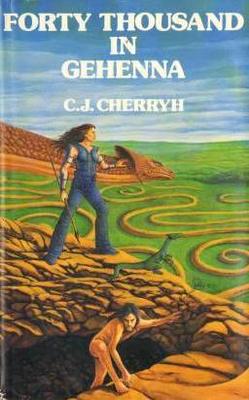
4. Many of these memos and papers take the place of actions and interior monologue in a way that makes the novel seem a little slow. There’s a lot that happens over these three hundred and five years, but most of the novel is people reacting to those changes and settling in as best they can. The action is usually fast—a couple of pages—and decisive, leaving the bulk of the novel to unraveling the meaning of those actions and what they signify. This isn’t necessarily a negative as I was enthralled throughout, but covers that show a human riding on a dragon-like creature mislead and that first edition cover (at the top) is the most informative as to what the novels feels like. Not sedentary, but also not rollicking, despite what the following cover wants you to believe:


5. This is a good novel. I wanted a bit more action and a bit more psychological depth—Jin Elder and McGee are really the only two who have any depth. But then, maybe that is me projecting on the novel too much of Cherryh’s other works, kind of like how Union and Alliance project on the Gehennans too much of their empirical data. I like seeing Cherryh trying a new method of storytelling with the time span that disallows her usual deep individual psychology, but I think her strengths primarily rest in the other way she writes. That’s not to say this isn’t a wonderful novel, because I really enjoyed it. It’s certainly better than other situational novels I’ve read, like The Plague by Albert Camus.

06 December, 2015

Startide Rising by David Brin


1. This novel switches points of view rapidly, but keeps most PoVs within a chapter. Each chapter break typically signals a PoV shift, but sometimes chapters are extremely short—like half a page or so. By having so many PoVs, this constant shifting effectively couches the action of the Streaker’s crew in its context. Brin keeps these switches legible by limiting his PoV character count—15 in the Streaker’s crew with around 5-10 aliens—and signposting the switches with chapter breaks, of which there are 124.


2. These PoV switches are very effective with worldbuilding. Brin shows willingness to allow a variety of characters to have a voice in the novel, but he also delves into their stances on the political issues, their unique characteristics, and their being. This variety and delving effectively builds the world while he’s telling the story. This is well-done here. He doesn’t overload the front, the middle, or the finish with world-building. He drips information out at a pace that is legible and easy to follow, while still creating an incredibly complex galactic society, and all without losing sight of the story and excitement.


3. [Added 12/14/15: Another thing Brin does well is grab and sustain the tension inherent in the situation he set up. The book takes place over about a month, maybe less than a month, and the situation doesn't significantly change throughout that time, but the tension does grow. The tension grows from characters essentially making their last play, trying to fulfill their desires through mutiny, assassination attempts, setting up traps, going AWOL, glimpsing and then grasping for spirituality, helping others at a cost to oneself, et cetera. These plays to fulfill their personal desires bring tension to the story, while the constant shifts in PoV allow the tension of the battle above the planet to substitute for tensionless times on the planet below. It essentially bleeds over due to the quickness of the shifts: after a chapter about the battle above, a chapter of a couple characters falling in love is tensionless, but I don't notice because the tension of the battle above is still with me.]


4. Brin builds characters well: each crewmember in each group is distinct, and I think that’s hard to do. He shows multiple sides of the mutineers, multiple sides of the ship’s crew, and multiple aliens. For instance, there are a few ship’s officers, and they’re very different people: the captain is forward looking and more willing to sacrifice one crewmember for the good of the whole, the second-in-command is a stickler for rules and desires quick solutions that require bravery, Hikahi is concerned about her crew and less willing to sacrifice even one—even an enemy. Brin keeps each of the main characters and secondary characters distinct, and does a good job of it. This characterization makes the whole novel feel realistic, despite the characters being sentient, spacefaring dolphins, chimpanzees, and humans.


5. But the pacing is not without problems: about 30% of the way in, something interesting of lasting importance to the story finally happens—the betrayal is finally revealed to the reader. Before that, there was just the arrival at a new planet, scant overly nebulous hints at tension within the crew, and a tsunami: the first just the setup, the middle making it seem like Brin wasn’t quite sure where he was headed, and the last a short-term tension at best. Once this point is hit about a third into the novel, it really takes off and the pacing is all but perfect from then on. Unfortunately that first third is a little slow. I was wondering where everything was going and why I should care. The inclusion of the tsunami and the weirdness of the planet in this part do serve important roles though: they set up the way the Streaker breaks free at the end, keeping the ending from being too much of a deus ex machina.


6. The setup is fantastic though, and that’s part of why the first third was disappointing. It’s a starship, mid-chase, landing on a planet to hide, followed by fleets of hostile aliens who are content to let it lie on the planet and duke it out in space for the right to capture the Streaker. There are no opening murders—a big advantage to any speculative fiction novel—and the story starts in media res. This opening is awesome, I just wish it wasn’t betrayed by the next third of the novel.


7. The writing is okay. It’s clear but nothing stood out as great or terrible. It’s not as efficient as some science fiction authors like Asimov, but that’s not a negative statement at all. Brin’s prose effectively allows some variety in language and sentence structure. This is his second novel, I believe, and I hope he gets better. This is a solid base to start from as a writer.


8. The theme of this novel is that diversity is both positive and negative. A diverse culture requires more from its members, but in so doing, greater heights can be achieved. The crew of the Streaker has multiple races of dolphins in addition to its token chimpanzee and humans. At the end, they use that diversity and the diversity of the aliens around the planet to escape the traps set for them by alien fleets. But it’s not without costs of racial tension in this high-stress environment: they first weather an assassination attempt, a mutiny, some desertion, and misunderstandings that require much sacrifice from the characters. I think Brin deals with this theme even-handedly, showing some good and some bad and, ultimately, coming down to a conclusion of diversity is worth the risks.


9. In short, this is a good novel, not great. It has a wonderful variety of situations, characters, motivations, and sentence structures. Match this variety to the story that is, for the most part, well-told, and a theme that is applicable and universal, and this becomes an enjoyable, good book.