Showing posts with label Robert Heinlein. Show all posts
05 August, 2019
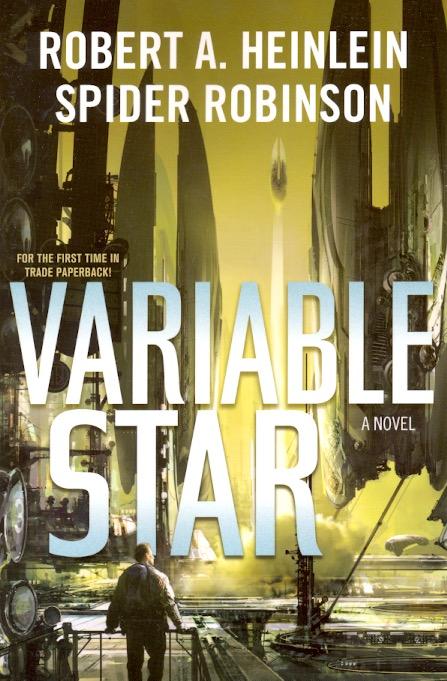
Variable Star by Spider Robinson
This novel was partially plotted by Robert Heinlein, who died before writing it. Spider Robinson was selected to tell the story Heinlein left behind. Initially, I think this was intended to be in the Heinlein juvenile novel series.
First and foremost, this novel kept me up at night reading. I enjoy reading most of this novel, and have picked up other Spider Robinson books as a result of this novel. It is very good. Though my notes below will raise some questions, I hope my liking of this book moderates any criticisms. This was given to me by a friend. It really feels like a funny Edgar Rice Burroughs.
A brief synopsis of the plot will serve to illuminate a few points I want to make about this story. The opening chapters detail the mental anguish of an 18 year old who finds that his betrothed is the heiress to the wealthiest corporation in the galaxy—though she lied to him about it throughout their dating life. Being 18 and heartbroken, he runs away, all the way away to an expedition to found a new colony lightyears away from Earth. Onboard the colony ship he starts to integrate into this new society, gain fame and renown for his musical abilities, and help in his small way to save the ship as each new crisis comes. Ultimately, he tries to save humanity from extinction, and it’s implied, does a pretty good job.
As the synopsis shows, there are three parts to the story: Terra, Colony Ship, and Post-Colony Ship. However, the ratios are a bit strange, in the reading. At the end of Terra, like Joel, the reader has little to stand on, as suddenly all of the characters vanish, and the novel starts again on the Colony Ship, with only Joel keeping on. The rest are new characters being introduced and explored. This feels like two-thirds of the book. And again, after they leave the Colony Ship, it’s a new start to another novel, though this one only plays for a few pages acting as a sort of epilogue. These massive shifts in narrative direction may annoy some readers, as the effort the reader puts into the first part is fulfilled only by, “and then he runs away” instead of those stories resolving. Then when those stories from the first part do finally resolve it is an epilogue at the end of the novel. Two things would’ve taken this plotting from good to great: first and foremost, more foreshadowing. The Colony Ship comes up once or twice during the first part, but not enough for me. I want more discussion about it before Joel signs up for it. Though the lack of discussion about it does help build Joel’s character, other tactics could’ve built his character and not left the reader feeling rudderless at the change. Second, this would’ve been helped by a “Part 1: Terra” style billboarding of the narrative shifts. At the end, I can see the whole structure, but even a single sentence saying, “I thought that was the last time I would ever see Jinny and Evelyn and Conrad of Conrad,” would’ve been a blinking light telling the reader that their roles in the novel would continue eventually, after the crises of the Colony Ship. To be clear, this was a good novel, but this minor annoyance could’ve been avoided and helped this book attain greatness.
Another tactic I would like to question is the referential nature: Ricky and Julian from Trailer Park Boys, Smithers from The Simpsons, George RR Martin, artist Alex Grey—there are probably a dozen name-drops in this book to friends of Spider Robinson and famous people. These also include in-canon references to Heinlein novels. This tactic seems weird. I don’t read science fiction to hear somebody else’s interpretation of Smithers’ sexuality, but this book gives that to me. If I don’t know Ricky and Julian from the TV show, do I understand their characters in the novel? Archetypes become shorthand—Herculean, Promethius, Einstein—but when basing them on pop-culture, their effectiveness diminishes because their universality lacks. I didn’t mind these as much as this paragraph makes it sound, but it’s certainly not a tactic I use or appreciate in writing.
Another problem is the humor being too present. This is a funny book and I love literature that makes me tear up from laughter, which I did here. But the humor is taken too far as tragic moments are not free of punny witicisms—even the extinction of 43 billion humans and the entire solar system elicits a couple of humorous one-liners. That seems more tone-deaf than anything. By that point in the story I already understand the main character to be a jokester, and don’t need it reinforced. I think it would’ve been more consistent with his change to maturity to leave some of those jokes behind. But, again, only about two percent of the jokes are misplayed. In the main course, I love the inclusion of so much humor here.
As a writer, Robinson can really construct some sentences well. There are a couple of awkward moments and weird changes of person that should’ve probably been rewritten. But I can only think of three or four parts where this applies. In all, the book is well written by an author that clips words from the English language to reflect how people speak more than how people write, without losing legibility for the most part.
The theme of the novel seems to orient around mental health and dealing with the hope and despair of life. Meditation and exercise and psychology help Joel go from punk kid to functioning adult. And Robinson does a good job of splitting the telling and showing of this change—enough of a good job that the jokes around the extermination of the solar system fall flat. Yet interesting ideas like Religion and Group Marriage are mentioned but not explored at all.
There is another inherent theme: humanity needs to escape the solar system to survive. And this is an interesting discussion, even drawing in Fermi’s Paradox to the narrative.
But the story still struggles to find a footing. Robinson is a big Heinlein fan and was a friend to the man. This leads me to question what happened here in regards to Heinlein’s rules for writing. He states that there are five types of stories, and this novel seems to try all five at once: it starts out boy-meets-girl, then goes all the boy who learned better, then it’s the little tailor, then a human interest story, and the gadgets underlie the whole thing, driving the plot every time a Relativist breaks down. I don’t necessarily take Heinlein’s divising of five story types to be prescriptive, but I wonder what he intended with this story.
Regardless, Spider Robinson turned in a novel I really like here. And I intend to read more of his work in the future. This story straddles the line between Heinlein’s adult fiction, with their deep dives into themes and ideas, and his juvenile adventure novels. I like pulp fiction, and this is good pulp fiction that kept me up at night reading from sheer joy.
Labels:
2006,
Robert Heinlein,
Science Fiction,
Spider Robinson
18 January, 2018
Farmer in the Sky by Robert Heinlein
A lot of Heinlein’s earlier work was tied up in Juvenile novels for Putnam, and this was one of those. I’m fine with that though. Starship Troopers was one that Putnam didn’t want to publish, breaking the relationship between author and publisher; and that’s a good book, whoever the intended audience was.
However, this one seemed juvenile in the way it engaged meaningful themes: namely, it didn’t. For instance, almost two thirds of the population of Ganymede died at one point, at least 24,000 of 37,000 people. Heinlein dropped that ball like a hot potato:
Like myself, Hank had been outside when it hit, still looking at the line up. The fact that the big shock had occurred right after the line up had kept a lot of people from being killed in their beds—but they say that the line up caused the quake, triggered it, that is, with tidal strains, so I guess it sort of evens up. Of course, the line up didn't actually make the quake; it had been building up to it ever since the beginning of the atmosphere project. Gravity's books have got to balance.That’s how the whole situation was dealt with. Heinlein allowed a bit more about the main characters’ sister and his neighbors, but the whole episode happened out of nowhere, and went nowhere.
The colony had had thirty-seven thousand people when the quake hit. The census when we finished it showed less than thirteen thousand. Besides that we had lost every crop, all or almost all the livestock. As Hank said, we'd all be a little hungry by and by.
They dumped us back at the Receiving Station and a second group of parties got ready to leave. I looked for a quiet spot to try to get some sleep.
It’s indicative of what I hated about this novel: it read like it was initially serialized in the Boy Scouts of America magazine. Which it was. That’s not inherently a bad thing. But it affected the novel in two ways: first, each chapter had a reference to scouting in it—usually well integrated, but sometimes a little awkwardly shoehorned in there. Second, it also meant that every chapter was its own self-contained thing: this book read like a comic book that slavishly adhered to the twenty-four page pacing. I didn’t know it was serialized when I was going into it, but I guessed it by the time I was done reading it.
Let me go through a couple of examples of placed where Heinlein should have expanded:
1. Two-thirds of the population dies.
2. Evidence of extraterrestrial life is discovered and saves the main characters’ life.
3. The spaceship Mayflower gets a hole in it.
4. The dead woman Anne.
5. The shotgun wedding of George and Molly.
6. The weird way that George and Bill interact.
7. Bill’s offer to go back to earth with his step sister.
As annoying as the pacing and depth was, I finished reading this novel, and even enjoyed parts of it. Primarily, the whole is organized around the nuts and bolts of terraforming: politically, ecologically, physically, the engineering behind it, and the human side of it. What most attracted me was this human side of it. The trip from Earth to Ganymede had some pretty memorable, Heinlein lines.
But then things quieted down and I was almost happy in a miserable sort of way.
+++
And there I got my first view of Earth from space. I don't know what I expected, but it wasn't what I expected. There it was, looking just like it does in the geography books, or maybe more the way it does in the station announcements of Super-New-York TV station. And yet it was different. I guess I would say it was like the difference between being told about a good hard kick in the rear and actually being kicked. Not a transcription. Alive.
+++
The people from the Daedalus and the Icarus were supposed to be stowed away by the time we got there, but they weren't and the passageways were traffic jams. A traffic jam when everybody is floating, and you don't know which end is up, is about eight times as confusing as an ordinary one.
So, despite everything that made this a bad novel—it didn’t have a plot so much as episodes, it didn’t have characters because it examined colonization from one sixteen year old boy's point of view instead, and it didn’t have much relatable to a reader who isn’t colonizing Ganymede—the small amount of human interest sections were very welcome. Most of them were also dropped balls but hey, it was a short book and I finished it.
Not his best, not by a long shot. But it was fascinating for me to look back at some of his early stuff and see how it differed with his later stuff.
Labels:
1950,
Robert Heinlein,
Science Fiction,
Young Adult
05 August, 2015
Starship Troopers by Robert Heinlein
For Morgan
1. The strongest thing about the writing at the start, just after that first bug-raid, is that instead of setting up a liberal-conservative dichotomy, Heinlein sets up debates within viewpoints. Two conservative viewpoints struggle for prominence—the father and the teacher. This feels more unique and honest to how I thought about politics in high school. It also sets up the way Heinlein is going to deal with Juan: he will seem to be all soldier, but he's actually going to be subtle and unique within that category.
2. Another strength of the writing is that it changes throughout. When Juan gets to OCS, we see him becoming more intelligent—we see this through word choice, sentence structure, and the way he argues, namely: the words are more unusual, the sentences more complex, and the arguments more detailed than the preceding chapters. Throughout, Juan is humorous, enthusiastic, and capable of an emotional poignancy that the reader feels. One example of his humor, "I couldn't say about that, I've never been a racehorse."
3. Juan consistently breaks the fourth wall, talking to the reader. I find this effective here. But why? Perhaps it invites the reader to pause and consider. Perhaps it increases immersion for the reader. But this direct addressing of the reader is effective for me here as it makes it hard for my mind to wander when Juan is talking directly to me. I think it would be boring over a whole book, but it works here because it does not happen all the time, and the book isn't too long. The teachers of HMP talking directly to Juan are also an effective way to talk to the reader without formally breaking the fourth wall.
4. Like other war memoirists, Juan is trying to... not quite justify himself, but certainly explain himself and perhaps convince the reader as well. Heinlein must've done his homework before starting this fictional war memoir, because it feels very honest to war memoirs that I have read. This realism helps make Juan more human—it comes from believing that humans always make the decisions they think will benefit them the most in the context of their personal experiences, their learned experiences from others, and the specific situation. Where he fails war memoirists is that he does not have the same relish for describing tactics. He tries to get away with this by saying they changed tactics each drop so the bugs wouldn't get wise; but with how many MI platoons would be involved in a war of this scale, I don't quite buy that. This is even more perplexing when I realize how liberal he is with throwing around ranks and group sizes like "rump battalion", with no explanation for the reader, expecting that they know this information. Perhaps he doesn't consider this important or interesting to the wider audience that he was writing to.
5. The best writing in the book is that Juan's changing reasons for joining and staying are illuminated without Juan changing who he is significantly, but through him becoming more self-aware. War and the right to vote are certainly motivators, but it is difficult to tell how important they are to Juan himself. He seems to try and talk himself out of those as reasons, but the amount of time spent on them in the novel seems to imply their importance. It may be a realization that he would wonder his whole life whether he was his own person—which is a fascinating either/or/if choice: either he joins or he doesn't, but if he dies he could never know anything. This is an effective problem to put a character into as a writer, and it helps illuminate Juan's character. But the time when he decides to quit boot camp until the end of that lengthy chapter is brilliant and evocative. The coup de grace is near the end where he starts noticing other people again—the band marching specifically. Essentially he becomes self-absorbed on orderly duty—despite the court marshal and Zim getting chewed out. But after the letter, on the march back, he stops living for himself and begins living for his squad mates. And the writing reflects that: it goes from introspective examinations of Juan's emotions to Juan looking around himself and realizing that he is not in a vacuum, and the writing describes the band and the march back. This scene really got me interested in boot camp stories—of which the two chapters in Lone Survivor do a very good job of evoking the experience, though the writing may be a bit thick on bravado. Anyways, this part is where he finally grasps why he fights—though it isn't mentioned here: he fights for the guy in the fox hole next to him, and so others do not have to. Why Juan fights and gets a commission shifts throughout the novel as he becomes more self aware. Initially it seems that he is joining up because of a shifting pattern of nebulous reasons: Carmen, Carl, franchise, teen angst, individuality, curiosity, boredom, pride, citizenship, et cetera. Then he realizes that he does it for other MIs. Yes, there is a small streak of pride and eagerness to try new things, but mostly he does it for the other soldier next to him. He continues with his training at OCS because of the challenge of it, for fear of not measuring up to it.
6. The other spectacular writing is in Juan's respect and empathy for the bugs. Killing them is his job, but he regrets the torture of captured bugs. He is not a genocidal racist. He actually learns from and respects the bugs. The three main conclusions of the bugs that Juan appreciates are their organization, their quick gestation, and the value they placed on a single life as below that of the good of the whole. The first two points are merely about efficiency and effectiveness in combat and war—it is understandable that a soldier like Juan would look at these with admiration. The third point is where Juan connects with the bugs the most—after all, he himself has become a soldier and placed the value of his own life below that of the good of the whole. In this may be Heinlein's greatest writing in the book: Juan, for all of his bravado, for all of that talk of his friends, empathizes with the bugs. He respects them on the battlefield, of course, but he also respects their society to an extent. He seems to regret the torture that the humans subject the bugs to when they capture a live specimen. Yes, he appreciates the safety and more effective weapons that study of bugs affords him and his squad, and I do not think that he would trade anything for that. But he still regrets the necessity of the torture. I'm reminded of once talking to my uncle—my great uncle actually, but nobody ever calls him that. He was in the Merchant Marines during the second world war. I was a kid in high school interested in nuclear physics, and I was dumb enough to ask him about the bombs. He told me and I will never forget what he said. But the point that applies to Juan's case is that Uncle Bob felt the same about the bomb that Juan feels about torturing the bugs for information. He was happy that the destruction of two Japanese cities saved the lives of so many Americans, so many of his friends. And yet he was in tears over the pain and damage caused to the people of those two cities. It was initially something that they rejoiced about and celebrated on board the ship because that final invasion tension had been released. But as he learned more about the effects, he also mourned.

7. However, I believe this book to be one of Heinlein's less skillfully written novels. I have a slight problem of the pacing, bookending a war memoir with action on both sides does not quite support the extensive introspection of the middle. This is something that Heinlein may have been able to fix with more actions from training camp and OCS to help pace Juan's introspection better. Also, it feels like he started writing this novel and then changed his mind about a few things without taking them out. For instance, page 33 gives some hints as to where the novel is going, but two things on this page are entirely dropped: the "neodog symbiote", and the SPCA (?) trouble at the neodog exhibit. My question is: why even hint at this event and then drop it? I can understand if your hints give some context of the world that Juan exists in, but these hints are so specific within the fiction that they're defective for setting the mood of Juan's context. It is baffling. And I've come to the conclusion that I think Heinlein intended to write a much longer novel, but when he decided to write this story closer to a novella, he forgot to take out some of the threads that he started in the early chapters. These abandoned threads were glaring to me. Part of the strength of most novellas and shorter novels is their tight focus.
8. The strongest part of this novel, and probably the reason why Heinlein received more letters about this book than any other, is the incredible amount of ideas that Juan expounds. This novel is not so much a story being told as a number of ideas being listed. It's unusual in that. I typically do not discuss the ideas within a book here in this space because these notes are intended to be useful for my writing and my memory. However, the whole point of this novel is Juan, and he is explained to the readers through maybe five to ten actions, and an overwhelming amount of interlinking ideas. To illustrate his point, I have listed all of the ideas that I could find within this book. A couple of the ideas are spoken by HMP professors, but even these ideas are merely there to explain Juan. I marvel at how related and interlocking each idea is with the rest of them. I want to stress here that I do not agree with all of these ideas, I just want to leave a record for myself of how many ideas it took Heinlein to create such a well rounded, believable character in Juan. Though I explicitly note why I disagree with a couple of the arguments, that does not imply that I agree with the others. Except for 1, 2, and 24, these ideas are listed in chronological order of where they are found within the book.
1. A whole class of ideas are witty one liners about the beliefs of soldiers:
—Sergeants are bad
—Soldiers find things not practical to be silly
—Soldiers want to die in bed
—Soldiers have mostly been the same through history
—Do something constructive at once, don't think too much because that wastes time
—Keep moving
—Gender roles are important for organizational benefits
—Show deference to women
—Cleanliness is key
—There are only two sizes in the army: too small or too large
—Do not ask a silly questions of your superiors
—Personal space is important
—Personal time is important
—Civilian life is complicated and untidy
—Practice makes actions unconscious
—Don't pass up the line what you can decide
—Civilians know more about the war's overall progress than a soldier
—Civilians do not speak the same language
—Stupid races do not build spaceships
2. A smaller class of ideas are witty one liners about the beliefs of civilians:
—Military service is silly
—Always take the easiest route
3. A lot of the ideas in the book center around violence. I have a friend who believes that violence is the most basic human language, so I was very interested in these ideas.
—First off is the idea that violence settles things: it has settled more issues in history than anything else, like Carthage. The HMP Professor goes on to state that the opposite view is thoroughly immoral and inexcusably silly.
—Second is the idea that violence is a tool, not a negative. It is a way to train people like when we use restrained violence when training dogs or spanking toddlers. Another way to put this is that you can save a lot of violence by getting one good punch in to make your opponent question whether he really wants to fight you are not. This is violence trying to prevent further violence. This is violence training another person. It's also that violence is just a symptom.
—Thirdly, war supports the government's decisions by force, by violence.
—Fourth, it is a form of communication: it can be about setting hierarchy or gaining respect; it can be a friendly bonding experience like that one between Zim, Frankel, and Shujumi; or it can express faith in a person after a mistake. Flogging is a compliment because it says we think you are capable and worthy of being corrected or fixed. (87)
—Fifth is the extensive portion on the violence inherent in Public Parks at night. This begins on page 90 and there are some smaller ideas about violence contained in the next five pages, but the real conclusion on page 95 is that violence is useful because it comes from our innate survival instincts: it loads the pain side of the pain-pleasure equation.
4. There are moral differences between a veteran and a civilian: a soldier has proven that he's willing to lay down his life for the good of the whole, while civilians have not inherently proven that of themselves.
5. Boot camp and OCS are as hard as possible because what comes next is harder—military service. They are finely tuned tools to create with the army needs with what it has. (45) Any other way or any less hard would not be safe to those around the soldier, or to himself.
6. Cave men are no dumber than us, they just had less tools. (49)
7. There are no dangerous weapons, just dangerous people. The idea here being that the technology itself is not inherently dangerous, but the way that people use that technology is dangerous. For example, a car used safely is safe; while a car used to run pedestrians over is a dangerous weapon. But the car did not choose to be a dangerous weapon, the driver chose to use it as a dangerous weapon.
8. Value is relative, not absolute.
—Marx does not work because people are different: an apple is inherently more valuable to a baker wanting to make an apple strudel to sell than to a farmer needing something to feed to his pigs. This is because of personal and contextual differences. What matters is what the baker can do with the apple, and what he is willing to do or give to get the apple.
—"Nothing of value is free," because we are most satisfied with what we have earned, therefore we value it more. Misplaced value drags countries, societies, and cultures down. By this he means makes them less powerful in the eyes of others because they value things differently. For instance, Russia did not value their land as much as Napoleon valued conquering it, so they were able to trade land for life and kept the French out. What does a Russian care for Napoleon? They do not value the same things.
9. Technology, like the armored suit, should be designed to work with humans instead of requiring a retraining of the mind and reflexes. (84) [For more on this conclusion, see Donald Norman's The Design of Everyday Things, from 1988.]
10. Symbolism is important throughout the book, but especially in the story of Dillinger. Symbolically, Dillinger is still a soldier. Not in truth, but in fact. Not to them, but to others. It is about taking responsibility after the fact for something that they did not do, could not have stopped, but will take responsibility for in order to serve the greater good of the people. It is a bummer for the group, and they do penance to clean their reputation and remind themselves of their duty to the larger whole. It also teaches Juan that there is bad luck out of his control, maybe even that accidents exist. Though I think he concludes that these are unanswerable questions, at least at this point in his education and life.
11. Moral instinct does not exist: we are trained into it. The basis of morality is duty. Duty is to a group what self interest is to an individual. Duty is purely an adult virtue.
12. The right to life is a fallacy when drowning in the Pacific. [Here he confuses right to life and right to continued life.]
13. The right to liberty costs blood—even in the bloodless revolution of a democracy.
14. The pursuit of happiness is a state of mind, not a right.
15. When dealing with the loss of someone close to a group, as much as possible, keep everything else as close to what it was like before they died.
16. Sanctuary as a planet: radiation is necessary for evolution. [The metaphor being that hardship is necessary for betterment. This is clever because Sanctuary is the opposite of hardship—by being without hardship for the first time since boot camp, Juan is finally able to catch his breath and reflect on hardship.]
17. Why Juan fights: mostly he does it for the other soldier next to him. He continues with his training at OCS because of the challenge of it, for fear of not measuring up to it. For his father, it is an act of faith and self exploration, a rite of passage and a break from the norm.
18. Citizenship is a selfless, long-term state of mind. It is humble and proud, and willing to sacrifice for the greater good. (129)
19. Citizenship and state power: basing citizenship on military service because those citizens have already proven themselves willing to sacrifice for the greater good. Veterans are no more able to put down rebellions than civilians—perhaps they are less able due to potential disabilities from war wounds. [But this idea seems to ignore those gadflies like Socrates—selflessly sacrificed for the greater good, but through different means than military service.] Absolute authority in right to vote wedded to the ultimate social responsibility: wagering one's own life for the right to vote and watch over the greater good of the public. It also takes aggressive people and gives them the power they want, but first a term to work out their aggression in the military. It also gives power to those who have had bad days, those who are less likely to balk under pressure, and who have memories of fallen comrades to remind them of their purpose in serving the greater good.
20. Morals are self preservation above the individual level. Like duty is self interest at the group level, morals are self preservation at the group level.
21. One prisoner is worth risking everything to save. Because if we do not save that one prisoner, what are we trying to preserve? Humans always want their prisoners back. They always attempt rescue, and typically more rescuers die.
22. War is inevitable: a population will be hunted to extinction if it does not expand. When it expands, it forces population pressures that lead to war.
23. Pare the army down to mostly fighting men and hire out all the other jobs to the navy or civilians. This will lead to more camaraderie which helps the army look after and take care of its own, as well as keep itself in line. It will also be much more efficient.
24. The three main conclusions of the bugs that Juan appreciates are their organization, their gestation, and the value they placed on a single life as below that of the good of the whole. [This implies that we should learn from our enemies, not only to beat them in combat, but also to better ourselves and understand our own context better.]
In closing, the wikiquote article on this novel is a good reference. Numerous quotes mostly organized per chapter.
1. The strongest thing about the writing at the start, just after that first bug-raid, is that instead of setting up a liberal-conservative dichotomy, Heinlein sets up debates within viewpoints. Two conservative viewpoints struggle for prominence—the father and the teacher. This feels more unique and honest to how I thought about politics in high school. It also sets up the way Heinlein is going to deal with Juan: he will seem to be all soldier, but he's actually going to be subtle and unique within that category.
2. Another strength of the writing is that it changes throughout. When Juan gets to OCS, we see him becoming more intelligent—we see this through word choice, sentence structure, and the way he argues, namely: the words are more unusual, the sentences more complex, and the arguments more detailed than the preceding chapters. Throughout, Juan is humorous, enthusiastic, and capable of an emotional poignancy that the reader feels. One example of his humor, "I couldn't say about that, I've never been a racehorse."
3. Juan consistently breaks the fourth wall, talking to the reader. I find this effective here. But why? Perhaps it invites the reader to pause and consider. Perhaps it increases immersion for the reader. But this direct addressing of the reader is effective for me here as it makes it hard for my mind to wander when Juan is talking directly to me. I think it would be boring over a whole book, but it works here because it does not happen all the time, and the book isn't too long. The teachers of HMP talking directly to Juan are also an effective way to talk to the reader without formally breaking the fourth wall.
4. Like other war memoirists, Juan is trying to... not quite justify himself, but certainly explain himself and perhaps convince the reader as well. Heinlein must've done his homework before starting this fictional war memoir, because it feels very honest to war memoirs that I have read. This realism helps make Juan more human—it comes from believing that humans always make the decisions they think will benefit them the most in the context of their personal experiences, their learned experiences from others, and the specific situation. Where he fails war memoirists is that he does not have the same relish for describing tactics. He tries to get away with this by saying they changed tactics each drop so the bugs wouldn't get wise; but with how many MI platoons would be involved in a war of this scale, I don't quite buy that. This is even more perplexing when I realize how liberal he is with throwing around ranks and group sizes like "rump battalion", with no explanation for the reader, expecting that they know this information. Perhaps he doesn't consider this important or interesting to the wider audience that he was writing to.
5. The best writing in the book is that Juan's changing reasons for joining and staying are illuminated without Juan changing who he is significantly, but through him becoming more self-aware. War and the right to vote are certainly motivators, but it is difficult to tell how important they are to Juan himself. He seems to try and talk himself out of those as reasons, but the amount of time spent on them in the novel seems to imply their importance. It may be a realization that he would wonder his whole life whether he was his own person—which is a fascinating either/or/if choice: either he joins or he doesn't, but if he dies he could never know anything. This is an effective problem to put a character into as a writer, and it helps illuminate Juan's character. But the time when he decides to quit boot camp until the end of that lengthy chapter is brilliant and evocative. The coup de grace is near the end where he starts noticing other people again—the band marching specifically. Essentially he becomes self-absorbed on orderly duty—despite the court marshal and Zim getting chewed out. But after the letter, on the march back, he stops living for himself and begins living for his squad mates. And the writing reflects that: it goes from introspective examinations of Juan's emotions to Juan looking around himself and realizing that he is not in a vacuum, and the writing describes the band and the march back. This scene really got me interested in boot camp stories—of which the two chapters in Lone Survivor do a very good job of evoking the experience, though the writing may be a bit thick on bravado. Anyways, this part is where he finally grasps why he fights—though it isn't mentioned here: he fights for the guy in the fox hole next to him, and so others do not have to. Why Juan fights and gets a commission shifts throughout the novel as he becomes more self aware. Initially it seems that he is joining up because of a shifting pattern of nebulous reasons: Carmen, Carl, franchise, teen angst, individuality, curiosity, boredom, pride, citizenship, et cetera. Then he realizes that he does it for other MIs. Yes, there is a small streak of pride and eagerness to try new things, but mostly he does it for the other soldier next to him. He continues with his training at OCS because of the challenge of it, for fear of not measuring up to it.
6. The other spectacular writing is in Juan's respect and empathy for the bugs. Killing them is his job, but he regrets the torture of captured bugs. He is not a genocidal racist. He actually learns from and respects the bugs. The three main conclusions of the bugs that Juan appreciates are their organization, their quick gestation, and the value they placed on a single life as below that of the good of the whole. The first two points are merely about efficiency and effectiveness in combat and war—it is understandable that a soldier like Juan would look at these with admiration. The third point is where Juan connects with the bugs the most—after all, he himself has become a soldier and placed the value of his own life below that of the good of the whole. In this may be Heinlein's greatest writing in the book: Juan, for all of his bravado, for all of that talk of his friends, empathizes with the bugs. He respects them on the battlefield, of course, but he also respects their society to an extent. He seems to regret the torture that the humans subject the bugs to when they capture a live specimen. Yes, he appreciates the safety and more effective weapons that study of bugs affords him and his squad, and I do not think that he would trade anything for that. But he still regrets the necessity of the torture. I'm reminded of once talking to my uncle—my great uncle actually, but nobody ever calls him that. He was in the Merchant Marines during the second world war. I was a kid in high school interested in nuclear physics, and I was dumb enough to ask him about the bombs. He told me and I will never forget what he said. But the point that applies to Juan's case is that Uncle Bob felt the same about the bomb that Juan feels about torturing the bugs for information. He was happy that the destruction of two Japanese cities saved the lives of so many Americans, so many of his friends. And yet he was in tears over the pain and damage caused to the people of those two cities. It was initially something that they rejoiced about and celebrated on board the ship because that final invasion tension had been released. But as he learned more about the effects, he also mourned.
7. However, I believe this book to be one of Heinlein's less skillfully written novels. I have a slight problem of the pacing, bookending a war memoir with action on both sides does not quite support the extensive introspection of the middle. This is something that Heinlein may have been able to fix with more actions from training camp and OCS to help pace Juan's introspection better. Also, it feels like he started writing this novel and then changed his mind about a few things without taking them out. For instance, page 33 gives some hints as to where the novel is going, but two things on this page are entirely dropped: the "neodog symbiote", and the SPCA (?) trouble at the neodog exhibit. My question is: why even hint at this event and then drop it? I can understand if your hints give some context of the world that Juan exists in, but these hints are so specific within the fiction that they're defective for setting the mood of Juan's context. It is baffling. And I've come to the conclusion that I think Heinlein intended to write a much longer novel, but when he decided to write this story closer to a novella, he forgot to take out some of the threads that he started in the early chapters. These abandoned threads were glaring to me. Part of the strength of most novellas and shorter novels is their tight focus.
8. The strongest part of this novel, and probably the reason why Heinlein received more letters about this book than any other, is the incredible amount of ideas that Juan expounds. This novel is not so much a story being told as a number of ideas being listed. It's unusual in that. I typically do not discuss the ideas within a book here in this space because these notes are intended to be useful for my writing and my memory. However, the whole point of this novel is Juan, and he is explained to the readers through maybe five to ten actions, and an overwhelming amount of interlinking ideas. To illustrate his point, I have listed all of the ideas that I could find within this book. A couple of the ideas are spoken by HMP professors, but even these ideas are merely there to explain Juan. I marvel at how related and interlocking each idea is with the rest of them. I want to stress here that I do not agree with all of these ideas, I just want to leave a record for myself of how many ideas it took Heinlein to create such a well rounded, believable character in Juan. Though I explicitly note why I disagree with a couple of the arguments, that does not imply that I agree with the others. Except for 1, 2, and 24, these ideas are listed in chronological order of where they are found within the book.
1. A whole class of ideas are witty one liners about the beliefs of soldiers:
—Sergeants are bad
—Soldiers find things not practical to be silly
—Soldiers want to die in bed
—Soldiers have mostly been the same through history
—Do something constructive at once, don't think too much because that wastes time
—Keep moving
—Gender roles are important for organizational benefits
—Show deference to women
—Cleanliness is key
—There are only two sizes in the army: too small or too large
—Do not ask a silly questions of your superiors
—Personal space is important
—Personal time is important
—Civilian life is complicated and untidy
—Practice makes actions unconscious
—Don't pass up the line what you can decide
—Civilians know more about the war's overall progress than a soldier
—Civilians do not speak the same language
—Stupid races do not build spaceships
2. A smaller class of ideas are witty one liners about the beliefs of civilians:
—Military service is silly
—Always take the easiest route
3. A lot of the ideas in the book center around violence. I have a friend who believes that violence is the most basic human language, so I was very interested in these ideas.
—First off is the idea that violence settles things: it has settled more issues in history than anything else, like Carthage. The HMP Professor goes on to state that the opposite view is thoroughly immoral and inexcusably silly.
—Second is the idea that violence is a tool, not a negative. It is a way to train people like when we use restrained violence when training dogs or spanking toddlers. Another way to put this is that you can save a lot of violence by getting one good punch in to make your opponent question whether he really wants to fight you are not. This is violence trying to prevent further violence. This is violence training another person. It's also that violence is just a symptom.
—Thirdly, war supports the government's decisions by force, by violence.
—Fourth, it is a form of communication: it can be about setting hierarchy or gaining respect; it can be a friendly bonding experience like that one between Zim, Frankel, and Shujumi; or it can express faith in a person after a mistake. Flogging is a compliment because it says we think you are capable and worthy of being corrected or fixed. (87)
—Fifth is the extensive portion on the violence inherent in Public Parks at night. This begins on page 90 and there are some smaller ideas about violence contained in the next five pages, but the real conclusion on page 95 is that violence is useful because it comes from our innate survival instincts: it loads the pain side of the pain-pleasure equation.
4. There are moral differences between a veteran and a civilian: a soldier has proven that he's willing to lay down his life for the good of the whole, while civilians have not inherently proven that of themselves.
5. Boot camp and OCS are as hard as possible because what comes next is harder—military service. They are finely tuned tools to create with the army needs with what it has. (45) Any other way or any less hard would not be safe to those around the soldier, or to himself.
6. Cave men are no dumber than us, they just had less tools. (49)
7. There are no dangerous weapons, just dangerous people. The idea here being that the technology itself is not inherently dangerous, but the way that people use that technology is dangerous. For example, a car used safely is safe; while a car used to run pedestrians over is a dangerous weapon. But the car did not choose to be a dangerous weapon, the driver chose to use it as a dangerous weapon.
8. Value is relative, not absolute.
—Marx does not work because people are different: an apple is inherently more valuable to a baker wanting to make an apple strudel to sell than to a farmer needing something to feed to his pigs. This is because of personal and contextual differences. What matters is what the baker can do with the apple, and what he is willing to do or give to get the apple.
—"Nothing of value is free," because we are most satisfied with what we have earned, therefore we value it more. Misplaced value drags countries, societies, and cultures down. By this he means makes them less powerful in the eyes of others because they value things differently. For instance, Russia did not value their land as much as Napoleon valued conquering it, so they were able to trade land for life and kept the French out. What does a Russian care for Napoleon? They do not value the same things.
9. Technology, like the armored suit, should be designed to work with humans instead of requiring a retraining of the mind and reflexes. (84) [For more on this conclusion, see Donald Norman's The Design of Everyday Things, from 1988.]
10. Symbolism is important throughout the book, but especially in the story of Dillinger. Symbolically, Dillinger is still a soldier. Not in truth, but in fact. Not to them, but to others. It is about taking responsibility after the fact for something that they did not do, could not have stopped, but will take responsibility for in order to serve the greater good of the people. It is a bummer for the group, and they do penance to clean their reputation and remind themselves of their duty to the larger whole. It also teaches Juan that there is bad luck out of his control, maybe even that accidents exist. Though I think he concludes that these are unanswerable questions, at least at this point in his education and life.
11. Moral instinct does not exist: we are trained into it. The basis of morality is duty. Duty is to a group what self interest is to an individual. Duty is purely an adult virtue.
12. The right to life is a fallacy when drowning in the Pacific. [Here he confuses right to life and right to continued life.]
13. The right to liberty costs blood—even in the bloodless revolution of a democracy.
14. The pursuit of happiness is a state of mind, not a right.
15. When dealing with the loss of someone close to a group, as much as possible, keep everything else as close to what it was like before they died.
16. Sanctuary as a planet: radiation is necessary for evolution. [The metaphor being that hardship is necessary for betterment. This is clever because Sanctuary is the opposite of hardship—by being without hardship for the first time since boot camp, Juan is finally able to catch his breath and reflect on hardship.]
17. Why Juan fights: mostly he does it for the other soldier next to him. He continues with his training at OCS because of the challenge of it, for fear of not measuring up to it. For his father, it is an act of faith and self exploration, a rite of passage and a break from the norm.
18. Citizenship is a selfless, long-term state of mind. It is humble and proud, and willing to sacrifice for the greater good. (129)
19. Citizenship and state power: basing citizenship on military service because those citizens have already proven themselves willing to sacrifice for the greater good. Veterans are no more able to put down rebellions than civilians—perhaps they are less able due to potential disabilities from war wounds. [But this idea seems to ignore those gadflies like Socrates—selflessly sacrificed for the greater good, but through different means than military service.] Absolute authority in right to vote wedded to the ultimate social responsibility: wagering one's own life for the right to vote and watch over the greater good of the public. It also takes aggressive people and gives them the power they want, but first a term to work out their aggression in the military. It also gives power to those who have had bad days, those who are less likely to balk under pressure, and who have memories of fallen comrades to remind them of their purpose in serving the greater good.
20. Morals are self preservation above the individual level. Like duty is self interest at the group level, morals are self preservation at the group level.
21. One prisoner is worth risking everything to save. Because if we do not save that one prisoner, what are we trying to preserve? Humans always want their prisoners back. They always attempt rescue, and typically more rescuers die.
22. War is inevitable: a population will be hunted to extinction if it does not expand. When it expands, it forces population pressures that lead to war.
23. Pare the army down to mostly fighting men and hire out all the other jobs to the navy or civilians. This will lead to more camaraderie which helps the army look after and take care of its own, as well as keep itself in line. It will also be much more efficient.
24. The three main conclusions of the bugs that Juan appreciates are their organization, their gestation, and the value they placed on a single life as below that of the good of the whole. [This implies that we should learn from our enemies, not only to beat them in combat, but also to better ourselves and understand our own context better.]
In closing, the wikiquote article on this novel is a good reference. Numerous quotes mostly organized per chapter.
Labels:
1959,
Hugo Award,
Robert Heinlein,
Science Fiction
03 August, 2015
The Moon is a Harsh Mistress by Robert Heinlein
1. Heinlein writes great characters—they feel like well rounded people instead of archetypes to progress the story. Mannie, Mike, Prof, the Frenchman, Mami—these are interesting characters that I want to follow. He draws a line between consistency and predictability, between realistic and commonplace, and by hitting this balance he avoids inevitability and mundanity. Even the more minor characters—Wyoming, Greg, Dr. Chan, Slim and the like—are interesting characters in their own right and I want to know more about them too. I feel like his characters are so successful here because Heineman uses the same people in different situations: he adds more stress, changes the prominence of different influencing characters, puts the character in new situations, and changes the character's goals. This variety allows Mannie to show the different sides of his personality to the reader. And this tactic keeps the plot moving.
2. I like Mike. Compared to other AI's in fiction, this is just as likely a result of self-awareness as the tragedy of HAL9000, the excess of GLaDOS, or the brutal but subtle judgment of Shodan. Mike's childlike wonder, philosophical search for questions, and taking for granted of his own self-awareness and talents creates an interesting base to draw a good character from, and a good starting point for both his character arc and his subservience to the humans—he wants to help them because they are his mystery and their goals are his game, his raison d'être. His sleep at the end is the real cost of the revolution to Mannie, and hence, to the novel.
3. Heinlein lets Mannie run away with the story. The dialect is a real risk to the novel, but it ends up working for me because Heinlein is consistent and Mannie is cynically funny. One of the reasons it is so hard to nail Heinlein down to any overarching philosophy or writing goal is because his characters so dominate his novels that they become his writers. It's more like Mannie wrote this book than Heinlein, and that shows a staggering aspect of Heinlein's skill. In this way, I believe that Heinlein writes like a method actor. [Heinlein's stories seem to mostly be about characters, and they take over his novels. He gives them free range over the whole shebang, and sometimes they're great storytellers, sometimes they're not, but it's about them.]
4. It is difficult to not be excited by this book. First, Heinlein is clearly so excited about his subjects and characters that it comes across in his writing and affects the reader. Second, the plot is interesting and reinterprets historical and fictional events in a fascinating, believable way. Third, the plot moves along at a good pace, ignoring or merely recapping gaps in the narrative that may have been drudgery—much as Mannie would have himself. Fourth, the world he builds is both familiar and fantastic in an intriguing way that is both consistent and important to the plot—like a Pixar movie, it requires only a couple of suspensions of disbelief, then logically examines the results of those suspensions deeply. Lastly, the writing itself, not groundbreaking or uniformly poetic, has some real high points in Mannie's wit and wryly humorous observations. These five points make the novel an exciting read.
5. I do not feel done praising the pacing. Not only does it move from each new important situation to the next with just enough pause for reflection, which allows the characters to change in believable ways, but it also covers an interesting time period. That post-revolution politicking is not often covered in novels, and it is the main part of the book here. Heinlein makes it interesting. The revolution almost goes without saying, but securing it proves much more subtle and difficult.
6. There's a good mix of characters. Mannie is only satisfied by action. Wyoming is a professional agitator who knows little about the fulfillment of that agitation. Prof is the lifelong revolutionary politician who understands the subtleties of timing. Mike finds the revolution fun and knows how to crunch numbers to intuitively look at tough situations as free from bias as possible. The ways these four work together, compensating each others' weaknesses and supporting each others' strengths, may be the true soul of the novel. I believe that these interpersonal relationships are the theme and driving force of this book.
Labels:
1966,
Hugo Award,
Nebula Award,
Robert Heinlein,
Science Fiction
Subscribe to:
Posts (Atom)


.jpg)