Showing posts with label 1989. Show all posts

14 May, 2017

Guards! Guards! by Terry Pratchett


1. Now we’re talking! This book shows everything that I love about Discworld, in one novel—and it’s a unique one to boot. The biggest step out of the normal for Pratchett is that this puts all the pieces of the earlier novels together in a confident way. Most notably, it features the multiple primary perspectives of Sourcery, and the ensemble cast structure of Wyrd Sisters. Where the prior seven novels had multiple characters, five were run through the lens of a central character: Rincewind, Mort, Eskarina, or Pteppic. Sourcery had multiple primary perspectives, but its own set of problems with pacing and story. Wyrd Sisters had an ensemble cast, but was so heavily focused on the eponymous three characters that they essentially functioned as the Rincewind to the rest of the characters—the base from which the tone and illumination was built from. Guards! Guards! is an ensemble novel, with multiple stories coming together to form a whole better than its parts. Multiple prime perspectives combine to explore a central theme and story to its conclusion. Where most of the rest struggled to be novels in places, this is a complex novel and pulls it off. Vimes and Carrot and Lupine Wonse and the Patrician play off each other so well, and have such different perspectives on life, that the whole thing impresses me in the craft. This is four stories in one, tied together by an overarching plot. Perhaps the city, Ankh-Morporkh, is the main character of Pratchett’s series as a whole, and this is the first book where he really digs into life in that city, with all the ups and downs, from multiple perspectives. The differences between the perspectives illuminate the city in a way that this architecture student had been looking for. The story itself involves all four characters and requires all four.
I believe you find life such a problem because you think there are good people and bad people. You're wrong, of course. There are, always and only, the bad people, but some of them are on opposite sides.

2. So I think that’s the main theme here: cities and how people live in them.
—Carrot is the recent immigrant, eyes still full of the bright lights and beauty of it all. He believes in the city’s inherent goodness and follows its laws so that he can be a benefit to the society. He is the optimist.
—The Patrician runs the city by making sure all the elements balance out. For instance, rather than trying to eradicate crime, he creates guilds for the criminals, and allots them a certain amount of crime every year. He’s hands off most of the time, but subtle with the way he influences things. He is the practical man.
—Captain Vimes is part cynic, part incompetent. He also experiences the most change throughout the novel. He’s an officer of the Night Watch, which Carrot joins, but aware of his position as top of the trash bag. He’s riding out his term, really. His job has lost its luster, as has his uniform. He’s the pessimist.
—Lupine Wonse is the head of a secret organization intending to change the basic structure of the city because it was better back in the day. He’s the nostalgically bitter old man and busybody who thinks he knows how to run things better.
—These four characters encapsulate views of the city. They put categories to the stages of city living, to the thoughts of city dwellers. They have been useful in my life, here in a small city in the Inland Northwest. I recognize these characters in people I meet, and vice-versa. It’s a startlingly discerning portrait of a city, through the eyes of four archetypes of city dwellers.
If there was anything that depressed him more than his own cynicism, it was that quite often it still wasn't as cynical as real life.

3. Pratchett doesn’t let the jokes run away with the story at all. Don’t get me wrong, there are many funny points here. Yet the funny isn’t the point the way it is in earlier novels. This is less slapstick and more wry wit. In other words, the jokes here illuminate and explore the theme, rather than the other way around. It’s more darkly humorous. It’s more ironic and cerebral instead of in your face and unexpected. Where he used to throw two crazy characters together and watch what happened until he ran out of funny ideas, here he throws them together and watches what happens until they wander away from the point of the novel—and this is a big improvement. He certainly uses jokes still, but he also uses them for a point, and that point is his exploration of city-ness. Urbanity. Whatever the hip architecture kids call it now.
Down there—he said—are people who will follow any dragon, worship any god, ignore any inequity. All out of a kind of humdrum, everyday badness. Not the really high, creative loathsomeness of the great sinners, but a sort of mass-produced darkness of the soul. Sin, you might say, without a trace of originality. They accept evil not because they say yes, but because they don't say no.

4. At its base, the story is a detective novel. This fundamental plot and driving force benefits the novel by making it go forward in a way that’s not too distracting, but still engages. This is a hard thing to say, and I think that prior sentence said it wrong. I will take two examples: The Odyssey by Homer, and A Princess of Mars by Edgar Rice Burroughs. A Princess of Mars is an engaging story that goes from conflict to conflict quickly and carries the reader along through cliff-hangers, murders, exploration, and fight scenes. The Odyssey has all the same pieces—exploration, cliff-hangers, murders, and fight scenes—yet is more focused on the theme of hospitality and how people react to this long war that just got over. A Princess of Mars is pulp fiction—there for the entertainment almost exclusively—while The Odyssey is literature based on a pulpy plot line—the pulp stuff drives the book forward in a way that engages, but doesn’t distract me from the theme. This Pratchett novel, Guards! Guards!, is more like The Odyssey than A Princess of Mars. It’s a book that rewards digging past the surface layer, but still relies on that surface to push the characters around, to pull the plot along, to engage the reader but not distract them, to pace the book appropriately. It’s a brilliantly pulled off tactic.
These weren't encouraged in the city, since the heft and throw of a longbow's arrow could send it through an innocent bystander a hundred yards away instead of the innocent bystander at whom it was aimed.

5. In closing, the prior seven novels—I use that term loosely—struggled to find the right balance between humor, story, characters, and ideas. Here, at last, Pratchett is confident with the experimentation in his earlier works. The books before this one were partially misses and partial misses, but this one shows a confident Pratchett incorporating all of the earlier novels’ successes, perfectly balancing the result of his learning. This one is an absolute hit. His confidence comes out as much in the flawless pacing as in the integration of multiple perspectives, as much in his humor as in his characters. This was the book that got me into Pratchett originally, and it’s my favorite that I’ve reviewed here so far. It’s a great place to start in on Pratchett.
It was the usual Ankh-Morpork mob in times of crisis; half of them were here to complain, a quarter of them were here to watch the other half, and the remainder were here to rob, importune or sell hot-dogs to the rest.

07 May, 2017

Pyramids by Terry Pratchett


1. Egypt—hot, in a river valley, introverted, and mixing gods and rulers. Djelibeybi—same. This satire, set in sandy climes, studies the power-behind-the-throne concept. And it focuses on this theme tightly.
—First, there is Dios, the pharaoh's right hand man. He stands in for the permanent employees and hangers on in a democratic society’s ruling classes (though this society is not specifically democratic, cue jokes by Pratchett about other countries trying to export and monetize democracy, but being too caught up in arguing about how to do this in order to actually do this). For instance, America gets John F Kennedy, and Bobby Kennedy basically comes along as a package deal. On the other end of Margaret Thatcher’s information tube sit a bunch of permanent government employees deciding what she sees and how it’s spun. Raymond Poincaré goes to war in 1914, and Joseph Joffre handles the military side of things. These three examples point out that though the people choose some things, they don’t choose everything when it comes to their governments. Pratchett explores this with Dios, a Richard Neville kingmaker mixed with that one secretary who is the only person who actually knows everything happening.
—Second, the nature of belief is the biggest secondary theme here. The people chose Dios over their new pharaoh, because they know Dios and why would he lie to them? The gods need to be believed in to have any power. The tyranny of tradition itself plays center stage to a large portion of this novel—the most prominent example of which is the ridiculous stuff Pteppic has to carry to meet his people (which echoes his assassin’s getup from early in the book, not letting even Ankh-Morporkh get away from his criticism of tradition and belief). And through this examination of blind belief, the power-behind-the-throne is dethroned. We believe what powerful people tell us. Pratchett wonders whether we should or not.
—To be fair, many people consider belief to be the main theme of the novel, with the power-behind-the-throne as a supporting theme. I see it the other way, but clearly see that it could go both ways. And both themes intertangle to the point that they are largely indistinguishable and Pratchett’s point comes out of both themes: think for yourself.
—The plot exhumes the theme of thinking for yourself through Ptraci taking power and making the positive changes at the end. In this way, everything is tightly focused and supporting each other. Brilliant writing.
The trouble with life was that you didn’t get a chance to practice before doing it for real.

2. However, the novel does wander off a little bit here and there. For instance, this is the first time Pratchett’s attempted to be sexy. Not really sexy, mind you, (the quote below is as sexy as it gets) but he wants to get a little more heat in there, and he does it in a funny way. Ptraci essentially treats sexual positions like a skateboarder treats their tricks: desiring to do them all and willing to talk about any of them casually, at any time, in any company. But this is a part of Pratchett already: in Sourcery, Cohen’s daughter is the woman who would be over-sexualized in any other novel. But Pratchett makes her a character instead. So yeah, she’s sexy, but she’s her own woman stuck in her own struggle between her parental influence and childhood, and her desires to be a hairdresser. Here, Ptraci desires usefulness, but isn’t allowed it because of her training as a concubine. This tendency in Pratchett shows that he treats characters as people. They may be the desire of many men, but women are still people and they are shown as such throughout the novel.
So this was it. You lost your kingdom, and then it was worth more because it was a tax haven, and you took a seat on the board, whatever that was, and that made it all right.

Ptraci defused the situation by grabbing Alfonz’s arm as he was serving the pheasant.

“The Congress of The Friendly Dog and the Two Small Biscuits!” she exclaimed, examining the intricate tattoo. “You hardly ever see that these days. Isn’t it well done? You can even make out the yogurt.”

Alfonz froze, and then blushed. Watching the glow spread across the great scarred head was like watching sunrise over a mountain range.

“What’s the one on your other arm?”

Alfonz, who looked as though his past jobs had included being a battering ram, murmured something and, very shyly, showed her his forearm.

“‘S’not really suitable for ladies,” he whispered.

Ptraci brushed aside the wiry hair like a keen explorer, while Chidder stared at her with his mouth hanging open.

“Oh, I know that one,” she said dismissively. “That’s out of 130 Days of Pseudopolis. It’s physically impossible.” She let go of the arm, and turned back to her meal. After a moment she looked up at Teppic and Chidder.

“Don’t mind me,” she said brightly. “Do go on.”

“Alfonz, please go and put a proper shirt on,” said Chidder, hoarsely.

Alfonz backed away, staring at his arm.

“Er. What was I, er, saying?” said Chidder. “Sorry. Lost the thread. Er. Have some more wine, Tep?”

Ptraci didn’t just derail the train of thought, she ripped up the rails, burned the stations and melted the bridges for scrap. And so the dinner trailed off...

3. But the novel shows some of his early-novel tendencies that pull back from the quality of the book. Again, this is a journey where the story wanders a bit. Some of the scenes don’t add much to the characters or plot. They bring in interesting discussions, as Pratchett is wont to do, but distract from the novel as novel here. Not disastrously, of course, because his writing saves it.
Djelibeybi really was a small self-centred kingdom. Even its plagues were half-hearted. All self-respecting river kingdoms have vast supernatural plagues, but the best the Old Kingdom had been able to achieve in the last hundred years was the Plague of the Frog*.
*It was quite a big frog, however, and got into the air ducts and kept everyone awake for weeks.

4. Pratchett’s writing is still spectacular. He’s hilarious, in more than just one way. He’s not riding a single joke or style of humor, he’s engaging a wide variety of humor and pulls all of them off.
"Therefore I will have dinner sent in," said the priest. "It will be roast chicken."

"I hate chicken."

Dios smiled. "No sire. On Wednesdays the King always enjoys chicken, sire."

5. The characters here are engaging in ways that are typically engaging: conflicted humans with good and bad habits. Most novelists employ this tactic to make their characters interesting and give the writer something to resolve. But here, the question is whether the characters are resolved at the end. I don’t know for sure. Certainly, Ptraci resolves nicely. But the main character is kind of left to wander a bit at the end.
These men are philosophers, he thought. They had told him so. So their brains must be so big that they have room for ideas that no-one else would consider for five seconds.

6. In short: a good Discworld novel, but not a great one. It’s closer to great than Sourcery was, and along the same lines as a quest novel. So, it’s a step forward towards better, but not quite great yet. I hadn’t read this one before and was happy to get into it as much as I did. I kind of wish more was done with the smuggler, but it wasn’t satirized as much as Pratchett’s typical. It’s kind of in there as a foregone conclusion that all importers are actually smugglers, without going into much more depth than that. In all, good book.
Mere animals couldn’t possibly manage to act like this. You need to be a human being to be really stupid.

06 January, 2017

The Sandman by Neil Gaiman

For David.


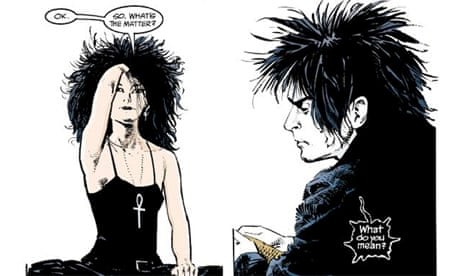
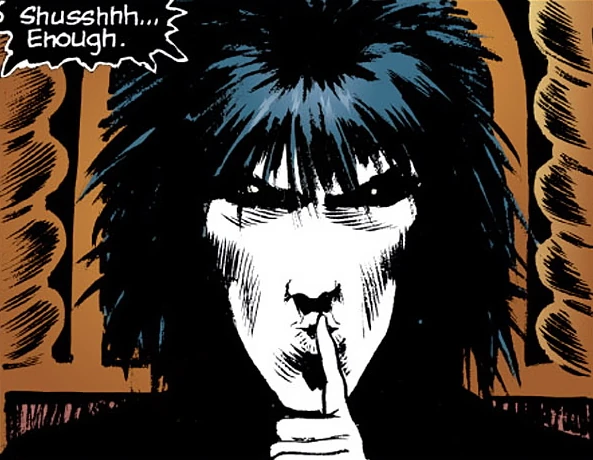
1. The Sandman is one of those comics that everybody talks about, a lot. Influential, especially to the current era in comics, and important to many people. So, I went into it interested. I’m not sure anything would’ve been different if I hadn’t ever heard of it though. This is a unique book, and that’s saying something because I’ve been so influenced by comics which came after The Sandman. It’s a seventy-six issue series, dealing with the eponymous main character, also known as Dream, and his family. His family are supernatural beings placed in dominion over various aspects of reality: Dream, Death, Despair, Delirium, Desire, Destruction, and Destiny. Now, I was hospitalized shortly after reading this, and the healing process took some time, so these notes will not do this work justice, but it’s interesting to see what still stands out after a couple of months away from this book.


2. The characters are not just the seven family members—there are mortals, other supernatural beings like Lucifer, denizens of the dream world like Biblical characters, and even the reader. Some of the characters are stronger than others, sure, but for the amount of characters included here, Gaiman does a remarkable job. It would be unjustly dismissive to quibble over his ability to create characters. I’ll just list a few of the characters and discuss what he built them of.
—Dream is a moody, emotional anti-hero who always rationalizes his emotional responses, even when they are mistakes. He is proud and unflinching, devoted to his own duty, but cannot exist in isolation, no matter how much he wants to—he needs other people, but hates that about himself. Self-centered and trying to be self-reliant, yet struggling because his situation and personality requires others. It’s a well-crafted character, but one I found somewhat boring because so many characters like him have come since this book. I’m used to this character in comics by now. His words are the main entry to his personality, for the reader. Though his mood often sets the tone in scenes as well.
—Death is a kind, caring woman who is strong willed and takes no crap from nobody. She does her job, but is able to handle it easily and still find time to take care of other priorities—like her emo brother Dream. Her humor and caring comes out in both her actions and her words.
—Delirium is a pendulum swing who trails off and shouts at the same time. She is determined at times, stubborn even, but also easily distracted and inconsistent. Her actions drive the reader’s understanding of her character.
—Destruction is the Heideggerian vision, where destruction necessarily means creation. For example: you tear down a house and you’ve necessarily created a pile of rubble. Destruction embraces this necessary pairing to the point that he leaves his realm and his duties behind. Other characters talking about Destruction explains him to the reader.
—Desire is neither male, nor female. It is conniving and antagonistic, while being exactly what some characters think they need. It lives in a biological mansion, and in that way it is our animal instincts writ large. It’s trappings are what explain it to us.
—Fiddler’s Green is old fashioned, in the sense that he knows his place and he does his best to do his little duty and expect nothing more or less. He is chivalrous. But he also has hidden dreams that he tries to fulfill—how he is to die, living like a mortal, or protecting weak people from attack. His desires and wishes, as stated by him and done by him, draw him out of the page into a full personality.
—In this way, you can see that he creates his characters with conflicts, and uses various methods to communicate that to the reader. Very simply, the tactic here is that the more screen time a character has, the more conflicts they have. But in addition to this, most of the characters have their own, distinct voices—and that’s astounding to me because of the sheer number of characters. Gaiman does a great job bringing them all from cliche to personality and a large part of that is his ability to write dialogue that fits each character well. In books, I consistently notice and appreciate authors who do this, and Gaiman hits it out of the park. It may be made easier for him because of who his characters are: his ability to draw on cultural assumptions about Loki, or Lucifer, so that he doesn’t have to delve into too much backstory that could bog the whole thing down. But part of it is his subverting these known characters and tropes in ways that are unusual and fresh, bringing new insights to old myths.


3. But more than the characters themselves, what really drove my first reading, what got me the most excited, was how complex their webs became. None more so than a mortal initially introduced as simply another of the short vignettes, Rose Walker, who ends up being integral to Dream’s own story and eventual death. This one situation is simply a single example of what Gaiman does throughout that makes it feel like nothing is forgotten, nothing is dead space, and even the breathing spaces may later become important.


4. And that’s how the story is built: this overarching story about Dream and his family, but consistently touching on shorter vignettes of specific characters, situations, and ideas. These short pieces don’t always grow to affect everything else directly, though they usually echo eventually. But some of these short parts are just that: short scenes meant to reinforce or introduce an idea that Gaiman will play with for a while. They’re both breather interludes, and integral parts of his exploration of ideas, and that’s why I can’t just call them interludes—the word doesn’t fit. The pacing may be inconsistent because of Gaiman’s constantly shifting focus—action stories, philosophical or spiritual ideas, and character drama all take center stage at various points. Yet the pacing never really annoyed me. I was willing to shift with Gaiman as he shifted emphasis. And that’s because I know the web he weaves here is worth it. There is payoff, and I’ve seen it over and over again. Things are not often forgot.


5. The theme uses mythology, the classics, the Bible, foreign cosmologies, and folklore interchangeably, placing most in Dream’s realm, but others as powers of their own. It’s hard to nail down a specific theme because Gaiman touches on so much, but the most apparent one to me is duty. Sure, he deals with death, love, and the nature of reality extensively, but I think it’s duty that drives the story, that is the base the rest of these themes are built on or relating back to. For instance, he is denied love of multiple women because of his adherence to his duty. His death is only important to him so far as it relates to his duty. And his duty deals directly with the nature of reality. Gaiman shows a few examples of duty throughout—Destiny is probably more addicted to his duty and Dream, but Death, Destruction, and really all the characters have their own relationship with duty. Death’s relationship with duty seems the healthiest, while Despair or Dream seem to have the most struggle with fulfilling theirs. But by giving numerous examples, Gaiman shows the effects of various devotions to duty. Let me be clear that devotion here is not a bad thing—some devotion is necessary. But too much devotion is still too much. And that plays out with the descent of Dream.


6. In all, this is a stunning work. It’s slightly inconsistent in pacing and my interest in each character is also varied. But at seventy-six issues, it’s long enough that I’m pretty sure something will hit for any reader in this massive book. And it’s not a bunch of issues with little to no dialogue—like an Alan Moore book, words fill the panels here. It took me maybe a month to read it all. It does everything I love about fiction well—good dialogue unique to every well-built character, a complex web of a story tied up with an overarching discussion but digressive at length with echoing discussions about the implications of the central theme on other themes, opinionated about philosophy and armchair anthropology with situations that reinforce the explorations or arguments, and using the format to its strengths instead of adhering to the last-page reveal and twenty-four page format. This is a tour de force and it’s easy to see why it became such a touchstone—despite being introduced to comics much after this seminal work first came out. I am surprised by how much I like this book because of how much I dislike Gaiman’s prose efforts. In many ways, I work towards writing a work like this someday. And I look forward to rereading this.

13 October, 2016

The State of the Art by Iain M Banks


1. This book is split in two: some short stories and the titular novella. The stories are a big departure from the Culture novels for Banks, and not in a good way. They attempt to be philosophical think-pieces, but end up being straw-man arguments ruthlessly taken apart. I even agree with some of his arguments, but the setup and resolution often comes off bitter and angry. And these may be things to be angry about, but the bitterness really drags them down. They’re bad short stories, one-sided, and I wonder who the intended audience is. Those who agree with him will find nothing new, and those who disagree will be turned off by how uncharitable he is in ranting against the lack of charity in others. They’re too short to really set up characters, so they set up archetypes and then take them apart. The one above-average one deals with a sentient space-suit and its occupant trekking across a planet after a crash and trying to reach civilization. This is one of the longer short stories and allows characters to develop. That’s part of what makes this one so good. But it also doesn’t feel like a bitter rant against something Banks hates, which really helps. I look forward to rereading this one, but none of the other short stories.


2. The novella, on the other hand, is alright. It’s not a fantastic Culture yarn, though the story is fine. In it, the Culture discovers Earth in the 1970s and spends some time there trying to decide if they should establish contact or not. They ultimately decide that Earth is, at this point, too hopeless to help and, to protect themselves from Earth’s idiocy—murder, toil, capital, sexual violence, genocide, war—they pull back and use Earth as a sort of experimental control, a test-bed for other potential contacts. And this is where the vitriol of the short stories infects this hundred page novella: Earth’s negatives are played up and the positives are spoken only from the lips of two lunatics, a man who chooses to stay, and a cannibal. These two characters set up the central conflict within the novella: should the “good ship Arbitrary” contact and change Earth to be more like the Culture, should the Culture become more like Earth, or should the Culture become exactly like Earth. It’s the arguments of the Reformation all over again: change the church from within, abandon it and go your own way, or change it from without. This is the central theme and an interesting discussion throughout. It’s a good novella, but not great: the vitriol leaves a bad taste in my mouth, but I enjoyed reading most of it.


3. The vitriol is partly understandable as the whole series is based on Banks’ ideas of what the future should look like. But, outside of the novella, it’s all vitriol with no time given to the other side of the argument. And the one-sidedness comes off bitter and unimaginative. The stories show what Banks hates about this or that, and those of us who live with this or that know some of the positives. This disconnect left me disappointed with the whole.


4. In all, it’s a book of short stories I will not be returning to, except for the novella and one short story mentioned above. I think the longer format of novels was Banks’ strength and look forward to reading more of those in the future.

18 June, 2016

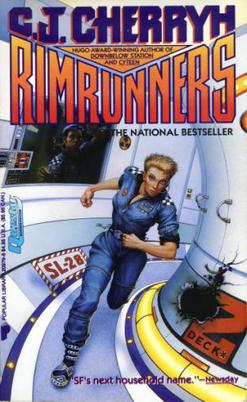
Rimrunners by CJ Cherryh


1. And the intro-info dump returns. It’s still not the best way for Cherryh’s writing, but at least this one is short, like three pages short. There is that. Alright, I’ve complained about this way too much, or not enough, so let’s move on.


2. This novel, unlike any of the other Cherryh novels I’ve read, focuses on one character, and that character isn’t at the top of a corporate or governmental body. Bet Yeager, the main character, begins the novel homeless and starving, in the midst of criminal activity caused by desperation, sleeping in a public restroom and washed up on a dying space station where she is the victim of sexual violence twice in the novel itself. She is a spacer and, as the novel progresses, the reader slowly finds out that she used to be a Marine on the Mazianni ship Africa—a low position on board, and she was just a sergeant, mostly because of time and experience. Then she gets a job on Loki, a mechanic position. Loki is a spook ship that sits around transfer points in space to gather information, then sells it—not exactly glamorous or trusted. The point is that where other Cherryh novels tell their story from a top-down perspective, showing the heights of society struggling to guide their society—even if it is just a washed-up captain who owns his own ship as in Merchanter’s Luck—this novel is about a low-life who was left behind by her ship during the events of Downbelow Station—expendable and expended. The every-woman focus fascinates and provides a picture of Cherryh’s world that I hadn’t yet seen and it really adds to the world-building of the whole. But in the specifics of this novel, it remains admirably rigorous to its focus. The characters of other novels are sometimes talked about by these plebeians, when their decision impact Bet, but they never show up. The captain of lowly-Loki only shows up twice in the novel, reinforcing this focus of Cherryh’s.


3. And Cherryh’s writing, as always, changes to fit her characters. Here the rougher dialogue helps illuminate the characters, the topics of conversation fit their desperation and ignorance, and the methods of interaction are more cut and dry, less polite and politically correct. The colloquialisms used by her and those around her reflect general shipboard colloquialisms, rather than the specific, esoteric colloquialisms of Reseune or Pell Station. Bet makes mistakes, big ones, and is punished immediately. That’s not to say there isn’t any politics—one of the points of the novel is that politics affect every strata of a culture. But Cherryh realizes her story and changes her writing to fit that, to support that, to reflect that. She doesn’t change everything, just modifies word choices and sentence structures to fit the people she is talking about. It’s a tactic that more writers need to adopt.


4. Instead of her typical third person, she loosens things up a bit and writes in second person quite often—a few times in each chapter. This helps the reader identify with the characters because there is a similarity there: advice and wisdom are often given, to oneself or others, in the second person, and most of the second person sentences are advice or wisdom. For instance:
But past is never past, man, past is, that’s all; all you can ever get at is what is now and will be.
This example of the writing shows how her voice and her writing changes in this novel to fit the characters who people her novel. This second person voice adds to her typical voice, not replacing it. As such, it strengthens her writing.


5. The theme here is about the past and how it comes back to haunt us in unexpected ways—a similar theme to Merchanter’s Luck, sure. But Cherryh doesn’t repeat her earlier book, she uses this theme and adds to it by saying that kindness can overcome a lot of the past’s repercussions. For instance, being an ex-Africa trooper, Bet doesn’t want to take a position on a ship heading towards Pell, where ex-Mazianni are reviled and actively hunted. So she stays on at Thule and ends up having to kill a couple of people to protect herself. In other words, she makes a decision attempting to protect herself from likely repercussions for her past, and ends up still being in danger. Later, on Loki, she befriends another social outcast and worries what he will do once he learns of her Mazianni past. But on Loki her kindness protects her from the worst of the ravages of her past. Oh, she gets beat up pretty badly, but she doesn’t die, she doesn’t have to kill, she ends up fixing some situations onboard through her direct actions. And what allows her to have that influence is the kindness she has sown throughout the preceding chapters.


6. Cherryh writes political intrigue at a rigorous psychological depth. When talking about Reseune, she told the psychology and showed it. But here, with a plebeian as a main character, the psychological depth resembles pop psychology through the colloquial language used instead of scientifically specific language. She shows the psychology here, rather than telling it. This works well and allows the reader to interpret the story in terms of their own experiences and similar experiences they’ve heard from others.


7. I like this book a lot. Yeah, there are uncomfortable instances of sexual and physical violence, but those are used to build the character that the whole book is focused on. This focus on one character allows Cherryh to get to a depth in building Bet that really works. The story, being focused on her, excludes the greater political picture except in how it affects Bet directly. Even in Merchanter’s Luck, a book about a loner, the greater political picture bleeds into the story some. Here however, it all but doesn’t: this is a snapshot of the life of a normal citizen in the Alliance—well, as normal as we've seen. Bet has a past, but in this post-war situation, who doesn’t? It’s a great story and good, good book.