Showing posts with label Company Wars Series. Show all posts
08 July, 2016
Finity's End by CJ Cherryh
1. What a tour de force! This novel is Cherryh sticking to what she does best—not ignoring any experimentation, but slightly modifying what she does well: an opening to introduce the characters, set the context, and get the story rolling in a quick, engaging way; deep introspection throughout for Fletcher, a slightly damaged main character trying to come to terms with a new situation; a supporting cast of actual characters who have their own philosophical insights, instead of being set-piece-characters; illuminating a central act through spaced out near-repetition of it, adding more to the reader's understanding each time; believable change within the characters that could only come from what happened within the novel; word choices and sentence structures modifying to fit the factions within the story; pacing that allows both rumination and action; and that wonderful, tightly focused voice that never allows the author to spoon feed the reader. In the rest of the Company Wars novels, Cherryh explores and focuses on some of these things, and here all that work pays off in a novel that clearly demonstrates a refinement and perfection of her skills. I just have one small complaint.
2. That ending is too pat, too tied up, too tidy. Sure, the Hisa stick is no deus ex machina—it has significant other importance to Fletcher, James Robert Sr, James Robert Jr, Jeremy, Satin, Elene Quen, and the whole of the ship Finity’s End throughout the novel. It’s final importance to the Alliance is being unveiled slowly as Fletcher matures and thinks his way through his past—so it’s no deus ex machina. But when Fletcher decides to search for the stick at the importers, I feel this is going to be a typical Cherryh ending: part tragedy, part triumph, all interesting puzzle to roll over in my mind for a few days after. In the end, it feels like the cost didn’t measure up to the victory gained. Sure, Fletcher being put in his place regarding Jeremy is a big change, but because he’s already gone through that—with his mother, Pell Station, Patch, Melody, Satin and the whole downer culture, Downbelow Station, Bianca, the rest of the crew, and his last foster family—this latest break isn’t a surprise, it’s a repetition. Things are different now in the sense that Fletcher is accepting the ship, with all its faults, with Jeremy’s actions, and more importantly with his own actions. But just explaining the ending in a minute to somebody makes the novel seem like a happy-ending too pat for any interesting thoughts. Thinking about it more and more, I realize that it isn’t, but it does come off that way. Cherryh could have better illuminated the cost to Fletcher at the end, and I think that would have helped. As the novel slowly pieces itself together in my mind after the fact, as events come into hindsight focus, the whole makes a lot of sense and the actual cost becomes clear, which is why this is only a small complaint.
3. Otherwise, this novel is perfect. I love it. I wish I would have written this novel. The most intriguing bit is, of course, Fletcher, the main character. This novel is Fletcher learning to look past himself and recognize reality. Even the time-dilation of the spacers points this out prominently, when Fletcher initially mistakes Jeremy for a twelve year-old. But what’s so intriguing here is that this realization of reality goes through a lot of wrong steps before Fletcher finally finds something solid to stand on. He wants to find a family, then he gets disgusted with humans and wants to work with Hisa, then he wants to change policy so he dreams of being administrator to Downbelow, etc, etc, until he realizes that he cannot stand on his own first impressions and ends up apologizing, trying to make right, and doing something good for the ship. He’s not fixed at the end, but he is on the right track finally. (In this sense, the end makes perfect sense: he finally breaks enough to be useful to others, and he is quite useful to the whole Alliance.) It’s not optimism, his desire to bring the stick before the Alliance, but it is the best in a set of bad possible decisions, and he goes about it the right way, for once. This growth, this acceptance of reality and his need to work within it, is the theme of the book, and the triumphal ending drives home Cherryh’s point successfully.
4. JR is a fascinating character. In many ways he is the foil to Fletcher within the novel. Where Fletcher is distrustful and destructive, JR is comfortable and committed. JR has it all figured out, and what he doesn’t have figured, he knows where to find. However, Fletcher’s arrival and the ship going off of a war footing, shoves him out of his comfort zone and he cannot quite find the right tactics to deal with this new aspect to his reality. Where Fletcher has trouble dealing with reality at all, JR has a hard time integrating new pieces into it, and tells himself that his caution is a virtue. He retreats to his current reality, hiding from the new of Fletcher. However, by the end, he too has grown, has changed, has taken a few steps of his own, on his own initiative, and come off fine for it. These two characters are, unlike other Cherryh novels, the only two main characters in the book. But the book doesn’t lack for that because by focusing herself down to just these two, it allows Cherryh to get deeper into their psychologies and philosophies in a worthwhile way.
5. This novel feels like the philosophical point the rest of the Company Wars novels are trying to make. All the discussions about the past come to a head here, refined. The pacing and depth are spectacular. The writing is satisfyingly varied in word choices and sentence structure. What more can I say? This is perfect.
02 July, 2016
Tripoint by CJ Cherryh
1. My question here is this: does this book stand on its own? I don’t know. But this question will guide these notes.
2. What a wonderful novel. This book carries on the quality of Hellburner: a well paced story that doesn’t forget to stop and take a walk in the woods; engaging, damaged characters overcoming themselves as much as others; there is no such thing as a free lunch -esque interpersonal relationships and politics. But this novel definitely is its own thing: Cherryh engages that broad political scope that affects her macro focus on the characters in a more direct, more explanatory way. In Hellburner, she focuses clearly on trying to get the ship to work. In this twenty years revenge tale, the context is everything that has occurred over the last twenty or so years at Mariner, Viking, Pell, Tripoint, the Rim Stations, Sol, and on the two ships that are the focus of the novel: Sprite and Corinthian. The characters respond to the big political shifts, but being free merchanters, they know more and discuss more of the broader politics. This wide angle perspective and narrow character focus creates an intimidatingly intriguing novel and it reminds me of The Fifth Season by NK Jemisin in that way. But I’m not sure that somebody who hasn’t already gathered what Tripoint is from Cherryh’s other works, should read it. The intricate relationships and political maneuverings within the Alliance play a most important role here, but they are alluded to in other novels that I have read, allowing me a familiarity that may have helped me understand more than the novel gave. I’m not sure, but it’s a possibility that reading at least Downbelow Station first really helped make this novel superb for me.
3. The writing here is superb, some of the best I’ve read from Cherryh. She manages to communicate things the reader must imagine, but in a way that makes them still strange. For instance, a portion of Tom’s story involves the spacer-sin of staying awake during jump.
They say you don’t come back sane, you leave a part of yourself out there in the chaos of the parallel universe. Well, among the Mazianni, it’s a mark of a good navigator to grow used to that place, to learn to read the sights and sounds of it, to literally feel themselves passing by masses, to feel starships around them.This military necessity creates a sort of mysticism in certain circles, and Tom runs into Capella, described perfectly as a “lend-lease navigator” from the Mazianni fleet—which has fractured into at least three parts: The Fleet, Mazianni, and Signy. Capella is from The Fleet and initiates Tom into this activity of staying awake when all else are tranked out—initially from pure lust and later for emergency purposes. Her guidance allows him to remain sane. But more profoundly, because Cherryh’s voice doesn’t allow a ton of description until a character sees something new or in a new way, it allows wonderful and beautiful descriptions:
He lay still—he thought he was lying down, Saby lying near him, but whether it was light or dark didn't seem relevant to his eyes. He saw, somehow, or something like. The brain kept shifting things around or the walls truly ran in streams of color. Things just were. Couldn't see Capella, then shivered at a strangeness as her hand met his body.But these are framed stunningly—Cherryh just drops them on the reader from nowhere: a lengthy, semi-erotic dream sequence describing jump to a tranked out human is strange, then gets stranger when he wakes up and the reader just doesn’t know until later what happened:
Pale, then. Capella's blonde, brazen flash and try-me attitude, Capella standing there with her bare arms resting through bars he recalled he wasn't dreaming, with the bracelet of stars evident on her wrist. It wasn't the freedom of the docks he was in, he was in a box he couldn't get out of, and an exposure that let the whole ship come and stare at him if they liked.It’s fractured and seeming nonsensical. But by the end of the book, the reader has a pretty good idea what being in jump would be like—unfathomable as a whole, but bits of it parsable.
Capella gave him an I-don't-give-a-damn rake of the eyes, leaned there, enigma like the fatal holocards. Her hands were death and life together, the serpent and the equation that cracked the light barrier, the bracelet no honest spacer wore…
Colors washed to right and left of him, red and blue and into infrareds and ultraviolets, a tunnel at the black peripheries of his vision. He daren't come any further. Christian wasn't his friend. This woman wasn't. This dream was destructive. He could make it go away.
He felt the loneliness, and the cold. Then… just felt/ smelled/saw the colors a while. And vast, terrifying silence. He tried to move, then. He couldn't feel things. Couldn't tell up from down. He leaned into space, flinched back toward solid limits, and thought he was falling.It’s these sentences—short, declarative—that jump around and don’t seem to fit together, but sometimes they do in a rambling, rolling way: the sound of it reminds him of music from another time, but he can’t remember time. But then Cherryh also allows phrases to shift out of place: something looks green but tastes purple and orange, and smells blue. These experimental steps are phenomenal, and her description is astounding. She spends a lot of pages to do what she does with jump, and I loved every second of it.
Arms were there. Caught him. Hands showed him where level was.
—However, without the context of the other Merchanter novels setting up that aversion to not tranking for jump, I’m not sure this exposition of what that experience is like would actually fly. It’s maybe a third into the novel when Tom wakes up in a jump, and I feel like I wouldn’t have bought how insane some people go when that happens if I hadn’t read the others. It’s as if Cherryh is saying it’ll drive you crazy while showing a character or three who ends up coming through it alright. A bit of a contradiction.
4. There are a few main characters: Tom, Marie, Austin, Christian, and Capella. And each of them gets portions of chapters devoted to them in a way that tells the story from multiple points of view. It is Tom’s story, but it’s told from the perspective of others as well as his own, and it grows out of others’ stories—kind of like how our lives do. This challenges the reader to make up their own mind about the story and characters within, instead of spoon-feading the reader opinions to hold about characters. I like this tactic when George RR Martin does it, and I like it here.
5. On one hand this is a revenge story and the theme is Marie’s revenge for rape. But the real theme is Tom's coming of age, his realization of reality. The book takes place twenty years after the rape and Tom’s still trying to find a place, a group of people he can belong to. And he finds it in the unlikeliest place: on the ship of the rapist, his father. But it’s not because Austin is his dad, but because Saby and Tink befriend him, accept him, support him in a way his mother and her ship never did. Yes, he hates his father. But he wants a new start and it's really the only place, the only choice he has. This theme is all tied up with ignorance and codes of conduct in a way that really strikes home for me. And Marie's rape echoes where each echo adds some to the reader's understanding and keeps drawing one deeper. This theme is applicable and understandable to somebody who never has read any other Cherryh.
6. I love this book, a lot. On the one hand the theme allows the book to stand on its own while the political context is probably a neutral influence—it may or may not help to have read her other novels. Taking the jump awake almost certainly relies upon the other novels to set the stage, but could potentially be grasped by a new reader—which I think is unlikely. So, on the whole, the book probably doesn’t require one to have read her other work, but it certainly doesn’t hurt. And for that, despite this being a real treat of a novel, it doesn’t quite stand on its own. But that’s the nature of a long series like this—seven novels in this Merchanter or Company Wars branch of Cherryh’s broader Alliance-Union universe. So I love this novel, a lot, but can’t quite recommend it as easily as Downbelow Station.
30 June, 2016
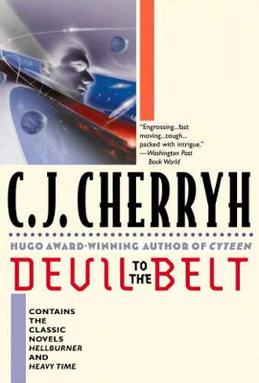
Hellburner by CJ Cherryh
1. A few months back, a friend and I lamented our agreeing perception of bad quality military science fiction today. We also reminisced on some of the big points in the genre: War of the Worlds, Starship Troopers, and The Forever War. This novel by CJ Cherryh is also military science fiction: four characters being trained in a program involving a specific spaceship that is difficult to fly, the program is failing, and political and fleet maneuvering try to save it from failing or hurry it on its way. Like Cherryh typically does, this is a novel based on interpersonal interactions first, political maneuvering second, and damaged people trying to find their way. So if you’re looking for military science fiction with depth, try here. There isn’t a stitch of combat until the end, but that ends up just being a test run. I do not think you need to read the prequel, Heavy Time, to understand this sequel or the characters, but Cherryh advises that you do.
2. There are five main characters in the novel: Meg, Sal, Ben, Dek, and Graff. And all of them change significantly throughout the novel.
—Graff sort of runs the show—that “sort of” taking up a bunch of the plot. He’s constantly uneasy at absentee management and that his direct superior in the program is not a part of his branch of the military. At the beginning he is sure of himself, but that’s quickly destroyed. By the end, as the scope of his influence spreads, and more importantly, as he realizes that it spreads in some ways and contracts in others, he is much more comfortable and effective in a wider variety of situations. For instance, the Graff at the beginning would not have been able to be so smooth in the press conferences at the end. He has changed throughout the novel to reflect the influences he comes under within the novel.
—Dek, recovering from an assassination attempt and heavily drugged up at the beginning, slowly gets his feet under him and learns to filter things out better. This is an ongoing process for him: coming to terms with the death of his team and their replacements, who are from an earlier point in his life he has cut off. By the end, he’s able to accept simple luxuries because he finally believes in himself.
—Ben begins by running away from hands-on work, believing he’ll be happier in some lab somewhere in Stockholm. But the fleet co-opts him and he finds uses for his skills that help his friends. He goes from an asshole who needs nobody to a man who comes to rely upon his friends deeply, and justifies their relying upon him as well.
—Sal is the one who doesn’t change much within this novel. She changes from the last novel to this one, but most of her change was in the prior novel, and this one helps solidify those changes in her. However, off-screen, between the novels, Sal’s greatest change occurs. At the end of Heavy Time she became a Shepherd, her goal. But eventually, between the novels, she realizes that Meg is more important to her by now, so she follows Meg into this novel. Coming to terms with this change in her is her story arc.
—Meg begins by being the egotistical, slighted political reformer and pilot. But through the training program, realizing her own age, the social situations on the station, and Sal’s kindness in coming with her—she eventually comes to a stable, happy place in her life. Some of that anger burns out, some she discards, the useful anger she keeps. And she becomes the first at something, proves herself to herself, echoing Dek’s journey but with specific points that are unique to Meg.
—These changing characters are the central focus of the novel. The plot supports their changing throughout.
3. And these changes are the theme here. By their changing and growing understanding of each other, the whole war effort is benefited through the program they save. In other words, improve yourself and many of those around you will also improve; find a place to fit in and don’t be surprised when you need to change to fit it too; and find a way to fit your situations without betraying your self. Tanzer’s method of leadership—anger and regulations—doesn’t fit who he has under him, and so he fails. Porey’s method of threats and grace in equal measures also don’t succeed. But this group of five people who ignore the chaff to learn to work with each other through understanding and kindness end up saving the whole program from ruin—and themselves in the process. This theme of communication leading to understanding leading to discussion leading to success is central and there are many, many smaller examples of this: Keu almost loses Graff’s efficacy through Keu’s lack of communication, but Saito and Demas pull him back; the first communication between Dek and his mother ends up averting a major political situation and more riots; Rob communicating a simple handshake to Dek helps diffuse a powderkeg; etc.
4. Again and again Cherryh changes her writing to fit the plot and characters of her novels, like she does here. This is a military training facility with military characters, and it reflects that. A lot less situations are gray areas while a lot more end up being black and white. Chain of command, word choices, training, regulations, gratuitous language—these all fundamentally change Cherryh’s writing. Meg and Sal, as they acclimate to the situation, are less flashy and more military by the end, and this change spread throughout helps set the tone of the novel. This tactic is incredibly effective at world building and drawing the reader into the novel.
5. And really, I don’t know what else to say. This novel is fantastic. There is no intro-info-dump, no last page reveal, no slow start, no wasted scene or word, no extraneous character, and no hint of deus ex machina. But of course it isn't just some list of how she writes: it's what she writes. This list just indicates which tactics she uses and which she avoids, indicates how much she respects the reader's intelligence rather than spoon feeding them, indicates the craft of her writing. The writing could pay a little more attention to description, but the payoff in world building with Cherryh’s tight voice is certainly worth that niggling lack. And the description of the ship from Meg’s eyes is wonderful. This is clearly one of her better works and, despite what she says, I think it does stand well on its own and can be read without first reading Heavy Time—though that’s not to say that Heavy Time is bad. This is a novel first, and a sequel second—which I couldn’t say about Regenesis. So far, I think it’s one of her best.
“The enemy of my enemy,” Demas said, and took the bottle up, “threatens both our livelihoods.”
25 June, 2016
Heavy Time by CJ Cherryh
1. The book begins with mining partners Bird and Ben stumbling across a distress signal in their Company assigned sector of the solar system’s asteroid belt. Obviously, because so much book comes after this first chapter, they don’t find something simple. Entering a ship identical to their standard, ubiquitous mining craft, they find a man named Dekker—not the only cyber-punk pun in here. Dekker’s physical state requires medical intervention and a quick trip back to home base, Refinery 2. While heading back, they realize Dekker is psychologically broken. Dekker has floated for 71 days with minimal life support after his partner and lover died on a space-walk. Dekker is convinced Cory was run down by another ship, a Driver who was trying to jump their claim. Ben responds to Dekker negatively, taking a typical Belter attitude towards something perceived as inefficient—insanity, in Dekker’s case—and trying to either stop it legally or dispose of it illegally. The inefficiency is what the problem is to Ben, and he sees Dekker's insanity as simply that. At the same time, he convinces himself Dekker’s ship will become his and Bird’s valuable salvage. Bird, being a blue-skyer, a human from earth, responds positively to Dekker, deciding to try and help this poor miner as much as he can. And this set-up, all in the first couple of chapters, introduces the central story elements that the rest of the novel revolves around. Dekker attempting to come back to reality and heal, Bird and Ben trying to get the salvage on his ship, Meg and Sal helping and attempting to secure the first place in line for leasing the potential new ship, and the political intrigue of this very messy situation with the Company, the proto-Mazianni military using the mined materials to build their carriers, the other freelance miners and Shepherds agitating for better conditions and pay, and the diverse political scene within the solar system. Throughout the novel, everybody is piecing together what happened to Dekker, even Dekker, and figuring out how to use his situation to get the Company to screw its employees less. Every chapter or so, Cherryh repeats Dekker’s basic situation and adds a little each time, expanding upon the basic personal trouble of the first couple of chapters to include the wider political context. And as strong as this tactic worked in Merchanter’s Luck, it works brilliantly here. I think it works better because of two reasons: the political context is much wider and more foundational to what the reader probably already knows from other novels, though it is still very much behind the scenes; and the addition of a honest-to-God earthman, Bird, gives the reader a familiar face, a point of reference to understand the rest from. Bird is extremely useful to the reader in this role, especially with Cherryh's tightly focused voice.
2. Kind of like Bet Yeager in Rimrunners, Bird, Ben, Sal, Meg, and Dekker are low-life freelancers, similar to gold miners during the gold rushes. They enjoy dark bars and dangerous living. They're skirting the law and trying to get rich. Where Bet was an ex-soldier, these are career miners. Sal, Dekker, Ben, and Cory want out, want a better life eventually, but while they are in, they embrace the low-lifestyle of the almost criminal underground.
—But the politics, mostly behind the scenes, keep poking influences into their lives. The Shepherds are using Dekker’s situation to try and strongarm the Company into making their employees’ lives better, and they're doing it through Sal, who wants to be a Shepherd. The military uses it as an excuse to take over the Company and restructure it to more efficiently give them the materials they need to build Mazian's fleet. The Company tries to keep it quiet and cover it all up to keep the status quo and their power. All of these influences drive the central five characters in the story, forcing them into situations and repercussions that are unforeseen by these people at the bottom of this chain of command.
—Like Cherryh typically does, the novel matches the story of these characters through word choices which embrace space mining shorthand, scenes which require the characters to respond in ways that only criminals and revolutionaries would, and their ignorance about the political currents which are driving their lives. This tactic of conforming the story and writing to the characters really works wonderfully to make a rigorous and interesting novel. But it also leaves big elements all-but-out of the novel: like the characters, the reader is confused about why certain things are happening until all is revealed in the final chapter.
3. Cherryh utilizes a variety of voices in this novel to define certain classes of people. Meg is a revolutionary and is always deprecating the Company. The miners are no friend of the Company, but they’re more understanding than Meg. Sal and Ben are scientists and end up being more cut-and-dry, talking statistics and logic. The doctors and orderlies have bedside manners that don’t quite communicate clearly. And each smaller group—military, security, traffic control, corp-rats, shepherds—has distinctive characteristics as well. The Corp-Rats speak in precise ways that utilize words from their operating manuals. But Cherryh’s typical tight third person voice also affects dialogue, spitting it at the reader without stopping to explain and leaving the reader to imagine the characters’ responses. This can be confusing at first, but it all eventually makes sense as the characters mull over their situations and explain things the reader may not have gathered at first. However, the variety of voices does help the reader define the speakers in the novel very quickly and efficiently.
4. Dekker’s chapters engage in some experimental writing utilizing fractured sentences and a deeply unreliable narrator to communicate both the story and Dekker’s state of mind. This writing effectively shows and tells simultaneously. The most impressive part is the balance she draws between information and the unreliability of Dekker as narrator. She manages to both communicate and obfuscate simultaneously. It’s fantastic and strange.
5. Because the reader and miners don’t really know what’s going on until the final chapter, the pacing ends up a little slow in the novel. The reader isn’t sure what’s going on for much of the novel, so it raises the question of whether all the scenes add to the characters or story or argument or world-building. That last-chapter reveal explains most of the scenes, but I’m still left with the impression of being lost for much of the novel. For such a short novel, this isn’t too much of a negative, but it does make it drag on a bit.
6. The theme here is Bird’s helpful nature versus Ben’s selfish one. Neither are perfect, but the combination is effective. It’s a microcosm of the political changes the solar system is undergoing at the time, within the story. But it’s applicable to the reader as well, as each of us needs to find our own balance between trying to help or protect oneself to the extent of the law, and allowing forgiveness and helpfulness to temper our actions and open us up to vulnerabilities or to an unrealistically optimistic and trusting way of life. It’s clear that understanding reality is important, but Ben is constantly unsure whether Bird has his head in the clouds or is acting in a safe way among the Belters. Bird’s natural helpfulness is not a problem only when it is tempered by reality, and Ben brings that tempering influence in order to make the whole partnership work well. Similarly, Ben relies too much on the laws and bureaucracy to be a well-liked member of society, but his association with the well-liked Bird helps him overcome this. Together, both will live longer in the Belt than either would being in a partnership with somebody who agrees with them.
7. There is no intro-info-dump here, but the last chapter reveal is moderately annoying—as it is in comic books. In order to avoid it, Cherryh could have spent a lot more words on this story, including characters from other stratas of this society to show the political influences more clearly and keep the reader tracking closer to the plot. But that would have demolished the meandering tone of the novel that, as slow and frustrating as it is, effectively communicates what the life of a space miner on three month shore-leave, known as Heavy Time for the influence of gravity, would be like. I haven’t really seen her try this meandering style of storytelling before, so it’s fun seeing her try something new. I like this novel, but it’s not her best. I think she found the breaking point for her voice where not enough is on-screen to really keep the plot moving. The novel stands on its own well, but by having read some of the others in this series that take place after this novel, this novel is also a fascinating look into a part of the story I hadn't come across yet. Good stuff, not great.
18 June, 2016
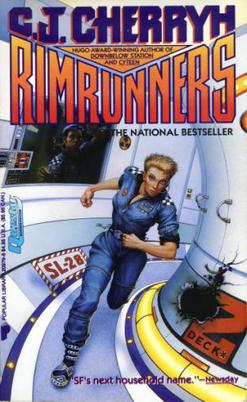
Rimrunners by CJ Cherryh
1. And the intro-info dump returns. It’s still not the best way for Cherryh’s writing, but at least this one is short, like three pages short. There is that. Alright, I’ve complained about this way too much, or not enough, so let’s move on.
2. This novel, unlike any of the other Cherryh novels I’ve read, focuses on one character, and that character isn’t at the top of a corporate or governmental body. Bet Yeager, the main character, begins the novel homeless and starving, in the midst of criminal activity caused by desperation, sleeping in a public restroom and washed up on a dying space station where she is the victim of sexual violence twice in the novel itself. She is a spacer and, as the novel progresses, the reader slowly finds out that she used to be a Marine on the Mazianni ship Africa—a low position on board, and she was just a sergeant, mostly because of time and experience. Then she gets a job on Loki, a mechanic position. Loki is a spook ship that sits around transfer points in space to gather information, then sells it—not exactly glamorous or trusted. The point is that where other Cherryh novels tell their story from a top-down perspective, showing the heights of society struggling to guide their society—even if it is just a washed-up captain who owns his own ship as in Merchanter’s Luck—this novel is about a low-life who was left behind by her ship during the events of Downbelow Station—expendable and expended. The every-woman focus fascinates and provides a picture of Cherryh’s world that I hadn’t yet seen and it really adds to the world-building of the whole. But in the specifics of this novel, it remains admirably rigorous to its focus. The characters of other novels are sometimes talked about by these plebeians, when their decision impact Bet, but they never show up. The captain of lowly-Loki only shows up twice in the novel, reinforcing this focus of Cherryh’s.
3. And Cherryh’s writing, as always, changes to fit her characters. Here the rougher dialogue helps illuminate the characters, the topics of conversation fit their desperation and ignorance, and the methods of interaction are more cut and dry, less polite and politically correct. The colloquialisms used by her and those around her reflect general shipboard colloquialisms, rather than the specific, esoteric colloquialisms of Reseune or Pell Station. Bet makes mistakes, big ones, and is punished immediately. That’s not to say there isn’t any politics—one of the points of the novel is that politics affect every strata of a culture. But Cherryh realizes her story and changes her writing to fit that, to support that, to reflect that. She doesn’t change everything, just modifies word choices and sentence structures to fit the people she is talking about. It’s a tactic that more writers need to adopt.
4. Instead of her typical third person, she loosens things up a bit and writes in second person quite often—a few times in each chapter. This helps the reader identify with the characters because there is a similarity there: advice and wisdom are often given, to oneself or others, in the second person, and most of the second person sentences are advice or wisdom. For instance:
But past is never past, man, past is, that’s all; all you can ever get at is what is now and will be.This example of the writing shows how her voice and her writing changes in this novel to fit the characters who people her novel. This second person voice adds to her typical voice, not replacing it. As such, it strengthens her writing.
5. The theme here is about the past and how it comes back to haunt us in unexpected ways—a similar theme to Merchanter’s Luck, sure. But Cherryh doesn’t repeat her earlier book, she uses this theme and adds to it by saying that kindness can overcome a lot of the past’s repercussions. For instance, being an ex-Africa trooper, Bet doesn’t want to take a position on a ship heading towards Pell, where ex-Mazianni are reviled and actively hunted. So she stays on at Thule and ends up having to kill a couple of people to protect herself. In other words, she makes a decision attempting to protect herself from likely repercussions for her past, and ends up still being in danger. Later, on Loki, she befriends another social outcast and worries what he will do once he learns of her Mazianni past. But on Loki her kindness protects her from the worst of the ravages of her past. Oh, she gets beat up pretty badly, but she doesn’t die, she doesn’t have to kill, she ends up fixing some situations onboard through her direct actions. And what allows her to have that influence is the kindness she has sown throughout the preceding chapters.
6. Cherryh writes political intrigue at a rigorous psychological depth. When talking about Reseune, she told the psychology and showed it. But here, with a plebeian as a main character, the psychological depth resembles pop psychology through the colloquial language used instead of scientifically specific language. She shows the psychology here, rather than telling it. This works well and allows the reader to interpret the story in terms of their own experiences and similar experiences they’ve heard from others.
7. I like this book a lot. Yeah, there are uncomfortable instances of sexual and physical violence, but those are used to build the character that the whole book is focused on. This focus on one character allows Cherryh to get to a depth in building Bet that really works. The story, being focused on her, excludes the greater political picture except in how it affects Bet directly. Even in Merchanter’s Luck, a book about a loner, the greater political picture bleeds into the story some. Here however, it all but doesn’t: this is a snapshot of the life of a normal citizen in the Alliance—well, as normal as we've seen. Bet has a past, but in this post-war situation, who doesn’t? It’s a great story and good, good book.
14 June, 2016
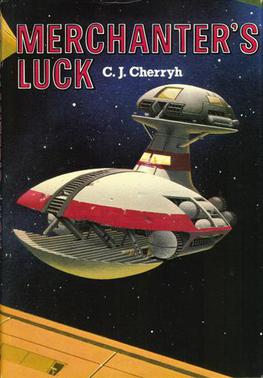
Merchanter's Luck by CJ Cherryh
1. This short, 208 page novel resembles none of the other three Cherryh novels that I have read so far—Downbelow Station, Cyteen, and Regenesis—but it also sort of does resemble them.
—This is an adventure novel. It’s a straightforward narrative with rising tension and a resolution after the crisis. It’s almost pulp fiction and can certainly be read and enjoyed as such. However, being Cherryh, it still delves deeply into the psychology of Sandor and Allison. They’re both merchanters, the smallest and biggest sort, respectively. Sandor has lost his family and is alone on his ship, going crazy in the blackness of space from: the stress of no job prospects, mounting debt, less and less friendly places being open to him, the constant threat of pirates or Mazianni, his past haunting him, and, most of all, simple loneliness and paranoia—some of which is justified throughout the novel. Allison is under different stresses: overcrowding, lack of advancement opportunities, self-doubt through knowing she is untested, and routine boredom. Cherryh focuses on the most applicable psychological stresses: loneliness and self-doubt. That psychological focus and discussion matches the amount of adventure in here, making the whole as literary as it is all tied into that pulp plot and pacing.
—No intro-info-dump accosts the reader’s first lines. And this absence makes me really happy because I was worried that all of Cherryh’s books would feature that oh so awkward of openings. But here, she fills in the backstories of the main and minor characters skillfully throughout the novel—taking moments when they are alone with their thoughts to reflect on how their situation now differs from their past lives. For instance, the whole story of Sandor/Ed’s dead family is not fully revealed until the last chapter, but most of it is revealed early and revisited throughout with additions to the story every time it comes up. It’s a great tactic to show Sandor as a character really well: he keeps reliving the horror of his past, and as it comes up again and again, with more detail each time, the reader is shocked and sympathetic to this character who is actually quite unlikable. He’s understandable, and his reactions are logical from his screwed up base, but I wouldn’t want to hang out with him—until maybe the end, that is.
—In these two ways, and others like them, I see Cherryh as both writing to her strengths and trying new things in this book. It adheres to Cherryh’s typical storytelling, but also deviates from it in a way that provides an appreciable variety. The new things she tries are done well, and the old things too.
2. This is a book of contrasts. Wealth and poverty are paired together in Sandor who owns his own merchantship outright and alone, but has no money to speak of. Skill and inexperience pair in Allison who is trained and practiced in simulations, but untested in reality. The main characters cross the Line between Union and Alliance, and then Alliance and Mazianni. Through these contrasting points, the novel is able to show how some contrasts strengthen the whole, some weaken them, and most do both. This theme feels complex enough to support a longer story than Cherryh chose to tell, but even in this short length she creates some interesting conclusions that got my mind working.
3. The writing here is great. I’ve already praised the storytelling tactic of revisiting Sandor’s family’s death—a tactic engrossing to both Sandor and the reader. But I think it works so well because the writing is a retelling where each retelling adds details and wrinkles the repetition to make the whole story more and more horrifying. It echoes itself throughout the novel and it’s a relief when the resolution hints that Sandor can start a new family. I like repetition in poetry—Yeats does it so well—and this is repetition in prose done right. It’s not a direct repetition, but a re-explanation, like when a teacher restates something the students don’t understand at first. I fully intend to steal this writing.
4. One thing I didn’t enjoy is the stupendous achievement Sandor makes in time from Viking to Pell. After it’s done, Cherryh explains how impressive a feat it is. But before that, I didn’t understand how impressive. Cherryh could have done more to explain during the journey what is so unusual about the action: but with the worldbuilding not setting the stage appropriately and her voice, that tight third person narrative (explained in point three of my notes on Regenesis), she is backed into a corner here because Sandor is tranquilized during the speed run, so he isn’t quite able to make sense to the reader. We also have not yet seen a normal journey of this length, so it’s unclear what makes this one unusual until it's over. I thought maybe this was how all journeys went when a ship had a solo crewmember. She does a good job of explaining it later, especially with the journalists' and Reillys' responses, but some more foreshadowing would’ve helped here.
5. However, Cherryh's use of her voice is not a mistake in the rest of the novel. For instance, when Sandor is on the dock at the start, there isn't that much description given because he isn't thinking about it—at least not until he chases Allison into an unfamiliar, expensive bar the likes of which he has never seen. But then, when he gets back on his ship, the intricate way that Sandor is shown thinking about his ship both describes it and communicates his utter love for it. Sandor's ship is a big part of the whole novel's plot: Allison wants it, Mallory wants it, Australia wants it, Sandor wants to keep it, Viking dock wants to detain it, Pell wants to shoot it out of the sky, etc. And Cherryh has foreshadowed the importance of the ship itself through this contrast in description at the very start. By the time Allison gets her idea, I've well understood the importance of the ship and Cherryh doesn't need to explain it to me. Wonderful stuff.
6. I enjoy this novel a lot. It’s a quick read, an exciting adventure, but there’s still some political backstabbing, interesting psychological discussion, and enough intrigue to prove that this is a Cherryh novel. It’s solid and engaging. It taught me that repetition in prose can be a really strong tactic to build characters and stories around.
19 April, 2016
Downbelow Station by CJ Cherryh
1. Cherryh’s dialogue uses three distinct voices consistently throughout this novel.
—One voice is the Downers, or hisa, natives from the planet called Downbelow by those on space station Pell. They speak in a lilting, sing-songy voice that often skips “to be” verbs. For example:
You safe. Make you names: call you He-come-again; call you She-hold-out-hands. You spirit good. You safe here. Love you. Bennett-man, he teach we dream human dreams; now you come we teach you dream hisa dreams.This speech pattern helps show the hisa thought processes and priorities. They imply the “to be” verb, like English implies “that”: sometimes it’s there and sometimes it’s assumed. In this way, it shows that the hisa do not yet have a philosophical question concerning being—an important difference between themselves and humans.
—Another voice is that of the stationers, the residents of Pell Station. Out of all the voices, the stationers are the closest to how we speak English today. Here is some of the dialogue:
Tom, if you get a gut feeling that something’s wrong in any of these cases, appeal it back to me regardless of procedures. We’re putting through too many condemnations too fast; mistakes are possible. I don’t want to find out after processing starts.This speech pattern reinforces that the reader is supposed to identify with the stationers. It provides a common ground between reader and characters that allows familiarity and reflects the familiarity the stationers have with their life on the station. They are pleased and satisfied with their stationary lives, so they talk normally.
—The last voice is that of the Mazianni, the originally Earth-based war fleet that constitutes the military forces of the Company in space. They speak in a clipped, military way that values efficiency and clear, dense communication over full sentences:
They ran us off the docks. Everyone’s aboard. Crew, troops, everyone’s aboard. Mainday to stations, alterday to backup. Flash battle stations. I’m pulling us out of here.As this quote shows, the Mazianni are efficient, quick, and precise—as befits the speed of space battles they’re often involved in.This shows their mental state—always ready and every little detail important.
—These three separate speech patterns help explain these three different cultures involved. Even the two other cultures in the book speak slightly differently, but mostly through word choices: the merchanters speak a lot like stationers do, while the Union forces speak a lot like the Mazianni, but word choices allow each to have distinct voices. This tactic of Cherryh’s brilliantly illuminates the cultures involved through showing rather than telling—and reinforces what telling is there. These significant differences also provide variety to the book, each portion’s dialogue reads differently and helps provide distinction between the different cultures. Cherryh does a great job with charactered voices. To reinforce these notes about her voicing: I simply opened the book to random places in order to get the above quotes—one really can open it up anywhere, read a bit of dialogue, and know what culture is being focused on in the chapter opened to.

2. My second note about her writing is Cherryh’s own voice—that of the omniscient narrator. The narrative voice uses a good mix of complex and simple sentences, mated to a fine mix of word choices. It’s engaging and unusual.
Russell’s had met disaster, and Mariner. Rumor ran through the station corridors, aboil with the confusion and anger of residents and companies that had been turned out with all their property. Volunteers and native workers aided evacuation; dock crews used the loading machinery to move personal belongings out of the area selected for quarantine, tagging items and trying not to confuse them or allow pilferage. Com echoed with announcements.Most authors I’ve read would not write their sentences this way. This almost stop-and-start pacing is actually quite interesting to me and excites me about Cherryh as a writer. She doesn’t try to make her prose flow too smoothly, but it also doesn’t come off like a rough draft. An analogy that explains this is music: after multiple listens, the slick, overproduced pop tune ends up being less interesting than a rougher, more inconsistent track that has some emotion to it. Yet Cherryh isn’t writing a rough, one-take, half-drunk, live punk song either. It’s tight writing, but there are still enough edges left in to make it amazing. It ain’t auto-tuned, nor is it live, it’s at a sweet spot in the middle. I can’t wait to read more of her writing!

3. Structurally, the story is told typically: chapters and portions alternating focus between areas where things are happening, between characters, but progressing the plot linearly. This isn’t a negative statement. There is so much going on in here that keeping everything straight must have been difficult for the author: Downbelow Station and the hisa place, the carrier Norway, the Union places which are all sort of the same Union place, the Finity’s End, the Hammer, a couple of places in space, Pell central, Pell Q, Pell Downers territory, and the other places on Pell Station. There are a lot of places involved here. She uses interstitial titles that name the place and date and time to keep everything straight in the reader’s mind, and they’re unobtrusive enough that they work well without distracting.
4. I appreciate that Cherryh doesn’t overburden the book with descriptions. She could—there are a lot of places in here where she could have spent pages describing things. Rather, she mentions a couple of details and moves on to the effect the places have on the characters or actions. For instance, when Satin first sees the sun, it’s in a spot on Pell that is described as nothing more than a large, darkened space with windows to the stars. The description is enough to outline the space, but she trusts the reader to fill in the blanks with their own imagination. And this works wonderfully. There are air-supported domes, but my conception of them is my conception of them, not a result of endless details or descriptors. She describes effectively and succinctly, just enough detail to get my mind running, but not too many descriptors to bog the story down.
5. This lack of description indicates that she focuses on characters and actions, not her set of science fiction ideas about faster than light travel, or war technology in space, or terraforming an inhabited planet, etc. In general, what seems to sell in science fiction is a well-told story with at least one interesting character surrounded by ruminations on future technology. That rumination often bores me, like when Isaac Asimov goes off about his robots in story after story, or Cixin Liu describes the physics problem his book is named after about eighteen times in the book. These ideas are somewhat interesting to me, but not as much as authors often seem to think they should be. Here Cherryh focuses on telling a story about many interesting characters, rather than about space travel, or the economy of Pell Station, etc. Through doing this, she actually delves into the psychology of the cultures involved, and ends up discussing the effects of interesting ideas about the future on humans more so than the ideas themselves. I love this psychological focus of hers.
6. The characters are engaging: Elene, Damon, Josh, Jon and his subordinates, Emilio, Miliko, Jessad, Kressich and his minions, Coledy, Ayres, Jacoby, Azov, Mallory, Mazian, Satin, Bluetooth, Bounder, Lily, the Old One, and the Dreamer all play major parts in the story. As I said above, she focuses on characters, and there are quite a few of them. She does a good job keeping characters distinct: each is unique in their desires, most are unique in their actions, and the voices spoken of above also help to keep each distinct. As a backup, she often names them, just to ensure legibility—there are enough things going on so quickly throughout the book that naming the characters often is a help to the reader. But the characters are not separate—like me, these characters exist in the world, surrounded by other people. This close affiliation really helps drive the novel’s theme and focus home.
7. The theme here is kindness. The central relationships in the novels—Josh and Damon and Elene, Emilio and the Downers, Kressich and Coledy, Mazian and Mallory, Azov and Ayres and Jacoby, Jon and his minions—are all based around kindness or a lack thereof. The relationships that are kind, like Josh and Damon and Elene, are largely successful in achieving their goals through kindness paying unexpected dividends down the line. Those unkind relationships, like Mazian and Mallory, end up breaking down disastrously. In this way, Cherryh admonishes her readers to be kind, even when it appears no benefit could occur, because benefit will always come from kindness, and selfishness will always bring ruin. In a story where so much action occurs, this is about as deep as she gets into her applicable theme, but it’s not the only theme: she’s also talking about human psychology during and right after space expansion. This is less applicable than the kindness theme, because space expansion hasn’t yet occurred, but it’s interesting and in depth to a satisfying degree. She examines this theme primarily through her voice and her characters. It’s an interesting metaphor for trying to understand what the Westward expansion must have been like in America—or, perhaps more appropriately due to the Union and Alliance, the American and Australian expansions from Britain. Through reading this book, I do feel like I understand that period of history better.
8. Cherryh does something here that I consistently rag on: the intro-info-dump. But, unlike Asimov’s when-will-it-end example in Foundation, this one isn’t painful. It may be appropriate because there is so much action in the novel, that to stop long enough to backfill details about the world could have easily felt awkward. But during the intro-info-dump, I wasn’t as annoyed as I typically am. How did she do it well?
—She doesn’t ramble or burden the reader with details. This is concise, need-to-know stuff. I get the feeling like she has pared this down again and again until it’s a tight, quick, efficient nine pages. She doesn’t lose interesting details, but doesn’t keep too many details in there. Like the balance her writing strikes between slick over-production and early-draft edges, this intro-info-dump manages to give me just enough details to get my mind racing, and not enough to make it difficult to follow or remember. This is how you intro-info-dump: write a wikipedia style and length article for your intro, then make it sound awesome and cut half the stuff out, that half that nobody cares about.
—Also, many authors will use the intro-info dump to trot out hints of stories or characters that never come up again. Cherryh, by sticking to details and only those that will influence the coming novel, avoids this pitfall. I think the problem with this pitfall is that it divides the reader’s attention, sending it towards something that is not the novel.
—That said, I still wish there wasn’t an intro-info-dump here. The Dreamer, if given more screen-time, could’ve easily and naturally backfilled details to Satin or Lily or some other Downer. And that could have gotten her on-scene more, helping to make the Downers’ actions around her more important when they occur. So yes, she intro-info-dumps, and even though she does it well, I still think a different strategy would’ve served the story better. One day I’ll find that perfect intro-info-dump. This one was good, but not yet there.
9. I enjoy this novel immensely. Though it’s a little short on depth of the applicable theme, it is not pulp fiction because the science fiction theme of expansion is deeply explored and interesting. The whole thing is told so well that I have a hard time stopping—many nights reading too late with this one. She is both a fantastic storyteller and a wonderful writer. I was very impressed with the writing and characterizations—which all become one sort of thing here. In short, I have already started another of her novels, that’s how good this one was.
Subscribe to:
Posts (Atom)