Showing posts with label 1968. Show all posts
26 June, 2019
A Wizard of Earthsea by Ursula K Le Guin
This is the story of Sparrowhawk, Ged, a young adult who has the gift of wizardry, learning to control himself at the same time as he is learning to control his powers. Structurally, it's a hero's quest, but it treats the hero more like Gawain in Gawain and the Green Knight, in terms of getting down into the nitty gritty psychological frustrations of day to day life. This isn't Merlin. This is a boy learning to be a man.
She assumes the reader knows what is what in the world of Earthsea. Instead of expository worldbuilding, Le Guin focuses on the story and drops hints where needed to flush out the context. This tactic of sparse backstory contrasts directly with Tolkein’s tendency to describe the history of every lichen-covered rock. And to me, it contrasts favorably. The focus of the novel rests firmly on the characters and story rather than the world being built. Which, when I’m reading a story, is something I prefer. It reminds me of what I like about China Mieville, those few, important hints flushing out a world and still leaving the reader space to use their imagination. It’s a style of writing I’m thoroughly convinced is effective, and Le Guin helps prove it here.
I think the point of the novel rests in the combination, the wholeness Ged reaches by melding himself with the shadow. The light and the dark coming together into one character. Though there are many other points to the book, I think this aspect is the clearest and touches all the other points: Ged’s pride and desire for power releases the dark shadow, which then runs rampant. He initially hides from it until he realizes how much of a danger to others it is. Then he systematically hunts down the shadow, needing help from his friends and finding other dangers along the way. He finally realizes that the shadow is a part of himself, and he calls it by his own true name, at which point the two become one. As a young adult novel, it’s easy to see Le Guin trying to show ways in which competitiveness, self-worth, and service to others are both beneficial and destructive. Like hiding: initially, he has to hide from it because he has no power to match it, then his hiding becomes cowardice and he has to hunt it down. Hiding is a benefit initially, but turns into a destructive crutch. His service to others first blinds him from his need to confront his shadow, but then he confronts it out of a desire to protect others.
One thing I always find interesting about magic in novels is what it says about the author’s prioritization of aspects of reality. For Le Guin, magic is power over things that comes only from understanding an aspect of the thing. Knowing the true name of the thing gives one power over it, as well as some innate ability to project that power, which can be trained to work more effectively. Empathy is a large part of what she seems to premise that power on. When Ged is trying to be helpful, he almost always succeeds. When he tries to hurt others, he fails and hurts himself and unintended others more. It’s a powerful system of magic, and one that clearly reinforces the theme of the novel.
In all, I really enjoyed A Wizard of Earthsea and don’t know why I hadn’t picked it up before. The writing isn’t as good as Le Guin gets later, but it’s also not as bad as some of her earlier works. It seems by trying to write for a young adult audience she allowed some sparseness to influence her voice in a way that I appreciate. A good story, written well, which leaves the reader plenty to think about and plenty to fill in. What more could you ask for?
Labels:
1968,
Earthsea Series,
Fantasy,
Ursula K Le Guin,
Young Adult
07 April, 2018
Stand on Zanzibar by John Brunner
1. Brunner writes this novel in an unusual way. Since I’ve finished reading it, I’ve seen it called a non-novel. I have also seen that this method is similar to what John Dos Passos employs in his USA Trilogy. I haven’t read the USA Trilogy, so this was my first experience with this method.
—First, the narrative aspects of this novel rely upon an ensemble cast, often widely dispersed around the globe. Casts’ stories relate directly in the cases of Norman, Donald, and Chad, but mostly tangentially for the rest. These characters are widely different as well: Donald the bottled up, Norman the sauve but unsatisfied, Chad the skilled but unemployable. The supporting cast represents the major forces in the background of this world: anarchists cooking up bombs, soldiers training for war, a famous beautician style guru, Mr & Mrs Everywhere, addicts in their homes, lawbreaking mating couples, ex-colonial “advisers”, etc. It’s a snapshot of how Brunner believed the late 20th century would look. It’s remarkably accurate, sure, but the strength of it doesn’t rely upon its accuracy. Rather, his wide net of secondary characters informs the breadth of the novel’s reach: though some of these characters appear for only a few pages, and are strawmen as a result of the briefness of their roles, the sheer number and variety allows the novel a satisfying scope of societal criticism.
“You’ve consulted the Book of Changes before, haven’t you?” he added to Gerry.—The chapters themselves are short: a few paragraphs or pages. These draw narrative arcs forwards, largely sticking to the characters being discussed and progressing their parts of this story. But the focus of the novel jumps back and forth between characters because of the shortness of the chapters.
“Yes. You showed it to me when I first met you.” Gerry drained his glass and set it aside. “I told you I thought it was a load of dreck.”
“And I told you it works for the same reason there’s no such thing as art. I quoted the Balinese who don’t have a word for it, but merely try to do everything as well as possible. Life’s a continuum. I must have said that to you because I say it to everyone.
—In between these narrative chapters are snapshots of the wider world. Newspaper headlines, vignettes of stories unrelated to the main characters, snippets of dialogue, paragraphs of opinion pieces, microfictional narrative sections that bridge chapters. This technique puts flesh on the world without relying on traditional expositional tactics. But it runs the risk of jarring the reader out of the narrative arc: these snapshots could easily distract from the whole. It took me about a third of this book to fall in love with it, as a result of feeling untethered while reading. Yet by the end I didn’t see any other way this story could have been told better, and I enjoyed the snapshot sections as much as the story sections.
Pierre Clodard has mentioned the idea of divorcing his wife Rosalie, but so far only to his sister Jeannine.—Like some experimental writing—and some ensemble cast books—it took me a bit to get used to Brunner’s techniques, but once I did, the whole was worth every second. Unlike Lincoln in the Bardo, these snapshots all occur in the same world as the rest of the book, providing more context for the characters, and building the world out with more detail. It’s a technique that fits this story perfectly, yet I don’t think it’s for every story. Many of the snapshots are quotes from books written by Chad Mulligan, and he ends up becoming one of the main characters in the book—if it can be said to have main characters—at least the most common secondary character. But it’s a real treat when the story and storytelling mesh so well.
Jeff Young sold that batch of GT aluminophage, and it did very satisfactory damage.
Henry Butcher is in jail.
There’s a new Begi story. Nobody knows where it got started. It’s called “Begi and the American”.
Mr. & Mrs. Everywhere have not yet been to Yatakang. If they go, all hell will break loose.
Occasionally Bennie Noakes says, “Christ! What an imagination I’ve got!”
Meanwhile, back at the planet Earth, it would no longer be possible to stand everyone on the island of Zanzibar without some of them being over ankles in the sea.
(POPULATION EXPLOSION Unique in human experience, an event which happened yesterday but which everyone swears won’t happen until tomorrow.
—The Hipcrime Vocab by Chad C. Mulligan)
“Ready now, ma’am,” a soft voice advised her, and she stared at the enigmatic shape of Shalmaneser, which she had made possible and did not understand.2. The tale told centers around societal criticism, and Brunner’s dissatisfaction with the culture at large. The main thrusts of his narrative attack are consumerism and government interference; but he also touches on his anti-war beliefs, ideologies, the sexual revolution’s likely results, the state of family in America, and opinions about religion. It’s a wide-ranging book and I could be here listing things he doesn’t like for days. But I’d rather discuss his conclusion: all you need is peace, love, and understanding, and these are based on effective communication. Things like supercomputers and war will not solve the problems inherent in a society: the former can only solve some of any one problem, the latter can only solve external problems which may relieve some internal tension, but not all. The premise is that our society is filled with contradictions—he spends a particularly good section discussing smells and our innate reactions to them, as well as our bipolar methods of dealing with them—and Brunner pushes forward these contradictions that he believes are tearing our society apart, fifty years into his future—coincidentally, about where we are today. His future vision of society is actually fairly accurate, which makes the book a mind-trip to read today: unpopular wars, domestic and foreign terrorist attacks, consumerism run rampant, nationalism transferred to diplomacy-ism, reliance on computers, propaganda overload, racism, etc. Brunner created a convincing future that has somewhat come true, and that does help the book be a fascinating read today. But it doesn’t matter: again, the book still would’ve been good if he had flubbed the future-vision. On one hand, it indicts the 1960s culture it was initially aimed at. So, if we had listened to him and spun away from his future vision, or done a worse job of changing our culture, and his future vision hadn’t largely come true, it still would’ve been a poignant cultural artifact and entertaining read.
I wonder if God sometimes feels that way about His creatures.
She liked speech-making and show because she fed on tributes to herself, but the mood of the times was against it. She rationed it, warily, to people who might appreciate it: meetings of stockholders who liked to sense the majesty and solemnity of a multi-billion dollar enterprise. This was only a gathering of staffers, most of whom were scientists not connected to the big scene of real life.
And to plot Yatakang’s next revolution on the threshold of a volcano seemed perfectly, inexpressibly apposite.3. Brunner’s writing is solid. He keeps a satirical, blackly humorous tone that made me laugh many times, and cringe just as many. Yes, there is rape and incest in this book, but he uses them to drive home his societal critiques. Yes, there is a lot of violence and racism, but all in ways that echo newspaper reports today. Brunner’s writing is one of his strong suits, and it kept me enthralled. I kept reading it thinking that the quality would dip, but I don’t think it ever did. He may not be the best story teller, but the sentences and short narrative bursts of his tale are told in such an interesting way that I don’t care that his story is a little shallow. (Emphasis on “a little”.)
“This very distinguished philosophy professor came out on the platform in front of this gang of students and took a bit of chalk and scrawled up a proposition in symbolic logic on the board. He turned to the audience and said, ‘Well now, ladies and gentlemen, I think you’ll agree that that’s obvious?’4. The characters are not the most memorable. The synthesist, the CEO, and the sarcastic, ivory tower, pop societal critic. Chad, the latter of the three, is the most memorable. I think this is because of three reasons: first, by the time of his introduction on-scene, the reader knows him through the quotes from his books. He says interesting things, his introduction is memorable, and the reader already has enough information to care about him by the time he arrives. Second, he’s perhaps the most iconoclastic personality. He gets in people’s faces and says unthinkable things consistently. He also does things outside the social normal that Brunner has set up. Third, his change from start to finish is the most true-to-life. Where Donald is brainwashed, and Norman goes native, Chad finds the answer to his lifelong quest, and it consumes him—for better and for worse.
“Then he looked at it a bit more and started to scratch his head and after a while he said, ‘Excuse me!’ And he disappeared.
“About half an hour later he came back beaming all over his face and said triumphantly, ‘Yes, I was right—it is obvious!’”
—Norman’s character relies on his race and religion to make him unique, but it relies on those things too much, and Norman isn’t developed well enough to be a great character. He is serviceable, and interesting, but he’s there to show the things around him, rather than to interest the reader in himself.
—Donald starts out as a sort of everyman, experiencing some nihilistic ennui. But his brainwashing comes out of left field and he’s a shattered man afterwards. He’s the government’s big mistake, and his arc is more metaphorically important than narratively essential.
—In short, Brunner can write great characters, but they all serve the pace and technique of the story instead of their own ends. Sure, I prefer characters, but this minor quibble doesn’t detract from the book at all, and I still love this book.
The world was a place of echoing colours, mostly drab—the colour-range of shit. The world was a place of tingling smells, making her nose run and her eyes water. The world was a place of indefinable menace, that clad her skin in the crawling caress of invisible cold snails. They figured out afterwards she must have been trying to hide, but what she opened wasn’t a closet-door. It was a window.5. So, my notes can be summed up by: great book, a couple of quibbles, but nothing that detracts from the greatness of the novel. Some people call it a non-novel, but I think that’s splitting hairs too much. Or maybe that’s just me, in the post-structuralist era, being all post-structuralist about what a novel is. This book has characters and tells a story about their fictional lives. It’s told in a prose that touches on beauty and profound insight. And to me, that’s a novel, so I’m happy with calling it a novel. Further, this is a great novel. If you like Joseph Heller, Kurt Vonnegut, or Joe Haldeman, this novel is definitely for you. At the same time, the narrative techniques will put some casual readers off, and that’s fine too.
And to plot Yatakang’s next revolution on the threshold of a volcano seemed perfectly, inexpressibly apposite.
Labels:
1968,
Hugo Award,
John Brunner,
Science Fiction
26 October, 2017
Do Androids Dream of Electric Sheep? by Philip K Dick
0. I’m interested in looking at this book for this book’s sake: not in discussing what became of these characters and this story later when Ridley Scott touched it. This is my second read, though the first was so long ago that I hardly remembered anything about the book.
1. The central theme here is pretty clear: what is human? Coming out in 1968, the same year as the Civil Rights Act of 1968—the Fair Housing Act—the metaphor here is pretty clear. And it’s not just context. The whole book deals with questions of what is human when Androids—bio-robotic beings created by humans in a human shape that largely act like humans—are considered subhuman. The culture has devised certain tests to differentiate between human and Android: two branches of testing mentioned in the book deal with reaction speeds and empathy. The former test relies on a limit of biotechnology in the world. But when Rachael is giving her villain interview in the car, she mentions that the company making androids, Rosen, will solve that issue. The main test discussed is the empathy one and the main character, Rick Deckard, is a bounty hunter trained to administer this test and retire/kill the fugitive Androids who have fled Mars for Earth. The empathy test mimics the classic security conundrum: a test detects Androids reliably enough to be used as evidence in a court of law, so the Android makers learn about the test, and design the next versions to pass it as humans, so the test is then modified to catch the new types, and so on. Dick’s conclusion seems to be,
2. The main way he wrinkles this central question comes from the specifics of the characters. Deckard isn’t a hero. He bests the other bounty hunters, in retirements/kills per hour, but that success tears him up inside through the central questions of the novel: spirituality, empathy, what makes humans human, and where Androids fit on a human spectrum. These conflicts carry the novel crashing forwards.
—Similarly, Rachael Rosen and the Batys question their states from the Android side. When humans can rationally dial their emotional outlook on a machine, and Androids can emulate the emotional tenor of opera, that emulation of humans annoys the Android characters. In a sense, they want to be allowed to be Androids, but they also know too well the ways they can’t be human, and want that too.
—This character building relies on Dick telling and showing Deckard, telling his thinking and showing the results of his mental processes; all while just showing the reader the Androids. The novel is a book about Deckard, through and through, yet his central conflicts constitute an interesting enough concept to carry the whole thing successfully. And Dick supports his theme with showing the Androids enough to bring contrasting viewpoints into the reader’s mind directly, rather than solely by implication.
3. At the same time that he has written great characters and focused in on an intriguing theme, Dick also seems maybe a bit too focused on that theme. If an effect of strong worldbuilding is the desire to know more about that world, the flipside is dissatisfaction with what is known. There are all these tantalizing glimpses of the wider world that get passed over to focus on the internal conflict of Deckard: World War Terminus, the architectural implications of a vastly depleted earth population, Mars colonies, why nobody is Jurassic Park-ing extinct animals when they have good enough genetic engineering to make credible humans, what’s really going on between the pair of married or sibling Androids who call themselves Batys. The first two of these may be aspects that Dick doesn’t want to get into—his rigid focus is in the way. But the Mars Colonies are teased so often and tantalizingly—in the TV ad, the words of the Batys and Pris, offhand remarks here and there—that the inclusion of more description or their presence on the page could have been a fantastic opportunity to further contextualize and wrinkle this central theme. Similarly, why Rosen isn’t using DNA to clone extinct animals appears a curious plot hole. And the Baty relationship is a dropped ball: Dick sets it up to be a discussion of potential Android empathy, between Androids rather than between an Android and an animal or human. Yet he drops that ball in order to focus on Deckard. While I appreciate the legibility the focus gives to the central theme, some missed opportunities beg for some more discussion in the book.
4. As to the writing, it doesn’t annoy me. The language never quite gets beautiful, but it communicates well. As Dick is focused on the theme, the writing itself exists to communicate that theme as efficiently as possible. And it does. When Deckard has his breakdown and is wandering in the wilderness, the language is esoteric and paradoxical. When he is killing Androids, it’s all short, declarative sentences with no room for any gray area or reader interpretation. And the rest of the writing oscillates between these two extremes as Deckard’s mental state changes. It’s a cool trick, but it’s not pulled off quite like Robert Heinlein lets his characters run away with his novels. With Heinlein, the characters are so different from novel to novel that the voice of his books changes drastically. With Dick, the voice here is pretty similar to what he did with Ubik. I wrote about that book, "The writing is fine. Nothing spectacular, nothing terrible. It’s a uniform quality, which is impressive, but doesn’t really sound beautiful or disappoint. It’s good, and that’s about as far as I can go." I think that applies to this novel as well. However, here he has more great one-liners that tap into the consciousness of American marketing strategies:
—Dick uses them for offhand humor as well, and I’m left kind of wondering how sarcastic this novel is. For instance, Isidore’s line, "She’ll probably want to, once I show her how; as near as I can make out, most women, even young ones like her, like to cook: it’s an instinct." Or lines like, "I like her; I could watch her the rest of my life. She has breasts that smile," help define characters through showing, but are also pretty awkward to read in today’s world. How sarcastic was Dick being with this text? I think there is some sarcasm in here, some lampooning of the "sexual revolution" for being to the benefit of men by encouraging women to give more of their physical selves for less. Is that too Marxist of an interpretation for Dick? Maybe. But at the same time, the Deckards’ marriage, Isidore’s internal monologue—this book has certain moments that don’t really make sense without Dick putting some sarcasm in there. I probably need to know more about Dick to tell when he’s being sarcastic and when not.
5. The structure here is my second favorite thing about the novel. On one hand, this is a pretty traditional structure: start with the character waking up, then going to work, then the task of the day spinning out of control until he’s sexing the enemy, finishing his task, and weeping alone in a desert of nuclear wasteland, hallucinating hard—and close novel. But the focus of the novel is the theme, not the sexy action plot. So, there are weird expansions within that pulp plot in sections where the theme takes over: the sex scene is pretty awkward and philosophical and long—intentionally—because it exhumes much of what is deep within Deckard. The ending doesn’t happen when the last Android falls, but rather after a bunch more pages of Deckard trying to come to terms with his place in the world and his views on Androids, spirituality, and the animal kingdom. So the structure is not a strict pulp plot, but rather a thinky book plot with a pulp plot inside it to help frame and drive the thinky bits. Great technique! As I bore of action, or every enemy is dead, a thinky bit appears; as I bore of contemplation, or it reaches a natural stopping point, a gunfight happens. Each pulls the other forward. It’s great pacing and feels honest to the lifestyle of a bounty hunter.
6. In all, I love this book, but it’s not my favorite. A couple of faults: the twin plots sometimes combine awkwardly in intentional ways—Deckard having sex with Rachael—and sometimes in ways that seem unintentional—Isidore is forgotten without really having enough flesh to contribute much; while the focus is maybe a little too tightly held.
—Yet, what I’m left with is not annoyance at these faults. What I’m left with is a full and entertained brain. The theme and characters are memorable, the structure strikes a nice balance between pulp and contemplation, the one-liners are endlessly quotable. It’s a good book, but not great.
—Like all books, Dick has to exclude some things in order to get his point across and finish the task of writing it. I may have made a couple of different decisions than what Dick did, but there’s no questions that Dick’s decisions worked out in the end. This is a book many people have read, but they’ve mostly read it in relation to Ridley Scott’s film. After approaching it as itself, some years after reading it for the first time, I found I appreciated this novel a ton. I hope more people will read it. After all, "Humans need more empathy." (Yet another great one-liner.) It’s a book I’ll read again and reference throughout my life. But hey, not every book is perfect: it’s just that the faults here speak to me personally.
1. The central theme here is pretty clear: what is human? Coming out in 1968, the same year as the Civil Rights Act of 1968—the Fair Housing Act—the metaphor here is pretty clear. And it’s not just context. The whole book deals with questions of what is human when Androids—bio-robotic beings created by humans in a human shape that largely act like humans—are considered subhuman. The culture has devised certain tests to differentiate between human and Android: two branches of testing mentioned in the book deal with reaction speeds and empathy. The former test relies on a limit of biotechnology in the world. But when Rachael is giving her villain interview in the car, she mentions that the company making androids, Rosen, will solve that issue. The main test discussed is the empathy one and the main character, Rick Deckard, is a bounty hunter trained to administer this test and retire/kill the fugitive Androids who have fled Mars for Earth. The empathy test mimics the classic security conundrum: a test detects Androids reliably enough to be used as evidence in a court of law, so the Android makers learn about the test, and design the next versions to pass it as humans, so the test is then modified to catch the new types, and so on. Dick’s conclusion seems to be,
Rachael said, "Or we could live in sin, except that I’m not alive."—But part of the reason why this book is so engaging intellectually is that neither side, human or Android, gets a free pass. Dick shows both at their best and their worst, giving screen time to both sides so that the reader gets a complex conception of the central circumstance. And this writing tactic is something I strive to emulate.
"Legally you’re not. But really you are. Biologically. You’re not made out of transistorized circuits like a false animal; you’re an organic entity." And in two years, he thought, you’ll wear out and die. Because we never solved the problem of cell replacement, as you pointed out. So I guess it doesn’t matter anyhow.
"Do you have information that there's an android in the cast? I'd be glad to help you, and if I were an android would I be glad to help you?"
"An android," he said, "doesn't care what happens to another android. That's one of the indications we look for."
"Then," Miss Luft said, "you must be an android."
2. The main way he wrinkles this central question comes from the specifics of the characters. Deckard isn’t a hero. He bests the other bounty hunters, in retirements/kills per hour, but that success tears him up inside through the central questions of the novel: spirituality, empathy, what makes humans human, and where Androids fit on a human spectrum. These conflicts carry the novel crashing forwards.
—Similarly, Rachael Rosen and the Batys question their states from the Android side. When humans can rationally dial their emotional outlook on a machine, and Androids can emulate the emotional tenor of opera, that emulation of humans annoys the Android characters. In a sense, they want to be allowed to be Androids, but they also know too well the ways they can’t be human, and want that too.
"I’ll tell you what fouls us up, Roy; it’s our goddamn superior intelligence!" She glared at her husband, her small, high breasts rising and falling rapidly. "We’re so smart—Roy, you’re doing it right now; goddamn you, you’re doing it now!"This scene plays against numerous scenes between Deckard and his wife. It also shows that internal conflicts exist in the Androids themselves, despite being hyper-rational beings at the end of the day.
—This character building relies on Dick telling and showing Deckard, telling his thinking and showing the results of his mental processes; all while just showing the reader the Androids. The novel is a book about Deckard, through and through, yet his central conflicts constitute an interesting enough concept to carry the whole thing successfully. And Dick supports his theme with showing the Androids enough to bring contrasting viewpoints into the reader’s mind directly, rather than solely by implication.
Reality is approximately as dependable as a politician’s promise... the result is the same: Reality, of the capital "R" variety, has become as relative a thing as the dryness of our respective Martinis. Yet the struggle goes on, the fight continues. Against what? Ultimately, Powers, Principalities, Thrones, and Dominations, often contained in hosts who are themselves victims, prisoners, manipulated men and women.
3. At the same time that he has written great characters and focused in on an intriguing theme, Dick also seems maybe a bit too focused on that theme. If an effect of strong worldbuilding is the desire to know more about that world, the flipside is dissatisfaction with what is known. There are all these tantalizing glimpses of the wider world that get passed over to focus on the internal conflict of Deckard: World War Terminus, the architectural implications of a vastly depleted earth population, Mars colonies, why nobody is Jurassic Park-ing extinct animals when they have good enough genetic engineering to make credible humans, what’s really going on between the pair of married or sibling Androids who call themselves Batys. The first two of these may be aspects that Dick doesn’t want to get into—his rigid focus is in the way. But the Mars Colonies are teased so often and tantalizingly—in the TV ad, the words of the Batys and Pris, offhand remarks here and there—that the inclusion of more description or their presence on the page could have been a fantastic opportunity to further contextualize and wrinkle this central theme. Similarly, why Rosen isn’t using DNA to clone extinct animals appears a curious plot hole. And the Baty relationship is a dropped ball: Dick sets it up to be a discussion of potential Android empathy, between Androids rather than between an Android and an animal or human. Yet he drops that ball in order to focus on Deckard. While I appreciate the legibility the focus gives to the central theme, some missed opportunities beg for some more discussion in the book.
"You will be required to do wrong no matter where you go. It is the basic condition of life, to be required to violate your own identity. At some time, every creature which lives must do so. It is the ultimate shadow, the defeat of creation; this is the curse at work, the curse that feeds on all life. Everywhere in the universe."
4. As to the writing, it doesn’t annoy me. The language never quite gets beautiful, but it communicates well. As Dick is focused on the theme, the writing itself exists to communicate that theme as efficiently as possible. And it does. When Deckard has his breakdown and is wandering in the wilderness, the language is esoteric and paradoxical. When he is killing Androids, it’s all short, declarative sentences with no room for any gray area or reader interpretation. And the rest of the writing oscillates between these two extremes as Deckard’s mental state changes. It’s a cool trick, but it’s not pulled off quite like Robert Heinlein lets his characters run away with his novels. With Heinlein, the characters are so different from novel to novel that the voice of his books changes drastically. With Dick, the voice here is pretty similar to what he did with Ubik. I wrote about that book, "The writing is fine. Nothing spectacular, nothing terrible. It’s a uniform quality, which is impressive, but doesn’t really sound beautiful or disappoint. It’s good, and that’s about as far as I can go." I think that applies to this novel as well. However, here he has more great one-liners that tap into the consciousness of American marketing strategies:
"Emigrate or Degenerate."These one-liners are great. They certainly help to keep the text moving along nicely and codify certain traits Dick is discussing.
"My schedule for today lists a six-hour self-accusatory depression."
"It's the basic condition of life to be required to violate our own identity."
"Everything is true," he said. "Everything anybody has ever thought."
"It's the basic condition of life to be required to violate our own identity."
"The writers," Pris said, "made it up."
You can't go from people to nonpeople.
Office gossip annoyed him because it always proved better than the truth.
—Dick uses them for offhand humor as well, and I’m left kind of wondering how sarcastic this novel is. For instance, Isidore’s line, "She’ll probably want to, once I show her how; as near as I can make out, most women, even young ones like her, like to cook: it’s an instinct." Or lines like, "I like her; I could watch her the rest of my life. She has breasts that smile," help define characters through showing, but are also pretty awkward to read in today’s world. How sarcastic was Dick being with this text? I think there is some sarcasm in here, some lampooning of the "sexual revolution" for being to the benefit of men by encouraging women to give more of their physical selves for less. Is that too Marxist of an interpretation for Dick? Maybe. But at the same time, the Deckards’ marriage, Isidore’s internal monologue—this book has certain moments that don’t really make sense without Dick putting some sarcasm in there. I probably need to know more about Dick to tell when he’s being sarcastic and when not.
"Is it a loss?" Rachael repeated. "I don’t really know; I have no way to tell. How does it feel to have a child? How does it feel to be born, for that matter? We’re not born; we don’t grow up; instead of dying from illness or old age, we wear out like ants. Ants again; that’s what we are. Not you; I mean me. Chitinous reflex-machines who aren’t really alive." She twisted her head to one side, said loudly, "I’m not alive!"
5. The structure here is my second favorite thing about the novel. On one hand, this is a pretty traditional structure: start with the character waking up, then going to work, then the task of the day spinning out of control until he’s sexing the enemy, finishing his task, and weeping alone in a desert of nuclear wasteland, hallucinating hard—and close novel. But the focus of the novel is the theme, not the sexy action plot. So, there are weird expansions within that pulp plot in sections where the theme takes over: the sex scene is pretty awkward and philosophical and long—intentionally—because it exhumes much of what is deep within Deckard. The ending doesn’t happen when the last Android falls, but rather after a bunch more pages of Deckard trying to come to terms with his place in the world and his views on Androids, spirituality, and the animal kingdom. So the structure is not a strict pulp plot, but rather a thinky book plot with a pulp plot inside it to help frame and drive the thinky bits. Great technique! As I bore of action, or every enemy is dead, a thinky bit appears; as I bore of contemplation, or it reaches a natural stopping point, a gunfight happens. Each pulls the other forward. It’s great pacing and feels honest to the lifestyle of a bounty hunter.
"At that moment, when I had the TV sound off, I was in a 382 mood; I had just dialed it. So although I heard the emptiness intellectually, I didn't feel it. My first reaction consisted of being grateful that we could afford a Penfield mood organ. But then I realized how unhealthy it was, sensing the absence of life, not just in this building but everywhere, and not reacting—do you see? I guess you don't. But that used to be considered a sign of mental illness; they called it 'absence of appropriate affect.' So I left the TV sound off and I sat down at my mood organ and I experimented. And I finally found a setting for despair. So I put it on my schedule for twice a month; I think that's a reasonable amount of time to feel hopeless about everything, about staying here on Earth after everybody who's smart has emigrated, don't you think?"
6. In all, I love this book, but it’s not my favorite. A couple of faults: the twin plots sometimes combine awkwardly in intentional ways—Deckard having sex with Rachael—and sometimes in ways that seem unintentional—Isidore is forgotten without really having enough flesh to contribute much; while the focus is maybe a little too tightly held.
—Yet, what I’m left with is not annoyance at these faults. What I’m left with is a full and entertained brain. The theme and characters are memorable, the structure strikes a nice balance between pulp and contemplation, the one-liners are endlessly quotable. It’s a good book, but not great.
—Like all books, Dick has to exclude some things in order to get his point across and finish the task of writing it. I may have made a couple of different decisions than what Dick did, but there’s no questions that Dick’s decisions worked out in the end. This is a book many people have read, but they’ve mostly read it in relation to Ridley Scott’s film. After approaching it as itself, some years after reading it for the first time, I found I appreciated this novel a ton. I hope more people will read it. After all, "Humans need more empathy." (Yet another great one-liner.) It’s a book I’ll read again and reference throughout my life. But hey, not every book is perfect: it’s just that the faults here speak to me personally.
03 August, 2015
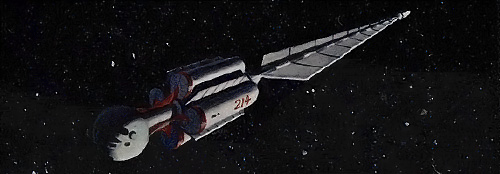
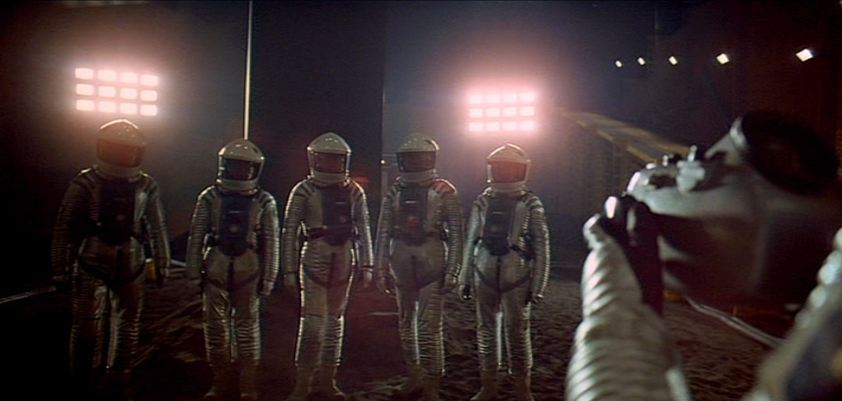
2001: A Space Odyssey by Arthur Clarke
1. One thing that I really enjoy about Clarke, both here and in Rendezvous with Rama, is his ability to give information in a way that laymen can understand and enjoy. This might be my bias of loving layman's physics, but here it interests me. This could be some pretty dry stuff—explaining slingshoting spaceships—but it works here. He finds that line between too much information boring the reader, and just enough information told in an interesting way to make learning enjoyable.
2. While he does this with physics, the detailed description of life aboard the spaceship is a bit boring. It is an incredible feat of imagination—even for Clarke, who is known as a fantastic predictor of the future—but it seems to drag on, much like the days must drag on for the two astronauts who are awake.
3. HAL is a great character. He ends up being so human in his panic, his difficulty to maintain a lie, and his return to childlike behavior—all while still being unavoidably computer. He believes that all people must be like him because he is the only existence he knows. This is a powerful character, and an effective emotional tragedy.
4. HAL's fault—the conflict of lying about the mission to the astronauts, then concluding that these instructions to lie must indicate that the astronauts are nonessential—is a beautiful moral metaphor, and convincing examination of future technology. Like much science fiction, Clarke examines a current thread in culture—AI and space travel here—and pushes it to a logical extreme to show both potential benefits and pitfalls. The basic premise that shakes out is the truism that humans know not what they do. By not knowing how HAL will develop, they know not what their creation will do. Here Clarke could have gone the pulp route and made HAL a secret villain delighting in punishing and testing the meatbags. But instead I empathize with HAL. He is a well developed character. His flaws are part willful and part ignorance and part situational, much like mine tend to be once I fully glimpse them.
5. The scope of this book is fearless: tackling a timeline from pre-human to post-human. I think Clarke pulls it off, which is amazing. He is a confident, talented author biting off a huge chunk of material, and getting it to do exactly what he wants. And he does it well. This is an episodic novel without a frame narrative, but this structure actually works here because the thread is so important to each episode. Human evolution and change is that thread, and it is central to every part of the book. Even the opening pre-human part is the same narrative as the other parts. The echoes come back in situations so different from the original that they offer new insights and the theme rolls along, keeping it all together. This tactic of a central theme tying all of the episodes together would have helped Foundation, where the central eponymous element changed so drastically between episodes that the novel felt disjointed.
6. As to that first part, the pre-humans are described with an empathy that is touching. What we take for granted today, their great leaps of logic, are almost as astounding in the showing as they could be. I think merely telling about them would have lacked power, but there's just enough telling to ensure and confirm that the reader is on the same page with the author and characters.
7. Clarke's world building here is amazing. But most of his characters are merely good. In this way he's almost the opposite of Heinlein: whose characters are great, but whose world building is not as perfect as they are. I am not saying that Clarke's characters are bad, they're just not as perfected as his world building.
8. At the end, I want more. Star Child blowing up the satellite is such an enigmatic and powerful act that I'm looking forward to seeing how this post human goes, and what it does. The contrast between it and humanity is so great that I'm interested to see if it becomes a god, and what humanity does next. The temptation is obviously there narratively for Star Child to assume divinity. But if there's one thing that I know about Clarke, it is that he foils whatever I predict he's going to do, then shows why what he came up with is more logical and correct.
9. Clarke's writing is not amazing, but it is good. His teaching moments are very good—and I think it is a special, valuable talent to be good at making orbital mechanics interesting. But he does have moments of brilliance here, the high point being: "Sorry to interrupt the festivities, Dave, but I think we have a problem." This is just one example, but it is so great! Overall, this is above average writing with moments of brilliance.
10. Another place where Clarke bites off more than the average author can chew is in the nearness of his future—this is not thousands of years hence; it is something he will probably see in his own lifetime. [He did live through 2001 and the intro to the audiobook that I listened to was really enjoyable, reflecting on what he got right and wrong, the way the book was written, and its influence.] It is courageous to try this. And although there are some clear differences between his work and how the future actually shook out—we have no AI, the human body requires a lot more exercise in space than he anticipated, we have yet to attempt artificial gravity in space, we have sent no manned missions farther than the Moon, etc.—he pulls the whole off well enough that it does not feel dated to me. Reading space travel stories by HG Wells or Jules Verne is difficult today, because all of the disbelief that must be suspended to buy into the narrative. Not so here. This is easy. 2001 has become alternate history since it was published, but it still works well.
Labels:
1968,
Arthur Clarke,
Science Fiction,
Space Odyssey
Subscribe to:
Posts (Atom)