Showing posts with label 1992. Show all posts

06 March, 2022

Snow Crash by Neal Stephenson


Around when Wired magazine was founded to appeal to fans of Cyberpunk, in the early 90s, two people used novels to satirize the genre and attempt to reform it or tear it down. Right time, right place. One was the man who invented the term cyberpunk, Bruce Bethke, who wrote Headcrash after Stephenson published Snowcrash. I am very thankful for what Stephenson did. I am stoked that somebody took the piss out of these self-centered, egotistical anti-heroes. And he did it in a way that uses some humor.

Unfortunately, what he wrote and published is crap. Instead of clever ideas, Stephenson cackles at the sheer number of ideas that he half-cocks into the novel. Some indict Cyberpunk, like Raven and Gargoyles. But others follow the genre tropes as unquestioningly and blindly as the bad stuff getting called Cyberpunk before it. If you write a bad novel and then tell everybody you did it on purpose, it’s still a bad novel.

I love satire. The Divine Comedy is what sealed my love of lit in the 10th grade. I should love this even more: it’s both Satire and Cyberpunk, combined. But no, this is a mess. I was bored halfway through and disappointed by every single element simply thrown against the wall to drip down to the pitch black alley below.

Language: China Mieville said more about language in a single chapter of Embassytown than this mess said in the whole book.

Heroes: Instead of writing an anti-anti-hero, Stephenson just wrote another shallow cyberpunk anti-hero.

Myth: Come on. Mentioning myth is not the same thing as discussing it.

I’ll stop here, something Stephenson did not know how to do. This is the novel of a person obsessed with their own cleverness, with no knowledge of how to tie up a narrative thread or say no to his impulses. This is the novel of a person who attempts to make us sympathetic to the rape and sexual assault of a 15 year old child. This is the novel of a person who wants simply to tear down, and not offer any ideas to build back up. As such, I have no time for this novel. After reading it once, I was unable to bring myself to read it again.

As a pulp adventure, I enjoyed my first read of it. Upon reflection, it was unfocused, discursive crap. Is he saying yay objective truth (Namshubs) or yay subjectivity (them chosing their reality [for now] at the end?).

28 January, 2020

Chanur Series by CJ Cherryh

This series has five novels that tell three interconnected stories: the first book, the middle three (published as three books, but they're really just one), and the last one. This Space Opera series tells an adventure tale of inter-station traders travelling faster-than-light to try and make a buck or two, becoming increasingly engaged in politics, and eventually coming to grips with their political reality as well as their personal reality. The stories focus on the characters and use action to change them or confirm their natures. Unlike other Cherryh novels, the focus of these is almost exclusively on single characters per book, though Chur, Hallan, and Tiar also get some alone-time on-screen, mostly due to their unique abilities. The story starts with, and focuses on, characters from a feline race of intelligent creatures: Pyanfar for the first four books, and Hilfy for the last. And Cherryh doesn't leave it there: the secondary Hani characters who play the antagonist role in the first novel come back in the second story arc and become, if not heroes, then at least sympathetic. Three things about Cherryh’s writing that really come to the fore in these five novels.

First, the laws of physics and tendencies of economics help build the world and tell the story. Whoever wrote the Wikipedia article calls these novels, "Unusually realistic examples of space opera", and that's a great way to put it. Technology and the laws of physics deeply influence the possibilities of the economic and political realities within this universe. For instance, time dilation exists in this universe⁠—unlike other Space Opera tales that ignore hundred year old physics. The speed of light has importance here: as a Chanur ship approaches a station, the light from their dropping out of FTL hasn't reached the station yet, and they have an opportunity to monitor the traffic and communications within system, light hours old information, before anybody else knows they've arrived. This fills in the context of this new situation they have dropped into. Then, the delay between sending and receiving a message⁠—due to the speed of light⁠—plays an important role both in perception of situations, and in decision making. Also, the political organization that guides these alien species trading together is just that, a loose political affiliation that tries to regulate trade for everybody, rather than a political force. (Or, at least it starts out that way...) Cherryh rationalizes the economic and political intrigue in ways that, if you like Cherryh’s other writing, you will love here. It absolutely feels "unusally realistic".

Second, the sparseness of her voice. I don’t know how to explain this adequately. So, her narrative follows her characters who don’t describe things they already know, don’t explain as much as dwell on and recontextualize pieces to puzzles they’re given. Let me try an analogy: sometimes, when I read a Greek Myth, I think, “Huh. I don’t think I get that one? Why? And why was that seen as entertaining?” Then later something happens in my life that recontextualizes it, and I go back and re-read it, and it’s newly emotionally effective, or logically understandable as a story. Cherryh has a tendency towards that type of writing. And these books more than a lot of her other books. That’s not a bad thing. I like books that require some effort from the reader, some contemplation from them.

Third, and I know I’ve said it before: she writes aliens well. Really well. Throughout the series, alien species tend towards more and more screentime, and understanding of them grows⁠—but never in leaps and bounds, never in a way that contradicts earlier knowledge, or doesn’t coalesce into a whole. The Compact (Yes, this absolutely is Space Opera, the central organization of trade is called The Compact) is made up of a methane side and a oxygen side⁠—each space station split down the middle. And from the start, when Pyanfar knows nothing, the T’ca and Knnn are entirely obtuse. They’re scary. But, by the end of the fourth novel, by the end of the second of three stories, some understanding is present. They’ve been seen on screen enough times now that Pyanfar becomes more comfortable around them, and hence the reader is allowed the same cautious thawing.

How does she write her aliens well? This question drove me to look up her writer’s advice and compare it to her work here. In her, “Creating a World and Culture”, she states, “First, your environment. That becomes a biological given. It produces the beings you're writing about. Culture is how biology responds and makes its living conditions better.” She then goes on to talk about how the alien species do things that humans either focus on or spend time doing⁠—finding differences between us and them, and using those as jumping-off points to further creation: eating, dying, questioning, modifying spaces for shelter, communicating with others, and believing about the afterlife. Out of these basic questions, and a knowledge of biology, her aliens come.

So, this seems to be a case of designing in a notebook, and then cherry picking the important or interesting data for the novel itself⁠—rather than a massive intro-info-dump, or an info-dump halfway through. By the end of the fifth novel, fundamental things about Stsho gender phasing biology remain unknown; the Kif tendency to push and prod and judge solely on their own morals with little cultural relativity has hinted at, but not explained, a homeworld culture never seen in the books; Hallan Meras’ encounter with the loading cart reveals more about the T’ca and dockside regulations, but nowhere near enough for Pyanfar's cautious thawing to take place for him or Hilfy.

In short, she keeps the aliens alien by:
• Not explaining them, except in what the characters know and rely on in dealing with them;
• Letting her characters curiously question the alien natures and discover pieces that only lead to more questions;
• Discovering and expanding on the ways they fundamentally differ from humanity in the way a bear or mosquito does, including communication, eating, death, etc. She takes all these one-step further, at least. Ok, so the Kif are exclusively carnivores, so they're competitive like earthly carnivores. But where Cherryh distinguishes herself is taking that further: therefore, when the meet an unexpectedly strong outsider, they're going to respect and follow and learn from and feel threatened by and threaten;
• She designs them first, and then never reveals the whole design.
In looking at it this way, this technique apes the old adage, “don’t show the monster,” which I agree with if the story wants the monster to stay monstrous. But she applies this adage to things that are not monsters, aliens, and they read as alien. Again, in Greek Myth, some of the magic of Myth is that the gods, titans, and other immortals operate on a different biological, moral, and spiritual level, and that constant mystery and surprise helps Myth beguile. For instance, Cherryh never explains humans. Tully is a known quantity by the end of book four, but his people remain mysterious to Pyanfar and Hilfy throughout. Cherryh rides this almost fourth-wall breaking line, by relying on the human reader to input their knowledge of humans to contextualize the novel's humans' actions, knowledge her main characters clearly lack. Brilliant.

My one single critique arrises from the way the first and second books relate. At the end of book one, many things seem solved in an optimistic way. Humans have discovered The Compact and Pyanfar has an exclusive contract to trade with them, saving her clan and culture, and the whole Compact, really. But the second book ignores this optimism and opens on a pessimistic note with Pyanfar held hostage and released by possibly different unknown parties, with her trading license revoked and her stranded. Reading these back-to-back like I did, this jarring shift took a few pages for me to understand, and at the end of the series it still feels like a bit of a cheap writer’s trick, like Cherryh wrote herself into an overly solved position, and had to hit a reset button to get the story back off the ground. That’s not to say that the middle three novels, composing a story by themselves, didn’t absolutely engage and engross me, just that a part of the story makes little sense by the end of the novel, Cherryh doesn’t explore that aspect enough for me to feel emotionally invested in Pyanfar’s misfortune, though I am still curious about it. It's almost as if the first book didn't need to be in the series, or was a rough draft.

In short, these novels show a lot of the strengths of Cherryh’s writing, and some of the weaknesses. Though it’s a Space Opera Adventure that I adore, I wouldn’t recommend it to everybody. I can think of two or three people that I can’t wait to tell about these books, but in requiring so much from the reader, and in skipping a major plot point that, between books, shifts the whole tone from victorious to defeated, recommendations have to come with a caveat. However, wholeheartedly, I can recommend her techniques of creating alien species and populating a universe. I am floored by how well she writes aliens. Where some of her books take a few pages, or a third of the book, to start getting to a point where I can’t put it down, here each book’s pacing brilliantly starts off with a bang and continues from problem to solution to new problem consistently and I turned the pages happily, devouring these stories. Finally, the realistic feeling of the aliens is matched by the realism and rationality she puts into designing the universe and reacting to physical laws and economic tendencies that help inform the story and keep it based in our reality. Brilliant stuff.

[EDIT 2/1/2020:] The novel series does some gender role reversal. Hani women are allowed off the planet's surface, while each tribal pride's male is not. Excess men retire to reservations and must fight to the death, and win over and over again to even find a chance of getting off the reservation alive. Men who portray any divergent masculinity die immediately at the hands of traditionalists, or must be strenuously protected by their family. I find this gender reversal engaging and wonderful: instead of simply reversing the roles, Cherryh reasons out what a matriarchy might look like, and uses stereotypically masculine traits to identify reasons why men constitute the hani second sex. For instance, she calls men flighty and over-emotional⁠—phrases that some men continue to call women today. Yet, instead of just "switching the pronouns" like some unimaginative authors have done in their gender reversal tales, Cherryh reasons out what stereotypical traits of males would be construed by those two words, and the hani males are viewed as unreliable or lazy, and quick to anger or sulk, especially when denied food. Cherryh uses the same words that men have used against women for centuries, yet changes what they mean to reflect toxicly masculine tendencies. This fantastic work leads to a gender reversal tactic that I adore. I've only ever respected one other gender reversal book this much, Y: The Last Man by BK Vaughan.

21 October, 2019

Doomsday Book by Connie Willis


I didn’t particularly enjoy reading Doomsday Book by Connie Willis. She held aspects of the plot and context back from the reader way too long for how heavily foreshadowed they were. She brings up a lot of ideas in this book, and she brings most of them up in interesting ways. However, while I respect some of what she does here, I also think she didn’t use her ideas perfectly. So, let me start with two things to praise unequivocally, then get on to the muddled critique.
Kneeling on St. Mary’s stone floor she had envisioned the candles and the cold, but not Lady Imeyne, waiting for Roche to make a mistake in the mass, not Eliwys or Gawyn or Rosemund. Not Father Roche, with his cutthroat’s face and worn-out hose. She could never in a hundred years, in seven hundred and thirty-four years, have imagined Agnes, with her puppy and her naughty tantrums, and her infected knee. I’m glad I came, she thought. In spite of everything.

Like Small Gods, Willis shows the good and bad of Christianity even-handedly. From Mrs. Gadson reading passages about pestilence to influenza victims, to the Bishop’s envoy’s party’s casual sexual harassment, Christianity doesn’t get a free pass from Willis. Yet she also shows Father Roche and Dunworthy and Mary all leading Christian lives full of charitable acts—even putting their lives at risk for others. I find this nuanced approach thought-provoking, which is what I want.
I wanted to come, and if I hadn’t, they would have been all alone, and nobody would have ever known how frightened and brave and irreplaceable they were.

My final unreserved praise for this book is that this new technology is just that: technology. Time travelling capabilities, inherently fantastic technology, come off common place. The people around it show some differences with us, but they’re still people, and they treat it sort of nonchalantly. It has limitations still, like cell phones sometimes being out of reception, you can’t just time travel willy-nilly. The professors are to varying degrees befuddled by it, but largely they treat it nonchalantly. It seems pretty honest to how people treat technology and I found it well communicated.
Apocalyptic was very likely the correct term for his even thinking he could rescue Kivrin, Dunworthy thought. He was worn out by the time Colin got him back to his room, and his temp was back up. "You rest," Colin said, helping him into bed. "You can't have a relapse if you're going to rescue Kivrin."

I think the central theme of the book is love for humanity, or charity. Many of the characters are examined in light of their selflessness. Not only the main characters, Kivrin, Dunworthy, Roche, Colin, and Mary; but also the secondary characters like Mrs. Gadson, William, Sir Blewitt, Montoya, and the bellringers. Where the main characters are unambiguously oriented on the welfare of others, these secondary characters follow paths that they view as attending to the welfare of others, but that conflict with the wills of others. And that’s a major sticking point for me, as well as a tactic I respect: no character is evil. Her characters all try their best. Some are more selfish than others, sure, but by and large sticky situations result from miscommunications and mistakes more than nefarious purposes. This means that there is little tension in the book—at least between characters. No central antagonist foils the characters, Just misunderstandings and mistakes. This isn’t necessarily a poor tactic, I like books that assume evil people think they’re doing good, but it doesn’t play well here because Willis focuses on so many ideas that there is little chance for tension to grow.
“You can’t go back,” Gilchrist said. “Haven’t you heard? We’re under quarantine, thanks to Mr. Dunworthy’s carelessness.”
It seems like a second theme shows the problem of the existence of pain to Christian theology. These ideas about what love is and how to show it, mixes with ideas of ease-of-life and leaves at least Kivrin questioning faith. Yet the central takeaway comes to the black plague being the theological underpinnings of atheism, and Willis doesn’t let this particular cat out of the bag until way too late in the novel for any depth to be reached here. Again, I like this theme, but it just doesn’t occupy enough of the book to be engaging.
It was impossible to imagine it overrun with the plague, the dead carts full of bodies being pulled through the narrow streets, the colleges boarded up and abandoned, and everywhere the dying and the already dead.

I don’t really understand what the future portions try to communicate. The past seems to be what Willis wanted to write here, at least she seems more excited to write the past, as it comes off more engaging. But then there’s this future section that mirrors the black plague. And it doesn’t really make sense to me as a writing tactic because I can’t tell what Willis tries to say with it.
None of the things one frets about ever happen. Something one's never thought of does.

In short, great premise, poor book. It held way too many cards too close to the chest for far too long. The first time Willis said that Kivrin is going to 1320, and it’s a good thing she’s not going to 1348 when the black plague hit, I agreed. The second time she did, I knew she was going to 1348, not 1320. Yet it takes half or more of this book for the characters to realize what Willis has already heavy-handedly hinted to the readers. That’s a bit too much reticence with the plot for my tastes, and it helped the book lack tension, lack teeth. How can you pull the teeth from the black plague? Willis seems to have done it—by confusing the narrative with an uninspiring epidemic tale in some future that’s unfocused, and by holding her cards too close for too long. Overlong for the conclusions drawn. Similarly, the character development’s flatness hindered this book’s power—and their general annoyingness sapped enjoyment. I end up respecting and decrying almost everything Willis does here. To the point that I’ll probably read another book in this series, but not right away. I want deeper character depth.
"Bless me, Father, for I have sinned," he began in Latin.
He hadn't sinned. He had tended the sick, shriven the dying, buried the dead. It was God who should have to beg forgiveness.
"—in thought, word, deed, and omission. I was angry with Lady Imeyne. I shouted at Maisry." He swallowed. "I had carnal thoughts of a saint of the Lord."
Carnal thoughts.
"I humbly ask pardon of God, and absolution of you, Father, if you think me worthy."
There is nothing to forgive, she wanted to say. Your sins are no sins. Carnal thoughts. We held down Rosemund and barricaded the village against a harmless boy and buried a six-month-old baby. It is the end of the world. Surely you are to be allowed a few carnal thoughts.

18 July, 2018

Lords and Ladies by Terry Pratchett


This book tells the story of myths invading Lancre, a small kingdom deep in the mountains. On the one hand, elves invade from a parallel dimension. On the other hand, Magrat embodies a fictional myth to defy the actions of the elves. On yet another hand, Shakespeare is being spoofed throughout.
In fact, the mere act of opening the box will determine the state of the cat, although in this case there were three determinate states the cat could be in: these being Alive, Dead, and Bloody Furious.

On the first hand, the theme is on the book cover. The elves are a kind of aristocracy—expectantly entitled, cruel but beautiful, and more powerful than normal people. Myth isn’t necessarily bad, it’s attractive. But when people subordinate themselves to myths of the past, they forget their own present and others’ futures. On the other side of myths being bad, having the aristocracy around to organize and lead some fighting can help: Magrat forgets too much of her earlier self while becoming a queen, but then is able to help when she remembers because she is a queen. Well, almost a queen.
Nanny Ogg looked under her bed in case there was a man there. Well, you never knew your luck.

But I think the more important theme lies in the myth-becoming-real. It allows Pratchett to play out how people typically deal with myth in their day to day life, or don’t as the case may be. For instance, Granny resists the myths because she can see the damage they have caused and will cause if allowed to reign again. However, at one point or another, all the people who can resist the myths are too tied up with their personal paramours to care or even notice—myths and shifts in cultural psychology are subtle things that are often missed. Yet, like the first-level analogy shows, myths are something to balance with reality, to banish when they’re dangerous and encourage when they’re beneficial. I think this is the main point of the novel.
Personal’s not the same as important. People just think it is.

On the third level, Shakespeare is both kind of silly (this book spoofs Midsummer Night’s Dream) and really important simultaneously. Quite like myths. He helps explain humans and their craziness, as well as making them laugh at the same time. I wonder if this book is Pratchett’s tribute to that most famous writer. So many parallels can be drawn between the two.
Verence would rather cut his own leg off than put a witch in prison, since it'd save trouble in the long run and probably be less painful.

Pratchett here combines all these aspects of examining myths into every facet, nook, and cranny of his book. The resolve argues that what we can do today is better than what we could have done back in mythic times, trying to drag people’s focus to the here and now instead of there and then. The whole well-focused affair comes off much like the strengths of Small Gods did: brilliantly.
It wasn't that Nanny Ogg sang badly. It was just that she could hit notes which, when amplified by a tin bath half full of water, ceased to be sound and became some sort of invasive presence.

Yet, where Small Gods kept the slapstick down and the philosophy more on the surface, here Pratchett subsumes the philosophy under the slapstick patina, as is typical of his other Witch tales so far. Pratfalls and Shakespearean parody run the show from start to finish, translated into the Discworld universe successfully. But the underlying philosophy is always there and always guiding the twists and turns in the plot.
Don't try the paranormal until you know what's normal.

That’s all I can say, I think. It’s somewhat more slapstick than Small Gods, but as deeply interesting philosophically or sociologically. And it’s a strong, strong novel that needs to not be ignored in the Pratchett cannon. Some Shakespearean love helps, I’m sure—but less than with Wyrd Sisters, his other Shakespearean tale.
You can’t say ‘if this didn’t happen then that would have happened’ because you don’t know everything that might have happened. You might think something’d be good, but for all you know it could have turned out horrible. You can’t say ‘If only I’d…’ because you could be wishing for anything. The point is, you’ll never know. You’ve gone past. So there’s no use thinking about it.

17 July, 2018

Small Gods by Terry Pratchett


Pratchett deftly handles faith and atheism, religion and politics, myth and reality, philosophy and theology, humanism and higher powers. He claims he has received letters from believers and non-believers praising him for this book, and I can see why. It’s a masterclass of even-handedness. Sure, Pratchett comes down on the side of atheistic humanism personally, but lets the book come down on a faith-based finish, as seems appropriate in this fantasy setting. And I think that balancing act indicates what makes this novel so great.
His philosophy was a mixture of three famous schools—the Cynics, the Stoics and the Epicureans—and summed up all three of them in his famous phrase, 'You can't trust any bugger further than you can throw him, and there's nothing you can do about it, so let's have a drink.'

The book is funny in two ways: it has some of the slapstick humor of earlier Pratchett fare, but starts to use a situational humor that seems to occupy much of Pratchett’s later works. For instance, a prophecy tells that the time of the eighth prophet is at hand, but the eighth prophet ends up being an illiterate novice gardener. This is inconceivable to the church hierarchy, particularly those glory-seeking members who believed themselves to be likely eighth prophets. Pratchett supplies this funny situation with some slapstick between Vorbis and Brutha and Om, the god of the religion, but the point of the situation illuminates human desire more than slapstick pratfalls. I hope Pratchett continues this strong technique because it allows him to reach a satisfying depth of analysis.
Fear is a strange soil. It grows obedience like corn, which grow in straight lines to make weeding easier. But sometimes it grows the potatoes of defiance, which flourish underground.

For anybody who contemplates the big questions in life, this study of belief and perception is more directly philosophical than much of Pratchett’s earlier fare. Through showing positives and negatives to both sides of every argument Pratchett brings out, his even-handed treatment goes a long way towards making this book palatable to both sides of each argument. And with something as contentious as religion tends to be, this treatment is perfectly readable by all. I’ve often said that the inherent strength of science fiction and fantasy lies in being able to freely discuss a contentious issue without offending either side—merely by couching it in the guise of some fictional analogy. The example I often give deals with religion: to write a book about the dangers of religious fanaticism and use Christianity or Islam as the religion in question will alienate potential audience members, at the least. To be able to make up a fake religion and take some parallels from actual religions, then discuss it negates the potentially off-putting nature of challenging beliefs people hold dear. Pratchett does exactly that here: he embodies this example and pulls it off sensationally.
The Ephebians believed that every man should have the vote (provided that he wasn't poor, foreign, nor disqualified by reason of being mad, frivolous, or a woman). Every five years someone was elected to be Tyrant, provided he could prove that he was honest, intelligent, sensible, and trustworthy. Immediately after he was elected, of course, it was obvious to everyone that he was a criminal madman and totally out of touch with the view of the ordinary philosopher in the street looking for a towel. And then five years later they elected another one just like him, and really it was amazing how intelligent people kept on making the same mistakes.

And he does throw everything in here: humanist secular philosophers, religious inquisitional fundamentalists, deep belief simpletons, political influences and reactions, religious war-mongering, people who only associate with echo-chamber believers of their own religion, anti-theists, and inter-religious relations. However, instead of trying to chew more than he can handle, Pratchett sets this whole varied work in the field of a religious pilgrimage of sorts, allowing him to expand and contract his focus to handle all of the variety he has adopted. For instance, the humanism Brutha encounters in Ephebe (think, Athens) is dealt with by Brutha later, while wandering in the desert. In other words, the array of influences Brutha sees and takes on in Ephebe is then dealt with in his own time in the desert. This pacing of putting many influences into the boys head, then letting him sort through them slowly allows the novel a clear direction, keeping it from getting lost in the weeds or twisted off into culdesacs of discussions. It’s an effective tactic and one that seems particularly Dostoevsky-esque.
Humans! They lived in a world where the grass continued to be green and the sun rose every day and flowers regularly turned into fruit, and what impressed them? Weeping statues. And wine made out of water! A mere quantum-mechanistic tunnel effect, that'd happen anyway if you were prepared to wait zillions of years. As if the turning of sunlight into wine, by means of vines and grapes and time and enzymes, wasn't a thousand times more impressive and happened all the time.

I believe that this is one of the best Discworld novels. The jokes are more dense than later works, but less so than earlier works, and this novel rides the line between early and late Pratchett while making some of the underlying philosophy he is known for more explicit. It’s a great place to start for anybody interested in reading Pratchett.
Time is a drug. Too much of it kills you.

30 June, 2016

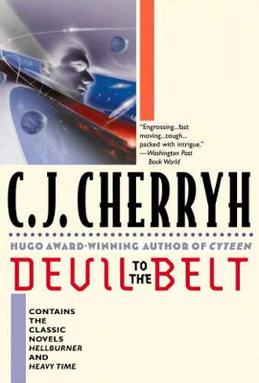
Hellburner by CJ Cherryh


1. A few months back, a friend and I lamented our agreeing perception of bad quality military science fiction today. We also reminisced on some of the big points in the genre: War of the Worlds, Starship Troopers, and The Forever War. This novel by CJ Cherryh is also military science fiction: four characters being trained in a program involving a specific spaceship that is difficult to fly, the program is failing, and political and fleet maneuvering try to save it from failing or hurry it on its way. Like Cherryh typically does, this is a novel based on interpersonal interactions first, political maneuvering second, and damaged people trying to find their way. So if you’re looking for military science fiction with depth, try here. There isn’t a stitch of combat until the end, but that ends up just being a test run. I do not think you need to read the prequel, Heavy Time, to understand this sequel or the characters, but Cherryh advises that you do.


2. There are five main characters in the novel: Meg, Sal, Ben, Dek, and Graff. And all of them change significantly throughout the novel.
—Graff sort of runs the show—that “sort of” taking up a bunch of the plot. He’s constantly uneasy at absentee management and that his direct superior in the program is not a part of his branch of the military. At the beginning he is sure of himself, but that’s quickly destroyed. By the end, as the scope of his influence spreads, and more importantly, as he realizes that it spreads in some ways and contracts in others, he is much more comfortable and effective in a wider variety of situations. For instance, the Graff at the beginning would not have been able to be so smooth in the press conferences at the end. He has changed throughout the novel to reflect the influences he comes under within the novel.
—Dek, recovering from an assassination attempt and heavily drugged up at the beginning, slowly gets his feet under him and learns to filter things out better. This is an ongoing process for him: coming to terms with the death of his team and their replacements, who are from an earlier point in his life he has cut off. By the end, he’s able to accept simple luxuries because he finally believes in himself.
—Ben begins by running away from hands-on work, believing he’ll be happier in some lab somewhere in Stockholm. But the fleet co-opts him and he finds uses for his skills that help his friends. He goes from an asshole who needs nobody to a man who comes to rely upon his friends deeply, and justifies their relying upon him as well.
—Sal is the one who doesn’t change much within this novel. She changes from the last novel to this one, but most of her change was in the prior novel, and this one helps solidify those changes in her. However, off-screen, between the novels, Sal’s greatest change occurs. At the end of Heavy Time she became a Shepherd, her goal. But eventually, between the novels, she realizes that Meg is more important to her by now, so she follows Meg into this novel. Coming to terms with this change in her is her story arc.
—Meg begins by being the egotistical, slighted political reformer and pilot. But through the training program, realizing her own age, the social situations on the station, and Sal’s kindness in coming with her—she eventually comes to a stable, happy place in her life. Some of that anger burns out, some she discards, the useful anger she keeps. And she becomes the first at something, proves herself to herself, echoing Dek’s journey but with specific points that are unique to Meg.
—These changing characters are the central focus of the novel. The plot supports their changing throughout.


3. And these changes are the theme here. By their changing and growing understanding of each other, the whole war effort is benefited through the program they save. In other words, improve yourself and many of those around you will also improve; find a place to fit in and don’t be surprised when you need to change to fit it too; and find a way to fit your situations without betraying your self. Tanzer’s method of leadership—anger and regulations—doesn’t fit who he has under him, and so he fails. Porey’s method of threats and grace in equal measures also don’t succeed. But this group of five people who ignore the chaff to learn to work with each other through understanding and kindness end up saving the whole program from ruin—and themselves in the process. This theme of communication leading to understanding leading to discussion leading to success is central and there are many, many smaller examples of this: Keu almost loses Graff’s efficacy through Keu’s lack of communication, but Saito and Demas pull him back; the first communication between Dek and his mother ends up averting a major political situation and more riots; Rob communicating a simple handshake to Dek helps diffuse a powderkeg; etc.


4. Again and again Cherryh changes her writing to fit the plot and characters of her novels, like she does here. This is a military training facility with military characters, and it reflects that. A lot less situations are gray areas while a lot more end up being black and white. Chain of command, word choices, training, regulations, gratuitous language—these all fundamentally change Cherryh’s writing. Meg and Sal, as they acclimate to the situation, are less flashy and more military by the end, and this change spread throughout helps set the tone of the novel. This tactic is incredibly effective at world building and drawing the reader into the novel.


5. And really, I don’t know what else to say. This novel is fantastic. There is no intro-info-dump, no last page reveal, no slow start, no wasted scene or word, no extraneous character, and no hint of deus ex machina. But of course it isn't just some list of how she writes: it's what she writes. This list just indicates which tactics she uses and which she avoids, indicates how much she respects the reader's intelligence rather than spoon feeding them, indicates the craft of her writing. The writing could pay a little more attention to description, but the payoff in world building with Cherryh’s tight voice is certainly worth that niggling lack. And the description of the ship from Meg’s eyes is wonderful. This is clearly one of her better works and, despite what she says, I think it does stand well on its own and can be read without first reading Heavy Time—though that’s not to say that Heavy Time is bad. This is a novel first, and a sequel second—which I couldn’t say about Regenesis. So far, I think it’s one of her best.
“The enemy of my enemy,” Demas said, and took the bottle up, “threatens both our livelihoods.”