Showing posts with label World Fantasy Award. Show all posts
04 July, 2019
The Other Wind by Ursula K Le Guin
Over time, Ursula K Le Guin wrote her Earthsea stories. She later took apart some of what she built early on—she changed her mind, and changed her Earthsea world. I’m not at all upset or in disagreement with her over this. I am actually more into this than an author who ignores or is embarrassed by their earlier works. I’m happy people change their minds, it gives me hope. The question here is this: now that she has deconstructed parts of her world, what does Le Guin do with it? The answer is quite simply that she continues to deconstruct it, taking apart the afterlife on Earthsea. That’s the theme of the book: death.
But there’s a problem with death here. You’ll need to remember The Farthest Shore to understand. The problem with death is that dead human souls go to the Dry Lands, where they have a listless, colorless existence, an eternal life of boredom. Well, turns out, the Dry Lands once belonged to the Dragons, humans stole it so long ago only the black wizards of Paln remember that, and Dragons want to claim it back. Some forgotten spell set up the Dry Lands, and apparently messed a bunch else up too in Earthsea. So the heroes research and talk and decide to bring in more voices to their discussion. Finally, by deconstructing the containing wall of their afterlife, the immortal human souls are then able to rejoin the cycle of life, death, and rebirth instead of being trapped in a black and white world, a fake immortality. This also means the humans are able to live up to their end of their ancient treaty with the Dragons, reconciling the two cultures—that’s the main plot—and in the meantime a subplot reconciles the Kargish lands with the rest of Earthsea, and another subplot also reconciles the black magicians of Paln with the Roke Wizards.
This plot relies on what her earlier books contained. The referential nature of this book clearly means that this is not a book to read unless you’ve read some other Earthsea first. Even then, it’s a fairly strange plot on the surface. But though Le Guin seems to be just talking about this made up world’s death and afterlife, this outlandish fantasy plot is actually doing something applicable. She’s talking about looking around, questioning what is, realizing that some of reality is the result of ancient, forgotten errors, and then doing what needs done to fix it despite the fact that those old mistakes are not ours. Taking responsibility for fixing problems that weren’t ours to begin with, reparations, the strength of humility, overcoming biases and fears to allow change for the better, sacrifice, the importance of wisdom and power. It’s a strong theme that really came home for me as a contemporary analogy to post-colonialist country borders.
But that’s not all the book does. Le Guin weaves in the tales of her characters: Alder, Idrian, Tenar, Tehanu, Lebannen, Ged, Seserakh, the master wizards of Roke. The story focuses on their day to day, on trying to get along with each other, on the conflict inherent in trying to come to grips with their discovery of what’s wrong with death. In other words, the heroes do heroic things, but they’re just people. In the midst of all this crazy, metaphysical, mythological repatriation, Seserakh’s sea-sickness is a major plot point. Tehanu’s shyness proves important throughout. Alder trying to deal with dreaming about his recently-dead wife sets this whole book off. And there are a hundred other examples of how Le Guin keeps these heroes people and not archetypes. It’s a strong tactic that made this book memorable for me. It adds complexity to the narrative and contextualizes the heroes’ quest in the same way Gawain and the Green Knight did so well—though much more completely than that text.
And that should be enough said. This is a great book, but it utterly relies on the reader having read the three preceding books in the series, at least. Le Guin balances the overarching, fantasy plot with relatable, human subplots perfectly. She relates her fantasy plot to current ideas about redrawing the map of the world, things like letting Tibet and Kurdistan exist, redressing mistakes made during the colonial era, getting cultures to work together, doing the courageous to fix the mistakes of the past, and taking responsibility for actions not that were done by you, but which are perpetuated by you. It’s a great book that doesn’t get bogged down by these high themes, nor does it lose itself in the details of the characters’ lives, but it shows just enough of both to allow the book to work well as a closing novel in this series of six books. Because it was more complex, I was more into this one than the other books in the series, and the first five were so good that I didn’t regret having to read them to fully appreciate this masterpiece at all.
Labels:
2001,
Earthsea Series,
Fantasy,
Ursula K Le Guin,
World Fantasy Award
06 January, 2017
The Sandman by Neil Gaiman
For David.
1. The Sandman is one of those comics that everybody talks about, a lot. Influential, especially to the current era in comics, and important to many people. So, I went into it interested. I’m not sure anything would’ve been different if I hadn’t ever heard of it though. This is a unique book, and that’s saying something because I’ve been so influenced by comics which came after The Sandman. It’s a seventy-six issue series, dealing with the eponymous main character, also known as Dream, and his family. His family are supernatural beings placed in dominion over various aspects of reality: Dream, Death, Despair, Delirium, Desire, Destruction, and Destiny. Now, I was hospitalized shortly after reading this, and the healing process took some time, so these notes will not do this work justice, but it’s interesting to see what still stands out after a couple of months away from this book.
2. The characters are not just the seven family members—there are mortals, other supernatural beings like Lucifer, denizens of the dream world like Biblical characters, and even the reader. Some of the characters are stronger than others, sure, but for the amount of characters included here, Gaiman does a remarkable job. It would be unjustly dismissive to quibble over his ability to create characters. I’ll just list a few of the characters and discuss what he built them of.
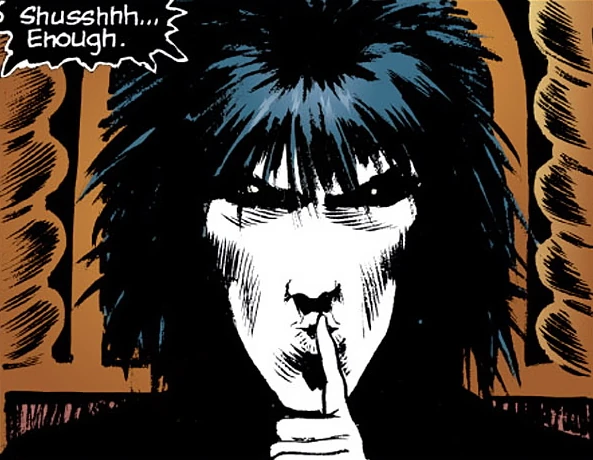
—Dream is a moody, emotional anti-hero who always rationalizes his emotional responses, even when they are mistakes. He is proud and unflinching, devoted to his own duty, but cannot exist in isolation, no matter how much he wants to—he needs other people, but hates that about himself. Self-centered and trying to be self-reliant, yet struggling because his situation and personality requires others. It’s a well-crafted character, but one I found somewhat boring because so many characters like him have come since this book. I’m used to this character in comics by now. His words are the main entry to his personality, for the reader. Though his mood often sets the tone in scenes as well.
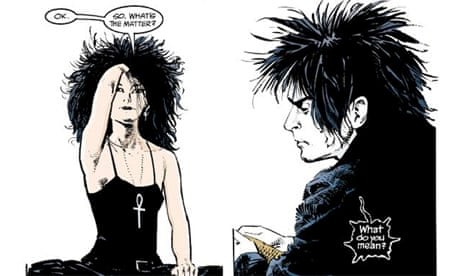
—Death is a kind, caring woman who is strong willed and takes no crap from nobody. She does her job, but is able to handle it easily and still find time to take care of other priorities—like her emo brother Dream. Her humor and caring comes out in both her actions and her words.
—Delirium is a pendulum swing who trails off and shouts at the same time. She is determined at times, stubborn even, but also easily distracted and inconsistent. Her actions drive the reader’s understanding of her character.
—Destruction is the Heideggerian vision, where destruction necessarily means creation. For example: you tear down a house and you’ve necessarily created a pile of rubble. Destruction embraces this necessary pairing to the point that he leaves his realm and his duties behind. Other characters talking about Destruction explains him to the reader.
—Desire is neither male, nor female. It is conniving and antagonistic, while being exactly what some characters think they need. It lives in a biological mansion, and in that way it is our animal instincts writ large. It’s trappings are what explain it to us.
—Fiddler’s Green is old fashioned, in the sense that he knows his place and he does his best to do his little duty and expect nothing more or less. He is chivalrous. But he also has hidden dreams that he tries to fulfill—how he is to die, living like a mortal, or protecting weak people from attack. His desires and wishes, as stated by him and done by him, draw him out of the page into a full personality.
—In this way, you can see that he creates his characters with conflicts, and uses various methods to communicate that to the reader. Very simply, the tactic here is that the more screen time a character has, the more conflicts they have. But in addition to this, most of the characters have their own, distinct voices—and that’s astounding to me because of the sheer number of characters. Gaiman does a great job bringing them all from cliche to personality and a large part of that is his ability to write dialogue that fits each character well. In books, I consistently notice and appreciate authors who do this, and Gaiman hits it out of the park. It may be made easier for him because of who his characters are: his ability to draw on cultural assumptions about Loki, or Lucifer, so that he doesn’t have to delve into too much backstory that could bog the whole thing down. But part of it is his subverting these known characters and tropes in ways that are unusual and fresh, bringing new insights to old myths.
3. But more than the characters themselves, what really drove my first reading, what got me the most excited, was how complex their webs became. None more so than a mortal initially introduced as simply another of the short vignettes, Rose Walker, who ends up being integral to Dream’s own story and eventual death. This one situation is simply a single example of what Gaiman does throughout that makes it feel like nothing is forgotten, nothing is dead space, and even the breathing spaces may later become important.
4. And that’s how the story is built: this overarching story about Dream and his family, but consistently touching on shorter vignettes of specific characters, situations, and ideas. These short pieces don’t always grow to affect everything else directly, though they usually echo eventually. But some of these short parts are just that: short scenes meant to reinforce or introduce an idea that Gaiman will play with for a while. They’re both breather interludes, and integral parts of his exploration of ideas, and that’s why I can’t just call them interludes—the word doesn’t fit. The pacing may be inconsistent because of Gaiman’s constantly shifting focus—action stories, philosophical or spiritual ideas, and character drama all take center stage at various points. Yet the pacing never really annoyed me. I was willing to shift with Gaiman as he shifted emphasis. And that’s because I know the web he weaves here is worth it. There is payoff, and I’ve seen it over and over again. Things are not often forgot.
5. The theme uses mythology, the classics, the Bible, foreign cosmologies, and folklore interchangeably, placing most in Dream’s realm, but others as powers of their own. It’s hard to nail down a specific theme because Gaiman touches on so much, but the most apparent one to me is duty. Sure, he deals with death, love, and the nature of reality extensively, but I think it’s duty that drives the story, that is the base the rest of these themes are built on or relating back to. For instance, he is denied love of multiple women because of his adherence to his duty. His death is only important to him so far as it relates to his duty. And his duty deals directly with the nature of reality. Gaiman shows a few examples of duty throughout—Destiny is probably more addicted to his duty and Dream, but Death, Destruction, and really all the characters have their own relationship with duty. Death’s relationship with duty seems the healthiest, while Despair or Dream seem to have the most struggle with fulfilling theirs. But by giving numerous examples, Gaiman shows the effects of various devotions to duty. Let me be clear that devotion here is not a bad thing—some devotion is necessary. But too much devotion is still too much. And that plays out with the descent of Dream.
6. In all, this is a stunning work. It’s slightly inconsistent in pacing and my interest in each character is also varied. But at seventy-six issues, it’s long enough that I’m pretty sure something will hit for any reader in this massive book. And it’s not a bunch of issues with little to no dialogue—like an Alan Moore book, words fill the panels here. It took me maybe a month to read it all. It does everything I love about fiction well—good dialogue unique to every well-built character, a complex web of a story tied up with an overarching discussion but digressive at length with echoing discussions about the implications of the central theme on other themes, opinionated about philosophy and armchair anthropology with situations that reinforce the explorations or arguments, and using the format to its strengths instead of adhering to the last-page reveal and twenty-four page format. This is a tour de force and it’s easy to see why it became such a touchstone—despite being introduced to comics much after this seminal work first came out. I am surprised by how much I like this book because of how much I dislike Gaiman’s prose efforts. In many ways, I work towards writing a work like this someday. And I look forward to rereading this.
1. The Sandman is one of those comics that everybody talks about, a lot. Influential, especially to the current era in comics, and important to many people. So, I went into it interested. I’m not sure anything would’ve been different if I hadn’t ever heard of it though. This is a unique book, and that’s saying something because I’ve been so influenced by comics which came after The Sandman. It’s a seventy-six issue series, dealing with the eponymous main character, also known as Dream, and his family. His family are supernatural beings placed in dominion over various aspects of reality: Dream, Death, Despair, Delirium, Desire, Destruction, and Destiny. Now, I was hospitalized shortly after reading this, and the healing process took some time, so these notes will not do this work justice, but it’s interesting to see what still stands out after a couple of months away from this book.
2. The characters are not just the seven family members—there are mortals, other supernatural beings like Lucifer, denizens of the dream world like Biblical characters, and even the reader. Some of the characters are stronger than others, sure, but for the amount of characters included here, Gaiman does a remarkable job. It would be unjustly dismissive to quibble over his ability to create characters. I’ll just list a few of the characters and discuss what he built them of.
—Dream is a moody, emotional anti-hero who always rationalizes his emotional responses, even when they are mistakes. He is proud and unflinching, devoted to his own duty, but cannot exist in isolation, no matter how much he wants to—he needs other people, but hates that about himself. Self-centered and trying to be self-reliant, yet struggling because his situation and personality requires others. It’s a well-crafted character, but one I found somewhat boring because so many characters like him have come since this book. I’m used to this character in comics by now. His words are the main entry to his personality, for the reader. Though his mood often sets the tone in scenes as well.
—Death is a kind, caring woman who is strong willed and takes no crap from nobody. She does her job, but is able to handle it easily and still find time to take care of other priorities—like her emo brother Dream. Her humor and caring comes out in both her actions and her words.
—Delirium is a pendulum swing who trails off and shouts at the same time. She is determined at times, stubborn even, but also easily distracted and inconsistent. Her actions drive the reader’s understanding of her character.
—Destruction is the Heideggerian vision, where destruction necessarily means creation. For example: you tear down a house and you’ve necessarily created a pile of rubble. Destruction embraces this necessary pairing to the point that he leaves his realm and his duties behind. Other characters talking about Destruction explains him to the reader.
—Desire is neither male, nor female. It is conniving and antagonistic, while being exactly what some characters think they need. It lives in a biological mansion, and in that way it is our animal instincts writ large. It’s trappings are what explain it to us.
—Fiddler’s Green is old fashioned, in the sense that he knows his place and he does his best to do his little duty and expect nothing more or less. He is chivalrous. But he also has hidden dreams that he tries to fulfill—how he is to die, living like a mortal, or protecting weak people from attack. His desires and wishes, as stated by him and done by him, draw him out of the page into a full personality.
—In this way, you can see that he creates his characters with conflicts, and uses various methods to communicate that to the reader. Very simply, the tactic here is that the more screen time a character has, the more conflicts they have. But in addition to this, most of the characters have their own, distinct voices—and that’s astounding to me because of the sheer number of characters. Gaiman does a great job bringing them all from cliche to personality and a large part of that is his ability to write dialogue that fits each character well. In books, I consistently notice and appreciate authors who do this, and Gaiman hits it out of the park. It may be made easier for him because of who his characters are: his ability to draw on cultural assumptions about Loki, or Lucifer, so that he doesn’t have to delve into too much backstory that could bog the whole thing down. But part of it is his subverting these known characters and tropes in ways that are unusual and fresh, bringing new insights to old myths.
3. But more than the characters themselves, what really drove my first reading, what got me the most excited, was how complex their webs became. None more so than a mortal initially introduced as simply another of the short vignettes, Rose Walker, who ends up being integral to Dream’s own story and eventual death. This one situation is simply a single example of what Gaiman does throughout that makes it feel like nothing is forgotten, nothing is dead space, and even the breathing spaces may later become important.
4. And that’s how the story is built: this overarching story about Dream and his family, but consistently touching on shorter vignettes of specific characters, situations, and ideas. These short pieces don’t always grow to affect everything else directly, though they usually echo eventually. But some of these short parts are just that: short scenes meant to reinforce or introduce an idea that Gaiman will play with for a while. They’re both breather interludes, and integral parts of his exploration of ideas, and that’s why I can’t just call them interludes—the word doesn’t fit. The pacing may be inconsistent because of Gaiman’s constantly shifting focus—action stories, philosophical or spiritual ideas, and character drama all take center stage at various points. Yet the pacing never really annoyed me. I was willing to shift with Gaiman as he shifted emphasis. And that’s because I know the web he weaves here is worth it. There is payoff, and I’ve seen it over and over again. Things are not often forgot.
5. The theme uses mythology, the classics, the Bible, foreign cosmologies, and folklore interchangeably, placing most in Dream’s realm, but others as powers of their own. It’s hard to nail down a specific theme because Gaiman touches on so much, but the most apparent one to me is duty. Sure, he deals with death, love, and the nature of reality extensively, but I think it’s duty that drives the story, that is the base the rest of these themes are built on or relating back to. For instance, he is denied love of multiple women because of his adherence to his duty. His death is only important to him so far as it relates to his duty. And his duty deals directly with the nature of reality. Gaiman shows a few examples of duty throughout—Destiny is probably more addicted to his duty and Dream, but Death, Destruction, and really all the characters have their own relationship with duty. Death’s relationship with duty seems the healthiest, while Despair or Dream seem to have the most struggle with fulfilling theirs. But by giving numerous examples, Gaiman shows the effects of various devotions to duty. Let me be clear that devotion here is not a bad thing—some devotion is necessary. But too much devotion is still too much. And that plays out with the descent of Dream.
6. In all, this is a stunning work. It’s slightly inconsistent in pacing and my interest in each character is also varied. But at seventy-six issues, it’s long enough that I’m pretty sure something will hit for any reader in this massive book. And it’s not a bunch of issues with little to no dialogue—like an Alan Moore book, words fill the panels here. It took me maybe a month to read it all. It does everything I love about fiction well—good dialogue unique to every well-built character, a complex web of a story tied up with an overarching discussion but digressive at length with echoing discussions about the implications of the central theme on other themes, opinionated about philosophy and armchair anthropology with situations that reinforce the explorations or arguments, and using the format to its strengths instead of adhering to the last-page reveal and twenty-four page format. This is a tour de force and it’s easy to see why it became such a touchstone—despite being introduced to comics much after this seminal work first came out. I am surprised by how much I like this book because of how much I dislike Gaiman’s prose efforts. In many ways, I work towards writing a work like this someday. And I look forward to rereading this.
Labels:
1989,
1996,
Comic Book,
Eisner Award,
Hugo Award,
Neil Gaiman,
World Fantasy Award
Subscribe to:
Posts (Atom)


.comiccover.jpg)