Showing posts with label 1990. Show all posts

06 June, 2017

Moving Pictures by Terry Pratchett


1. This novel deals with Holy Wood, or the creation of the movie industry on discworld. Obviously, Holy Wood is an analogy of Hollywood, and the references do not end there. The topic covered is the beginning, with silent movies and big studios and stars, and doesn’t progress much past that point. And that’s maybe some of where Pratchett potentially loses readers: nobody watches Nosferatu or Metropolis anymore. General knowledge of the silent film era is low. But I think Pratchett links it to all other popular art forms in the early days: poetry, plays, novels, opera, etc. It’s all heady potential and learning as you go. And this theme applies to all sorts of stages in life—new job, new house, new friends, new relationship, new interest. Pratchett strips down this topic people don’t know or care about from our own world to the point where it’s applicable to everybody, and that’s a real strength in a satirist. For instance, I don’t know much about symbolic medieval theology in the Catholic Church, but I sure enjoy reading The Divine Comedy.
The whole of life is just like watching a film. Only it's as though you always get in ten minutes after the big picture has started, and no-one will tell you the plot, so you have to work it out all yourself from the clues.

2. But the real theme here is the dangers inherent in this potential, in getting carried away and forgetting about consequences. It’s a hot topic today, how violence in media does or does not encourage violence outside of media. And Pratchett dives in with all his attendant humor, excellent character creation, and descriptive wit. It’s not that potential is bad, inherently, it’s that people focusing on it can get so carried away and taken advantage of. One must pay attention to requirements of reality, otherwise you could lose everything—here made explicit by the fabric of reality unraveling, a check on the pro-column of setting this on discworld. It’s a warning tale, as things get away from the characters and take them to places they didn’t expect, and can’t handle.
It was dawning on the wizards that they were outside the University, at night and without permission, for the first time in decades. A certain suppressed excitement crackled from man to man. Any watch trained in reading body language would have been prepared to bet that, after the click, someone was going to suggest that they might as well go somewhere and have a few drinks, and then someone else would fancy a meal, and then there was always room for a few more drinks, and then it would be 5 a.m. and the city guards would be respectfully knocking on the University gates and asking if the Archchancellor would care to step down to the cells to identify some alleged wizards who were singing an obscene song in six-part harmony, and perhaps he would also care to bring some money to pay for all the damage. Because inside every old person is a young person wondering what happened.

3. In the same way, it feels like the story gets away from Pratchett a bit at the end, like he doesn’t know quite how to close the curtain and run the credits. Maybe this is intentional, in order to draw the reader into similar states of mind as the characters. Maybe it’s a critique on what cinema has become. But it’s still a niggling disappointment that this wonderful beginning devolves into a bit of a mess, and I feel the story could’ve written the ending better. Particularly because other endings are so strong: like Guards! Guards! and Eric.
This is space. It's sometimes called the final frontier. (Except that of course you can't have a final frontier, because there'd be nothing for it to be a frontier to, but as frontiers go, it's pretty penultimate.)

4. In all, this is the first time Pratchett explicitly deals with something from earth in discworld. And I’m looking forward to his treatment of Rock and Roll in Soul Music, and his treatment of News Media in The Truth. I enjoyed this novel quite a bit, but as a cinema nerd who’s spent time exploring the era in history and cinema, I’m in love with this book. It’s not the greatest Pratchett I’ve read, but it’s one I’ll return to again, and suggest to other film buffs as a starting place for them.
The Necrotelicomnicon was written by a Klatchian necromancer known to the world as Achmed the Mad, although he preferred to be called Achmed the I Just Get These Headaches. It is said that the book was written in one day after Achmed drank too much of the strange thick Klatchian coffee which doesn't just sober you up, but takes you through sobriety and out the other side, so that you glimpse the real universe beyond the clouds of warm self-delusion that sapient life usually generates around itself to stop it turning into a nutcake. Little is known about his life prior to this event, because the page headed 'About The Author' spontaneously combusted shortly after his death. However, a section headed 'Other Books By the Same Author' indicates that his previous published work was Achmed the I Just Get These Headaches's Book of Humorous Cat Stories, which might explain a lot.
Being trampled almost to death by a preoccupied troll is almost the ideal cure for a person confused about what is real and what isn’t. Reality is something walking heavily up your spine.

29 May, 2017

Faust Eric by Terry Pratchett


1. This book returns to the format of the first two in the series: four interconnected short stories. It’s better as a novel than those early ones—Pratchett has learned a lot about telling a good story since then—but it’s still underwhelming. That’s not to say I did not like the book—some moments are extremely memorable. But it’s not one I’ll return to often.
Just erotic. Nothing kinky. It's the difference between using a feather and using a chicken.

2. My biggest problem is still with the format. These four stories explore different themes and situations.
—The first wish is to rule the world, and the story takes place in an age of exploration, South American analogy. Quetzalcoatl and Ponce de Leon are parodied. It’s about the nature of gods and belief.
—The second wish is the most beautiful woman in all of history. This story takes place during the discworld equivalent of the Trojan war. Homer is parodied—Helen as an aging mother with a mustache, a Trojan Horse when the men come out of the anus of the animal, etc. This is about believing history and artistic license.
—The third is to live forever, and the story takes place in the discworld’s pre-history. This is mostly an extended joke on the literal meaning of living forever and was a short section. The point being that new experiences are denied the immortal.
—The fourth story is in hell, which is a giant bureaucracy with some distinct, Dantean levels. This portion parodies Faust most directly by acting as a sort of behind the scenes peek at the whole story. The backstory of Faust.
—Again, we have a character on a journey with little else in the way of continuity between these four stories. Rincewind simply snaps his fingers and they teleport through time and space. That’s not much of continuity, I think. And this lack of continuity means that the story should probably be read in four sittings, rather than all at once. Maybe it would be better that way.
“But I read where she was the most beautiful—”

“Ah, well,” said the sergeant. “If you’re going to go around reading—”

“The thing is,” said Rincewind quickly, “it’s what they call dramatic necessity. No one’s going to be interested in a war fought over a, a quite pleasant lady, moderately attractive in a good light. Are they?”

Eric was nearly in tears. “But it said her face launched a thousand ships—”

“That’s what you call metaphor,” said Rincewind.

“Lying,” the sergeant explained, kindly.

3. But the real positive from this book is the theme: this parody of history and metaphysics from our world, played up by simply looking at it all from a slightly different angle. This is where the humor of this book sits. Yes, the characters and situations and descriptions and dialogue and worldbuilding are all funny. But the humor in Pratchett’s speculations about these historical and metaphysical things is really the highlight. For instance, hell isn’t a pit of fire or other people here, it’s a bureaucracy. The way this idea plays out is hilarious.
Rincewind trudged back up the beach. “The trouble is,” he said, “is that things never get better, they just stay the same, only more so.”

4. So that’s Faust Eric, a parody of Faust that’s not actually about Faust. It’s disjointed but it shows an emphasis on parodying our own world that is endearing. This was my first time reading it and I’m not sure I’ll go back to it again. I might, as I study the periods and topics discussed, re-read portions of it, but the structure really lets it down.

The consensus seemed to be that if really large numbers of men were sent to storm the mountain, then enough might survive the rocks to take the citadel. This is essentially the basis of all military thinking.
No enemies had ever taken Ankh-Morpork. Well technically they had, quite often; the city welcomed free-spending barbarian invaders, but somehow the puzzled raiders found, after a few days, that they didn't own their horses any more, and within a couple of months they were just another minority group with its own graffiti and food shops.

22 February, 2016

The Fair in Emain Macha by Charles de Lint


1. The driving plot force here is actually pretty simple: give the main character something to want, then don’t let him have it. Colum wants to go home, to stay away, to just get away from everywhere, to get the girl, to kill the king, to befriend the Bear—and all of these are forbidden to him. This sets up the plot perfectly for a novella: five balls thrown up in the air straight off, then some exposition and ball-catching to bring them to closure. It works here because there is enough driving the story forward to keep one interested, but not so much that de Lint needs a large amount of exposition to make sense of the plot points he’s juggling. In other words: there’s enough going on to keep interest throughout the length, but not so much that it bogs the book down with information. De Lint balanced these well and his plot is mostly a success because of it.


2. I write ‘mostly successful’ because there is one annoying aspect of the plot: a deus ex machina moment at the end. Colum spears a dying druid through the heart, who then turns into a god and, instead of dying, is healed. This came with too much import to be seen as anything other than a cheap escape from a corner de Lint had written himself into. He foreshadows this transfiguration with a similar one a few pages earlier, and with the mystery surrounding druids throughout. But because the spearing is the ultimate moment of the book, the culmination, the foreshadowing isn’t enough. Aside from this one cheap bit, the plot works really well.


3. Character development is appropriate. Colum has competing desires, and competing mental states. This might be a little too cut and dry with the red rage, but it works in this novella because how much space does de Lint really have to make three dimensional characters with all the action going on? There’s not enough action to justify this being a novel without stretching a complex theme awkwardly over the top, but it’s too much to allow the author to develop these characters without splitting his attention awkwardly. Despite this, Colum is a well-crafted character, as are a couple of the others. And that shows good instincts.


4. The writing is a bit awkward, only because I haven’t read enough Yeats to understand all about Irish mythology, which is what the writing relies on. This keeps the reader inferring from context constantly, which is fine but a little annoying. The sentence structure and word choices are pulp fiction, but they’re done well. The dialogue is a bit stilted. In all, the writing is passable and fine.


5. It is a fun little tale with a theme of keeping promises and knowing when to be patient and when to be aggressive. Colum tries to fit his goals into a society that had forgotten him, and ends up relying upon others in order to accomplish some of them. It’s about compromise without compromising.


6. In short, I like Fritz Leiber, but out of this double-book, this story is more enjoyable than Leiber’s. I read on the internet that de Lint is all about urban fantasy, and I’ll have to read some of that because this is enjoyable as a short, quick adventure tale. This is more mythical fantasy though—dealing directly with Irish myths.

23 November, 2015

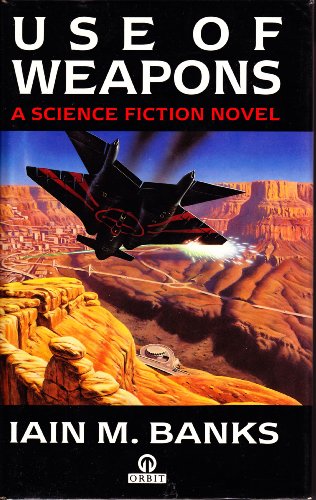
Use of Weapons by Iain M Banks

This one should be fairly short, and not terribly in depth, because I got sick right after reading this and spent a week in bed.


1. The one that everybody talks about with this book is the structure. To describe it, there are two stories going on: the chapters progressing forwards in time and numerals progressing backwards in time. To give an example, by the end of the book with returned to the formative moments of the main character in the numerals, while the chapters have brought us to a conclusion of this part of his life. Banks also includes a prologue and epilogue outside of this structure, as well as infuses these structures with multiple flashbacks. This creates a fairly complicated thing, but I think banks mostly pulls it off. It's legible, but there are parts that lag. For instance, the portion at the observatory, where they find a game, and nothing else happens in that chapter. Boring. But mostly he holds it all together. It's an interesting idea done passably. I'd like to see it done with a little more skill. It just creates this to really weird pacing where super tense moments and mundane moments are placed in areas that create odd relations between them. And I think it could work, it just doesn't quite happen here. Almost. But not yet.


2. The writing does not improve either.
'Let me tell you a sort of story.'

'Must you?'

'No more than you must listen.'

'Yeah... okay, then. Anything to pass the time.'

'The story is this. It's a true story, by the way, not that that matters. There is a place where the existence or non-existence of souls is taken very seriously indeed. Many people, whole seminaries, colleges, universities, cities and even states devote almost all their time to the contemplation and disputation of this matter and related topics. About a thousand years ago, a wise philosopher-king who was considered the wisest man in the world announced that people spent too much time discussing these things, and could, if the matter was settled, apply their energies to more practical pursuits which would benefit everybody. So he would end the argument once and for all. He summoned the wisest men and women from every part of the world, and of every known persuasion, to discuss the matter. It took many years to assemble every single person who wished to take part, and the resulting debates, papers, tracts, books, intrigues and even fights and murders took even longer. The philosopher-king took himself off to the mountains to spend these years alone, emptying his mind of everything so that he would be able, he hoped, to come back once the process of argument was ended and pronounce the final decision. After many years they sent for the king, and when he felt ready he listened to everyone who thought they had something to say on the existence of souls. When they had all said their piece, the king went away to think. After a year, the king announced he had come to his decision. He said that the answer was not quite so simple as everybody had thought, and he would publish a book, in several volumes, to explain the answer. The king set up two publishing houses, and each published a great and mighty volume. One repeated the sentences, "Souls do exist. Souls do not exist," time after time, part after part, page after page, section after section, chapter after chapter, book after book. The other repeated the words, "Souls do not exist. Souls do exist," in the same fashion. In the language of the kingdom, I might add, each sentence had the same number of words, even the same number of letters. These were the only words to be found beyond the title page in all the thousands of pages in each volume. The king had made sure that the books began and finished printing at the same time, and were published at the same time, and that exactly the same number were published. Neither of the publishing houses had any perceivable superiority or seniority over the other. People searched the volumes for clues; they looked for a single repetition, buried deep in the volumes, where a sentence or even a letter had been missed out or altered, but they found none. They turned to the king himself, but he had taken a vow of silence, and bound up his writing hand. He would still nod or shake his head in reply to questions concerning the governing of his kingdom, but on the subject of the two volumes, and the existence or otherwise of souls, the king would give no sign. Furious disputes arose, many books were written; new cults began. Then a half-year after the two volumes had been published, two more appeared, and this time the house that had published the volume beginning, "Souls do not exist," published the volume which began, "Souls do exist." The other publisher followed suit, so that theirs now began, "Souls do not exist." This became the pattern. The king lived to be very old, and saw several dozen volumes published. When he was on his death bed, the court philosopher placed copies of the book on either side of him, hoping the king's head would fall to one side or the other at the moment of death, so indicating by the first sentence of the appropriate volume which conclusion he had really come to... but he died with his head straight on the pillow and with his eyes, under the eyelids, looking straight ahead. That was a thousand years ago,' Ky said. 'The books are published still; they have become an entire industry, an entire philosophy, a source of un-ending argument and -'

'Is there an ending to this story?' he asked, holding up one hand.

'No,' Ky smiled smugly. 'There is not. But that is just the point.'

He shook his head, got up and left the Crew Lounge.

'But just because something does not have an ending,' Ky shouted, 'doesn't mean it doesn't have a...' The man closed the elevator door, outside in the corridor; Ky rocked forward in the seat and watched the lift-level indicator ascend to the middle of the ship. '... conclusion,' Ky said, quietly.
It's passable, but not spectacular. There was one other good part:
He loved the plasma rifle. He was an artist with it; he could paint pictures of destruction, compose symphonies of demolition, write elegies of annihilation, using that weapon. He stood, thinking about it, while the wind moved dead leaves round his feet and the ancient stones faced into the wind. They hadn't made it off the planet. The capsule had been attacked by... something. He couldn't tell from the damage whether it had been a beam weapon or some sort of warhead going off nearby. Whatever it had been, it had disabled them. Clamped to the outside of the capsule, he'd been lucky to be on the side that shielded him from whatever had hit it. Had he been on the other side, facing the beam or the warhead, he'd be dead. They must have been hit by some crude effector weapon as well, because the plasma rifle seemed to have fused. It had been cradled between his suit and the capsule skin and couldn't have been affected by whatever wrecked the capsule itself, but the weapon had smoked and got hot, and when they'd finally landed - Beychae shaken but unhurt - and opened up the gun's inspection panels, it was to find a melted, still-warm mess inside.
The writing just doesn't really engage me, and that's a shame. The plot is mostly exciting, the structure is interesting, he's tackling topics of forgiveness and redemption, and yet the writing lets it all down by simply being unimaginative on the whole. This is very same-y throughout.


3. The theme here discusses redemption and forgiveness, but focuses on doing so from inside oneself. The main character is proud of some of his past actions, but intensely guilty of others—both sets in service to the same goal, and that's where his turmoil comes from.
The man stood on a tiny spur of clay and watched the roots of the huge tree as they were uncovered and washed bare by a gurgling wash of dun-coloured water. Rain swarmed through the air; the broad brown swell of rushing water tearing at the roots of the tree leapt with thrashing spray. The rain alone had brought visibility down to a couple of hundred metres and had long since soaked the man in the uniform to the skin. The uniform was meant to be grey, but the rain and the mud had turned it dark brown. It had been a fine, well-fitting uniform, but the rain and the mud had reduced it to a flopping rag. The tree tipped and fell, crashing back into the brown torrent and spraying mud over the man, who stepped back, and lifted his face to the dull grey sky, to let the incessant rain wash the mud from his skin. The great tree blocked the thundering stream of brown slurry and forced some of it over the clay spur, forcing the man further back, along a crude stone wall to a high lintel of ancient concrete, which stretched, cracked and uneven, up to a small ugly cottage squatting near the crown of the concrete hill. He stayed, watching the long brown bruise of the swollen river as it flowed over and ate into the little isthmus of clay; then the spur collapsed, the tree lost its anchorage on that side of the river, and was turned round and turned over and transported bodily on the back of the tumbling waters, heading into the sodden valley and the low hills beyond. The man looked at the crumbling bank on the other side of the flood, where the great tree's roots protruded from the earth like ripped cables, then he turned and walked heavily up towards the little cottage. He walked round it. The vast square concrete plinth, nearly a half-kilometre to a side, was still surrounded by water; brown waves washed its edges on every side. The towering hulks of ancient metal structures, long since fallen into disrepair, loomed through the haze of rain, squatting on the pitted and cracked surface of the concrete like forgotten pieces in some enormous game. The cottage - already made ridiculous by the expanse of concrete around it - looked somehow even more grotesque than the abandoned machines, just because of their proximity. The man looked all about as he walked round the building, but saw nothing that he wanted to see. He went into the cottage. The assassin flinched as he threw open the door. The chair she was tied to - a small wooden thing - was balanced precariously against a thick set of drawers, and when she jerked, its legs rasped on the stone floor and sent chair and girl sliding to the ground with a whack. She hit her head on the flagstones and cried out. He sighed. He walked over, boots squelching with each step, and dragged the chair upright, kicking a piece of broken mirror away as he did so. The woman was hanging slackly, but he knew she was faking.
He effectively treats with this topic: the main character remains in tension and these tensions do affect the story and his twin arcs deeply. And in the end he comes down on the side of forgiveness from others:
Sma turned, face almost bloodless, to look at the body of the man lying on the bed... while Skaffen-Amtiskaw worked on, engrossed in its struggle to make good.
Sma can't handle it, but the drone, he's busy trying to make the universe a better place, one medical procedure at a time. I think that in the context of the Culture, this is Banks saying the humans should use their geritocracy to better others more vigorously than they do. To us, it means we should be charitable and volunteer more to help and understand people, and forgive.


4. After The Player of Games was so good, I really had high hopes for this novel. But it wasn't what it was trying to be. It could've been so much more. I think in terms of pacing, this is a clear step backwards and it feels like the interesting structure was more than Banks could handle. The writing doesn't progress at all. However, the story was interesting. By this point in the world building, I was curious about the ins and outs of Special Circumstances, and this really illuminated that for me satisfactorily. But that's just fan service. As a literary artifact, this is an interesting failure. It's interesting, nobody can deny that. But it just doesn't pull off what it attempts consistently enough.