Showing posts with label Neil Gaiman. Show all posts

21 August, 2019

Norse Mythology by Neil Gaiman


I ended up with the audiobook for this before a roadtrip with my wife, and we loved it. I listened to the opening parts of it, read the rest, and all around enjoyed my time with this book. Gaiman here retells some Norse Myths, claiming that these are stories he means to read to his children before they are advanced enough in reading to get to the Eddas and Sagas. But, unlike retellings that shift the time period, Gaiman keeps everything in the mythical past. Where the BBC ShakespeaRe-Told: The Taming of the Shrew makes the titular character into a British Member of Parliament in contemporary times, Gaiman simply leaves Thor and Loki in the past. I appreciate this decision of his, not because the context of the myths prove overly important to them, but because the objects and natures of the characters are important—Thor’s hammer, Fenrir the wolf, the snake that drips venom onto Loki. Gaiman chooses to leave the stories in their original context to keep these aspects true, and retells the stories so that modern audiences can understand their importance through his explaining their powers and natures.
“Because,” said Thor, “when something goes wrong, the first thing I always think is, it is Loki’s fault. It saves a lot of time.”
Gaiman tells these stories well, with sensibilities helped by his comic book past. He uses episodic presentation to pace his book. Each chapter stands alone as a short story. But by the time the reader reaches the second half, these stories start to meld together into a larger whole—earlier stories start to affect later tales as characters come up again and are still angry over what happened before, political dealings between characters play out, objects of importance arrive and depart in the narrative. This reads like a comic book without the art—and it does so wonderfully. This episodic structure benefits the narrative through strong pacing. Gaiman knows how to write a comic book, and by approaching these myths with similar sensibilities, he tells the story well.

He is tolerated by the gods, perhaps because his stratagems and plans save them as often as they get them into trouble. Loki makes the world more interesting but less safe. He is the father of monsters, the author of woes, the sly god.
Where Gaiman chooses to linger with his language helps pace these stories. It effectively billboards important moments and effectively communicates emotions. For instance, when Loki is bound below the snake, the extended focus on that scene helps get across horror, pity, and the importance of that event. The result is brother fighting against brother in the future, and the rational is already apparent to the reader when that scene is reached.
He said nothing: seldom do those who are silent make mistakes.
But also, where Gaiman chooses to use sparse language helps foster a sense of wonder. When describing the mythological places, he often uses a couple of opposed general descriptors, and fewer specific ones, then moves back to the actions and the characters quickly. This not explaining, not exploring the physical scene, helps keep the physical scene mysterious and my mind loves that, adores the unknown. By pairing effective descriptions of characters and motivations with sketchy and paradoxical descriptions of place, Gaiman allows the reader both a solid base to stand on, and enough mystery to engage the mind.

The Norse myths are the myths of a chilly place, with long, long winter nights and endless summer days, myths of a people who did not entirely trust or even like their gods, although they respected and feared them.
Though these stories are intended for a younger audience, I personally find them engaging. Their conclusions about motives and human nature apply to everyday life, and constitute the theme of this book. In the Aesir’s relationships, the ever-present debate between the optimism of future hope and the pessimism of history come to the fore. Loki is a trickster, but by hoping that he has changed, by believing that he will change, the other Aesir fall into their traps. Yet their beliefs that he is a trickster blinds them when he does things for good motives, causes suspicion and resentment where gratefulness should be present. People change, and people do not change. Perception and discernment help determine the right course of action.
That was the thing about Loki. You resented him even when you were at your most grateful, and you were grateful to him even when you hated him the most.
This is one of three Gaiman books that I have read that I enjoy. It makes me interested in rereading the Sagas and Eddas again. This retelling does not supplant them, but through rephrasing, helps explain them. It’s a sibling piece to those original sources, and one that I recommend reading to a wide variety of people. Where I initially thought the title was a bit full of itself, after reading the book I understand why the title is so simple, and agree with titling it this way. I end up hoping to find similarly engaging treatments of other mythological traditions. One last reflection: Loki comes off looking a lot like Lucifer in Paradise Lost—the sympathetic anti-hero.

25 June, 2019

The Graveyard Book by Neil Gaiman


Outside of three books, I simply don’t like Neil Gaiman’s writing. Especially in American Gods and Anansi Boys, the sentence structures repeat again and again to the point of boredom. The word choices prove useful but not effective. In short, I regret reading those books. However, The Sandman is one of the best things I have ever read and it’s near the top of my “To Re-read” list. I ended up with the audiobook for Norse Mythology one day before a road trip with my wife, and we loved it. So, I thought I would give Gaiman another go, and I thought I would read a book I had heard was his best.


The Graveyard Book may be perfect. His language and sentences fit in well with the story and cast of characters. Where I’ve been known to say he writes like a young adult author, or a journalist⁠—when he’s writing a young adult book, he absolutely shines. The short sentences provide a rhythm for the mood to build off of. The word choices focus the attention onto the characters and actions. The structure of the novel allows almost each chapter to be seen as a short story, a separate episode in Bod’s life. There is humor and terror and heartwarming moments, and conspiracies and chases and supernatural creepies. Myth and legend and urban fantasy⁠—dishwashers and goblets, ghost witches and modern mayoresses.


And that complexity dealt me a blow I hadn't seen coming: instead of using metaphors and extensive worldbuilding to talk about race relations, immigration, or crime, the novel is full of natural diversions into these subjects. They surprised me, but not in a deus ex machina way: oh, the writer must have written himself into a corner so here comes the gods/eagles/dragons to save the day. Yet it doesn’t bog down under the weight of associations because of Gaiman’s deft handling of them. Instead of discussing issues specifically, he touches on them generally. He shows guiding principles instead of spelling out specific courses of action. He embraces the mystery of aspects of his world instead of explaining everything.


I read it in a single day. That’s how enthralled I found myself. Part audiobook⁠—as read by Gaiman himself⁠—and part text reading. I cannot say enough good about this book and how it balances including interesting concepts and delving into them just enough to keep the book engaging without diverting the book. Great work.

06 January, 2017

The Sandman by Neil Gaiman

For David.


1. The Sandman is one of those comics that everybody talks about, a lot. Influential, especially to the current era in comics, and important to many people. So, I went into it interested. I’m not sure anything would’ve been different if I hadn’t ever heard of it though. This is a unique book, and that’s saying something because I’ve been so influenced by comics which came after The Sandman. It’s a seventy-six issue series, dealing with the eponymous main character, also known as Dream, and his family. His family are supernatural beings placed in dominion over various aspects of reality: Dream, Death, Despair, Delirium, Desire, Destruction, and Destiny. Now, I was hospitalized shortly after reading this, and the healing process took some time, so these notes will not do this work justice, but it’s interesting to see what still stands out after a couple of months away from this book.


2. The characters are not just the seven family members—there are mortals, other supernatural beings like Lucifer, denizens of the dream world like Biblical characters, and even the reader. Some of the characters are stronger than others, sure, but for the amount of characters included here, Gaiman does a remarkable job. It would be unjustly dismissive to quibble over his ability to create characters. I’ll just list a few of the characters and discuss what he built them of.
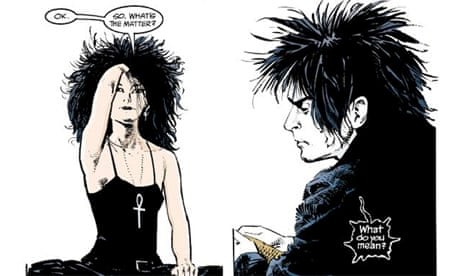
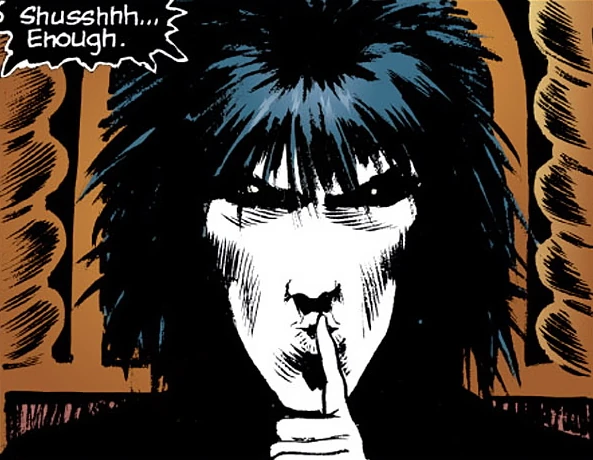
—Dream is a moody, emotional anti-hero who always rationalizes his emotional responses, even when they are mistakes. He is proud and unflinching, devoted to his own duty, but cannot exist in isolation, no matter how much he wants to—he needs other people, but hates that about himself. Self-centered and trying to be self-reliant, yet struggling because his situation and personality requires others. It’s a well-crafted character, but one I found somewhat boring because so many characters like him have come since this book. I’m used to this character in comics by now. His words are the main entry to his personality, for the reader. Though his mood often sets the tone in scenes as well.
—Death is a kind, caring woman who is strong willed and takes no crap from nobody. She does her job, but is able to handle it easily and still find time to take care of other priorities—like her emo brother Dream. Her humor and caring comes out in both her actions and her words.
—Delirium is a pendulum swing who trails off and shouts at the same time. She is determined at times, stubborn even, but also easily distracted and inconsistent. Her actions drive the reader’s understanding of her character.
—Destruction is the Heideggerian vision, where destruction necessarily means creation. For example: you tear down a house and you’ve necessarily created a pile of rubble. Destruction embraces this necessary pairing to the point that he leaves his realm and his duties behind. Other characters talking about Destruction explains him to the reader.
—Desire is neither male, nor female. It is conniving and antagonistic, while being exactly what some characters think they need. It lives in a biological mansion, and in that way it is our animal instincts writ large. It’s trappings are what explain it to us.
—Fiddler’s Green is old fashioned, in the sense that he knows his place and he does his best to do his little duty and expect nothing more or less. He is chivalrous. But he also has hidden dreams that he tries to fulfill—how he is to die, living like a mortal, or protecting weak people from attack. His desires and wishes, as stated by him and done by him, draw him out of the page into a full personality.
—In this way, you can see that he creates his characters with conflicts, and uses various methods to communicate that to the reader. Very simply, the tactic here is that the more screen time a character has, the more conflicts they have. But in addition to this, most of the characters have their own, distinct voices—and that’s astounding to me because of the sheer number of characters. Gaiman does a great job bringing them all from cliche to personality and a large part of that is his ability to write dialogue that fits each character well. In books, I consistently notice and appreciate authors who do this, and Gaiman hits it out of the park. It may be made easier for him because of who his characters are: his ability to draw on cultural assumptions about Loki, or Lucifer, so that he doesn’t have to delve into too much backstory that could bog the whole thing down. But part of it is his subverting these known characters and tropes in ways that are unusual and fresh, bringing new insights to old myths.


3. But more than the characters themselves, what really drove my first reading, what got me the most excited, was how complex their webs became. None more so than a mortal initially introduced as simply another of the short vignettes, Rose Walker, who ends up being integral to Dream’s own story and eventual death. This one situation is simply a single example of what Gaiman does throughout that makes it feel like nothing is forgotten, nothing is dead space, and even the breathing spaces may later become important.


4. And that’s how the story is built: this overarching story about Dream and his family, but consistently touching on shorter vignettes of specific characters, situations, and ideas. These short pieces don’t always grow to affect everything else directly, though they usually echo eventually. But some of these short parts are just that: short scenes meant to reinforce or introduce an idea that Gaiman will play with for a while. They’re both breather interludes, and integral parts of his exploration of ideas, and that’s why I can’t just call them interludes—the word doesn’t fit. The pacing may be inconsistent because of Gaiman’s constantly shifting focus—action stories, philosophical or spiritual ideas, and character drama all take center stage at various points. Yet the pacing never really annoyed me. I was willing to shift with Gaiman as he shifted emphasis. And that’s because I know the web he weaves here is worth it. There is payoff, and I’ve seen it over and over again. Things are not often forgot.


5. The theme uses mythology, the classics, the Bible, foreign cosmologies, and folklore interchangeably, placing most in Dream’s realm, but others as powers of their own. It’s hard to nail down a specific theme because Gaiman touches on so much, but the most apparent one to me is duty. Sure, he deals with death, love, and the nature of reality extensively, but I think it’s duty that drives the story, that is the base the rest of these themes are built on or relating back to. For instance, he is denied love of multiple women because of his adherence to his duty. His death is only important to him so far as it relates to his duty. And his duty deals directly with the nature of reality. Gaiman shows a few examples of duty throughout—Destiny is probably more addicted to his duty and Dream, but Death, Destruction, and really all the characters have their own relationship with duty. Death’s relationship with duty seems the healthiest, while Despair or Dream seem to have the most struggle with fulfilling theirs. But by giving numerous examples, Gaiman shows the effects of various devotions to duty. Let me be clear that devotion here is not a bad thing—some devotion is necessary. But too much devotion is still too much. And that plays out with the descent of Dream.


6. In all, this is a stunning work. It’s slightly inconsistent in pacing and my interest in each character is also varied. But at seventy-six issues, it’s long enough that I’m pretty sure something will hit for any reader in this massive book. And it’s not a bunch of issues with little to no dialogue—like an Alan Moore book, words fill the panels here. It took me maybe a month to read it all. It does everything I love about fiction well—good dialogue unique to every well-built character, a complex web of a story tied up with an overarching discussion but digressive at length with echoing discussions about the implications of the central theme on other themes, opinionated about philosophy and armchair anthropology with situations that reinforce the explorations or arguments, and using the format to its strengths instead of adhering to the last-page reveal and twenty-four page format. This is a tour de force and it’s easy to see why it became such a touchstone—despite being introduced to comics much after this seminal work first came out. I am surprised by how much I like this book because of how much I dislike Gaiman’s prose efforts. In many ways, I work towards writing a work like this someday. And I look forward to rereading this.