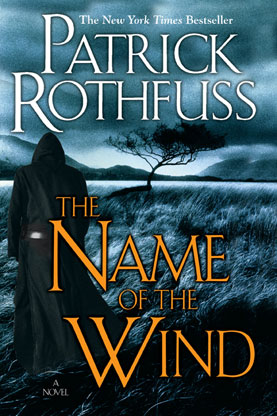
The fiftieth posted set of notes on this blog.
For Isaac and Garrett.
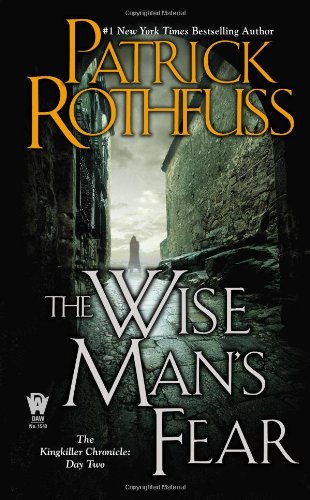
1. So much sex. It felt like twenty percent of this novel was sex-scene. Three explanations spring to mind right off the bat: two pessimistic and probably wrong, one optimistic and probably right. First, perhaps Rothfuss was disappointed winning young adult literature awards for the last book, The Name of the Wind, and wanted to separate himself from that potential pigeon hole, so he added sex. Second, his audience grew four years since the last book, putting those young adults into puberty by now, and sex sells. These two pessimistic potential reasons are far from the simplest explanation though: it seems Kvothe is now 16, and sex is certainly a thing at that age. I believe this third reason, though there is still a lot of sex in this novel.
2. But Rothfuss writes the sex well: it lacks both sensationalism and stuffy moralizations. It’s not explicit, like George RR Martin is, but nor is it lightly implied and unconfirmed. He strikes a balance between the two that allows the sex to teach Kvothe much about himself, others, the world, history, the Fae, and morality. What I mean is that Rothfuss doesn’t moralize the sex, but through sex, Kvothe understands better how to treat other people and himself, how to do so morally—even in the differing morals of the different places and people he encounters. I want to say that he treats sex like he does magic and music, and mostly that’s true. It’s just that first sexual encounter with Felurian that potentially betrays that treatment. But even then, it’s treated like the first time Kvothe discovers his own music next to the pool in the forest, and his first sympathy in Ben’s cart. So yeah, the sex is treated like magic and music. It’s well done.
3. Rothfuss’ writing improves here: his sentence structures are slightly more complex, and he broadens the vocabulary he uses. This improvement is slight, but marked. It raises the quality from legible to readable—readable in the sense that I’m not constantly substituting words while reading it because I’m bored by his word choices, like I was in the first book. These minor changes increase the quality of the writing a lot. It’s a small change that makes the book much more enjoyable.
4. The improvement to the writing is necessary because this book is 1,000 pages long. If the writing hadn’t improved, this would’ve probably been a slog. One thousand pages is a long novel. Rothfuss uses 152 short chapters, averaging 6.54 pages per chapter. This is dangerous in that the short chapters break up the writing so much that it could feel like I’m constantly starting and stopping as a reader. By contrast, Martin uses long chapters to break up his long books: each is basically a short story. Here, each chapter is not short story: something happens in each chapter, something distinct, but it’s not quite as deep as a short story. Because Martin jumps around between characters in every chapter, he needs the longer chapters for supplementing his character building and making each chapter memorable so that when the book returns to that character a few chapters later, he doesn’t have to refresh the reader’s memory and slow down the story telling. Here Rothfuss sticks to Kvothe and keeps the story rolling, explaining even the travels between spaces in order to keep the focus on Kvothe’s story. It works for him with these short chapters.

5. Speaking of storytelling, Rothfuss is on fire here. Instead of a typical novel structure of one major crisis being built up, happening, then resolving, this is the story of Kvothe. He goes through many crises, resolves them, and then the novel stops. This isn’t a negative, because each portion of the book—college, Maer, bandit hunt, Fae, Adema, and college—are all self-contained novellas. In essence, this book is six novellas put together. Yet they’re all interconnected so closely that this novel works very well and the edges of each portion bleed into the next—most apparent at the end, when he returns to college and the story of his deeds in the other four portions catch up with him. This serial structure shows the novel's kinship to any series of short pulp fiction novellas. It could seem meandering if Kvothe didn't change from all of these experiences, but because he does, the novel is tight and a quick read.
6. As a character, Rothfuss shows and tells Kvothe well. The writing strikes a fine balance between showing Kvothe’s actions and reactions, and explaining Kvothe. One of Rothfuss’ tactics is borrowed from pulp fiction: he tells the action without letting the reader know the why, then explains it later. For instance, when Kvothe kills the troupe, it’s unclear to the reader what he thinks, why he’s angry. It feels very out of character for Kvothe and the novel, which is more violent than the first, but not as violent as most speculative fiction novels. But after the deed is done, the reader is let into Kvothe’s mind to justify his actions. This tactic let’s Rothfuss explain the killing in a chilling way, then explains Kvothe’s thinking and actions. In essence, this sets the reader at odds with Kvothe, makes them wonder why he is killing his family members, then explains it all away by showing what Kvothe knew that the reader didn’t—namely that this troupe wasn’t Edema Ruh. This tactic works because the payoff is quick in coming, not held from the reader for chapters and chapters. Rothfuss tells a story well, and he tells this one particularly well.
7. The theme of this novel is embracing the unknown, unknowable, and risk to gain knowledge and experience, but not being stupid about it. Kvothe doesn’t rush into battle against long odds, screaming and waving his arms. Rather, he plans and takes care and minimizes his risk, but still embraces the unknown to understand some known. Like when the element of surprise is lost in the bandit ambush, Kvothe makes the best of a bad situation, limits his exposure, but certainly has embraced some exposure just being there. A simple theme, sure, but supported well throughout the novel. This simplicity keeps the focus on the storytelling, as is appropriate for this book, which focuses everything on the storytelling.
8. As Garrett and I talked about this book, he brought up a point I wanted to write down for my own records: the past storyline is from Kvothe’s point of view moreso than many other first-person novels. For example, Devi is fairly one dimensional when introduced, but as the story progresses she gains more depth, especially here in the second book. This is because Kvothe understands more and more about her as time goes on. Kvothe is young and misunderstands people, categorizes them too rigidly on first meeting. But as with Denna beforehand, his understanding grows more accurate and wrinkled with more encounters. Kvothe is telling this story, so it makes sense that we only have his perspective on these characters he comes into contact with. This is initially off putting, making the characters seem one-dimensional on first meeting, but the payoff of seeing the characters grow more complex helps immensely to create reader’s trust in Rothfuss. The way he keeps everything so tightly focused through Kvothe’s perspective strongly supports the focus of the book being squarely on Kvothe's story.
9. In all, I found this book enjoyable, more so than the first. I think the pacing is perfect here, the writing improved, the characterizations more complex. I found the structure intriguing and appropriate to this biographical tale. The present storyline interludes continued to support the overarching mood of tragedy. I’m still curious about the story, and more so now. I look forward to the third book, and hope his writing improves even more.
Showing posts with label Kingkiller Chronicles. Show all posts
18 January, 2016
The Wise Man's Fear by Patrick Rothfuss
Labels:
2011,
Fantasy,
Kingkiller Chronicles,
Patrick Rothfuss
05 January, 2016
The Name of the Wind by Patrick Rothfuss
For Isaac and Garrett.
1. Rothfuss tells this story mostly well. The story is interesting, with a satisfying number of things going on. Each chapter adds to some part of the narrative. There are various interesting characters and experiences. But some aspects feel like a foregone conclusion. For instance, the main character makes a few claims that things don’t work out like they do in a story—but they totally do here: Denna’s attraction to Kvothe surprises nobody except Kvothe; Kvothe’s slaying of the cow-beast thing works just like it has a hundred times before in books; everytime Kvothe is down to his last penny, some stroke of luck grants him reprieve from starvation. These lucky breaks annoy me a bit, as do his wry observations about storybook tales being constantly undermined. However, they manage to stay just this side of deus ex machina: the beast being killed accidentally and costing Kvothe much more than he anticipated, getting a whole silver talent as a beggar then getting it beat out of him, running into and losing Denna again and again. Rothfuss keeps the tale from relying too much on deus ex machina, but still manages to weave some surprise into the novel. This is done passably, but in all, the story is pretty good. I enjoyed it and it certainly kept me reading. It was exciting without a big body count, and that’s refreshing.
2. The structure of the story is pretty interesting. There are two timelines going on: the present-day and the past. In the present, the area Kvothe lives in is nebulous and torn apart by wars and weird creatures, while in the past the tale shows young Kvothe growing up. I assume that at the end of the third book, these two storylines will meet. But this allows Rothfuss to drop hints and foreshadow heavily. For instance, we know at one point that Kvothe will kill a king, get expelled from the University, and lose Denna irrevocably. But at this point, we don’t know why or how or when any of this will happen. This helps add to the way the book keeps me reading. The heavy foreshadowing shows this book for what it is: pulp fiction. But the structure is interesting and really works well.
3. Rothfuss even foreshadows that the tale is switching from present to past and staying there for a long time in the way Kvothe warns Devan that the tale will take three days to tell. This switch is a real risk for the author. It occurs around twenty percent into the book and it’s a major shift: basically restarting the book with new characters in a new place, changing the tone entirely, and not referring back to the present day world he’s already built explicitly. This is a real risky point where Rothfuss could’ve lost the reader easily, but he uses three pages to explain Devan’s appointment and Kvothe’s unwillingness to adhere to Devan’s time schedule. This explains to the reader what is coming. From there, the narrative is mostly in the past, with brief interludes into the present timeline. It’s well done.
4. Unfortunately, the writing is poor. Well, that’s not entirely fair. The writing is fine, but it’s pulp fiction writing. This novel won an award for Young Adult literature and Rothfuss’ vocabulary is limited, but not overly so. He even tries his hand at a few interesting tactics: specifically some nice repetition and some consonance. So it’s interesting for me to read as an adult. But I can also see my teenage boy self liking it more than I did.
5. One area where he steps away from traditional pulp fiction is in his characterizations. Nobody is perfect, nobody is wholly evil. The Fae are humanized by Bast, while Denna has a crooked nose. She is the love interest and, as such, Kvothe looks at her through rose-colored glasses, but Kvothe’s friends point out that she is cruel and has a crooked nose. She’s not perfect, and neither is Kvothe, and that’s a positive for the story. It somehow feels more honest, even with the storybook aspects Rothfuss has in there.
6. The theme seems to be some sort of call to find the silver lining in everything. I mean, this seems to be Rothfuss’ conclusion most of the time. Kvothe decides to be satisfied with how much time he gets to spend with Denna. He is satisfied with his paltry rainy day fund while homeless. At college he isn’t satisfied with being banned from the Archives, but he finds ways to work with it and doesn’t let it eat him apart. His whole family is murdered and he finds a healthy way to deal with it—it even teaches him about other people in a very important way. I guess this list shows that the theme is more about how to handle what life throws at you and turn all to your advantage, no matter how small that advantage. It’s about the importance of turning a negative into a positive, owning your faults in the sense of learning from them and when to allow them, and keeping a positive attitude.
7. I have some friends who consider this their favorite book, and I can see that. I know I have said some critical things so far, but it’s a cracking read and a good book: very exciting without being overly violent for the built world, and it kept me reading way past my bedtime. It has enough going on, enough threads to keep me reading. Being interested in the story and world from reading this book, I will be immediately reading the next one. This one is a good book.
1. Rothfuss tells this story mostly well. The story is interesting, with a satisfying number of things going on. Each chapter adds to some part of the narrative. There are various interesting characters and experiences. But some aspects feel like a foregone conclusion. For instance, the main character makes a few claims that things don’t work out like they do in a story—but they totally do here: Denna’s attraction to Kvothe surprises nobody except Kvothe; Kvothe’s slaying of the cow-beast thing works just like it has a hundred times before in books; everytime Kvothe is down to his last penny, some stroke of luck grants him reprieve from starvation. These lucky breaks annoy me a bit, as do his wry observations about storybook tales being constantly undermined. However, they manage to stay just this side of deus ex machina: the beast being killed accidentally and costing Kvothe much more than he anticipated, getting a whole silver talent as a beggar then getting it beat out of him, running into and losing Denna again and again. Rothfuss keeps the tale from relying too much on deus ex machina, but still manages to weave some surprise into the novel. This is done passably, but in all, the story is pretty good. I enjoyed it and it certainly kept me reading. It was exciting without a big body count, and that’s refreshing.
2. The structure of the story is pretty interesting. There are two timelines going on: the present-day and the past. In the present, the area Kvothe lives in is nebulous and torn apart by wars and weird creatures, while in the past the tale shows young Kvothe growing up. I assume that at the end of the third book, these two storylines will meet. But this allows Rothfuss to drop hints and foreshadow heavily. For instance, we know at one point that Kvothe will kill a king, get expelled from the University, and lose Denna irrevocably. But at this point, we don’t know why or how or when any of this will happen. This helps add to the way the book keeps me reading. The heavy foreshadowing shows this book for what it is: pulp fiction. But the structure is interesting and really works well.
3. Rothfuss even foreshadows that the tale is switching from present to past and staying there for a long time in the way Kvothe warns Devan that the tale will take three days to tell. This switch is a real risk for the author. It occurs around twenty percent into the book and it’s a major shift: basically restarting the book with new characters in a new place, changing the tone entirely, and not referring back to the present day world he’s already built explicitly. This is a real risky point where Rothfuss could’ve lost the reader easily, but he uses three pages to explain Devan’s appointment and Kvothe’s unwillingness to adhere to Devan’s time schedule. This explains to the reader what is coming. From there, the narrative is mostly in the past, with brief interludes into the present timeline. It’s well done.
4. Unfortunately, the writing is poor. Well, that’s not entirely fair. The writing is fine, but it’s pulp fiction writing. This novel won an award for Young Adult literature and Rothfuss’ vocabulary is limited, but not overly so. He even tries his hand at a few interesting tactics: specifically some nice repetition and some consonance. So it’s interesting for me to read as an adult. But I can also see my teenage boy self liking it more than I did.
5. One area where he steps away from traditional pulp fiction is in his characterizations. Nobody is perfect, nobody is wholly evil. The Fae are humanized by Bast, while Denna has a crooked nose. She is the love interest and, as such, Kvothe looks at her through rose-colored glasses, but Kvothe’s friends point out that she is cruel and has a crooked nose. She’s not perfect, and neither is Kvothe, and that’s a positive for the story. It somehow feels more honest, even with the storybook aspects Rothfuss has in there.
6. The theme seems to be some sort of call to find the silver lining in everything. I mean, this seems to be Rothfuss’ conclusion most of the time. Kvothe decides to be satisfied with how much time he gets to spend with Denna. He is satisfied with his paltry rainy day fund while homeless. At college he isn’t satisfied with being banned from the Archives, but he finds ways to work with it and doesn’t let it eat him apart. His whole family is murdered and he finds a healthy way to deal with it—it even teaches him about other people in a very important way. I guess this list shows that the theme is more about how to handle what life throws at you and turn all to your advantage, no matter how small that advantage. It’s about the importance of turning a negative into a positive, owning your faults in the sense of learning from them and when to allow them, and keeping a positive attitude.
7. I have some friends who consider this their favorite book, and I can see that. I know I have said some critical things so far, but it’s a cracking read and a good book: very exciting without being overly violent for the built world, and it kept me reading way past my bedtime. It has enough going on, enough threads to keep me reading. Being interested in the story and world from reading this book, I will be immediately reading the next one. This one is a good book.
Labels:
2007,
Fantasy,
Kingkiller Chronicles,
Patrick Rothfuss
Subscribe to:
Posts (Atom)