Showing posts with label Roger Zelazny. Show all posts

17 February, 2016

Damnation Alley by Roger Zelazny


1. This novella steps out of the normal mode of Zelazny, or at least the mode of the last three books of his that I read—Creatures of Light and Darkness, This Immortal, and Lord of Light. Creatures tells a story with many characters and few explanations, This Immortal mixes dreams and reality but explains much, Lord of Light starts halfway through the story and then backtracks—while Damnation Alley tells a straight adventure, start to finish. Hell Tanner, yes his first name is Hell, drives from LA to Boston, carrying the cure for the plague eviscerating Boston. But this is a post-apocalyptic America, twenty-five years after an atomic war. He faces radiation, rough terrain, giant gila monsters, big bats, evil humans, storms that drop boulders and fish from the sky, and himself. It’s paced well and reads quickly. In other words, this is pulp fiction, and that’s unusual for Zelazny.


2. But it’s not entirely pulp fiction. Hell contemplates his own actions and place in the world, questioning his past life and wondering what comes next. This isn’t moralizing because Hell doesn’t go in for that, but it is turning a new leaf. He begins resisting changes, yet throughout the novel he changes, or realizes things about himself that he’s hidden from himself. The road, I’m sure, the solitude, his time in prison, the adrenaline and boredom—Hell finds out all about Hell. Hell actually feels bad a couple of times, for others, and this is a big change from the Hell the novel opens with. And I think that’s the theme here: at the end of the day, we still have to live with ourselves. It seems perhaps a little obvious in a post-apocalyptic tale, but I see this theme in Hell throughout as well, so to me it is the most apparent theme. However, it doesn't take up much space within the book. Of course, the theme of anti-nuclear war also pervades: this isn’t a glorification of the post-apocalypse, it tends towards a dark existence.


3. The writing doesn’t disappoint, but it also doesn’t thrill as much as in Lord of Light or Creatures. Here it’s refreshingly simple—Raymond Chandler-esque, rather than his typical poetic sentence structures and word choices. It moves the reader, but along such familiar, well-tread paths of adventure that the writing is not good for being groundbreaking, it’s good for perfecting the pulp voice—like Chandler. I just opened to a random page and started this next quotation anywhere to give you an idea of the writing; it occurs as Hell is driving past a hot crater:
He hurried. And he wondered as he sped, the gauge rising before him: What had it been like on that day, Whenever? That day when a tiny sun had lain upon this spot and fought with, and for a time beaten, the brightness of the other in the sky, before it sank slowly into its sudden burrow? He tried to imagine it, succeeded, then tried to put it out of his mind and couldn’t. How do you put out the fires that burn forever? He wished that he knew. There’d been so many different places to go then, and he liked to move around.

What had it been like in the old days, when a man could just jump on his bike and cut out for a new town whenever he wanted? And nobody emptying buckets of crap on you from out of the sky? He felt cheated, which was not a new feeling for him, but it made him curse even longer than usual.

He lit a cigarette when he’d finally rounded the crater, and he smiled for the first time in months as the radiation gauge began to fall once more. Before many miles, he saw tall grasses swaying about him, and not too long after that he began to see trees.
This is great efficient writing. This efficiency doesn’t lack for beauty, where somebody like Asimov misses beauty consistently in his striving for efficiency. I really enjoy this book as a straight, efficient story that doesn’t disallow beauty.


4. The character of Hell is fairly standard Zelazny, according to the other three books of his that I have read. They all feature superhuman male characters as the lead, and so does this one. But this one is less superhuman, and he’s constantly questioning himself, which leads to him being more sympathetic to the reader. Aside from this, Hell is also an iconoclastic character, a badass who relies on violence and surprise to stay alive in a dangerous world. Yet he’s also a criminal turning more square. This creates an interesting tension that assists the straight plot in driving the story forward.


5. In all, I love this book. It reads quickly and beautifully. It tells the story and doesn’t worry about too many implications to distract or bore the reader through lengthy interior monologues, but has just enough introspection to keep the reader’s mind engaged. It is really good pulp fiction, not terribly complex, but paced well and with an interesting main character. This is the type of book that non-Zelazny fans would probably like—I think it has a much wider appeal than Creatures or This Immortal. Think Alfred Bester and Raymond Chandler—and what a combination that is here! This book was nominated for the Novella Hugo in 1968, but lost out to two books. If those are better than this, I’ll have to read them soon. [This ebook is currently available free until 1 March 2016.]

05 February, 2016

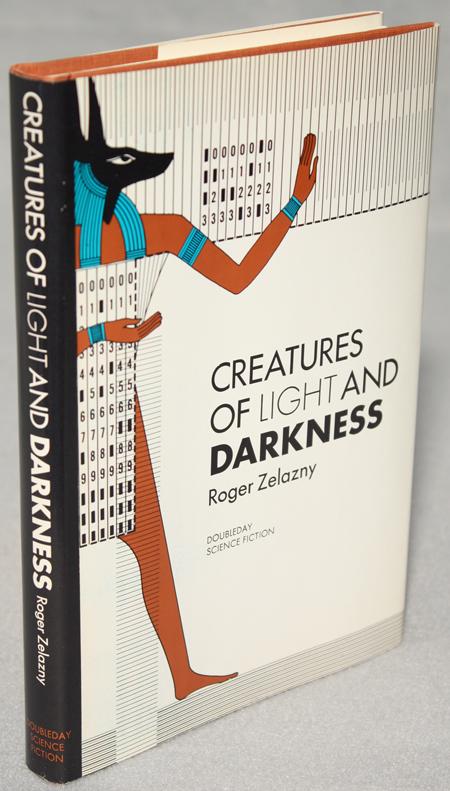
Creatures of Light and Darkness by Roger Zelazny


1. Zelazny’s storytelling appears messy and barely legible. This isn’t neccesarily a fault: David Lynch practices non-linear storytelling and gets away with it easily, in my book. So my question is not whether Zelazny’s storytelling is good or bad, it’s whether the puzzle he creates is worth it for the reader or not. Let me describe the storytelling first.
—Zelazny jumps around quite a bit: short chapters, a number of characters, and various places all contribute to this sense of jumping around. He also begins chapters with no introduction. There is almost no intro-info-dump in any chapter, and what little there is simply describes the environment of the scene to come. However, there are so many places involved in this novel, and Zelazny’s method of description is so mysterious that even these descriptions do little to increase reader comprehension. Chapters also follow different characters, jumping back and forth. And it’s not always clear which character is which right off the bat because of Zelazny’s descriptions. Again, I want to stress that mystery is not a negative to me. But Zelazny jumps around. He does appear to be moving linearly though.
—So what is Zelazny going for? Why the mystery? Options typically include: attempting to impress the reader with the author’s intelligence, trying to give the reader that “ah ha” moment partyway through the novel, poor storytelling, and attempting to win a certain audience by being mysterious. This novel seems like mystery for mystery’s sake—trying to attract and keep readers who like having their mind working while they’re reading. And it pulls this off.
—Does it pay off? I simply don’t know. I was personally left with a desire to have more understanding at the end, but I enjoyed the journey quite a bit. There’s something to be said for that, but I know a lot of people who would hate this book.


2. Zelazny’s mysterious descriptions rely on perception almost entirely. Zelazny warns the reader of the coming mysteriousness in the first lines of the first chapter:
The man walks through his Thousandyear Eve in the House of the Dead. If you could look about the enormous room through which he walks, you couldn’t see a thing. It is far too dark for eyes to be of value.

For this dark time, we’ll simply refer to him as “the man.”

There are two reasons for this:

First, he fits the general and generally accepted description of an unmodified, male, human-model being—walking upright, having opposable thumbs and possessing the other typical characteristics of the profession; and second, because his name has been taken from him.

There is no need to be more specific at this point.
This description tells us three things explicitly: the man exists, has no name, and is at his Thousandyear Eve; he is in the House of the Dead, which might be where he spent the last nine hundred and ninety-nine years; and Zelazny sees no need to be more specific yet. However, this isn’t much information, nor is it very illuminative to the reader. Who is this man? What is the House of the Dead and what is it made of? Where is it? Why are we following him? Why should specifics be left for later? How does he not have a name? Four of these six questions are answered later. I’m still unsure why specifics needed to be left, and I’m also unsure what the House of the Dead is made of. Throughout the novel, even explanatory descriptions continue to be focused on perception:
Listen to the world. It is called Blis, and it is not hard to hear at all: The sounds may be laughter, sighs, contented belches. They may be the clog-clog of machinery or beating hearts. They may be footsteps, footsteps, the sound of a kiss, a slap, the cry of a baby. Music. Music, perhaps. The sound of typewriter keys through the Black Daddy Night, consciousness kissing paper only? Perhaps. Then forget the sounds and the words and look at the world.

First, colors: Name one. Red? There’s a riverbank that color, green stream hauled between, snagged on purple rocks. Yellow and gray and black is the city in the distance. Here in the open field, both sides of the river, are pavilions. Pick any color—they’re all about.
This example shows Zelazny’s typical descriptive technique. He describes a perceived aspect of the thing in order to set the mood: here it’s a riot of colors and noises. But the descriptions are mysterious because Zelazny sticks mostly to showing. Sure, he later tells that Blis is busy and full of people, but at the time of the description, this riot of colors and life could be for many reasons: it could be a penal colony, a life-rich world, a place where people have loud voices and love colors, or Zelazny’s instruction to forget the sounds could signify that this world is lifeless, as if the people there have left. It’s open. He narrows it later, but initially all is left open. In other words, Zelazny relies upon showing instead of telling, and only uses telling when he needs to narrow the possibilities to hint at the plot: like when Anubis explains the function of the House of Life and the House of the Dead, or when Zelazny tells us that Blis is crowded. Confusing this is how Zelazny often dips into second person and tells the reader what he is showing them. In short, his mysterious writing supports the mystery of the storytelling and plot.


3. The characterizations are weak: there are a lot of main characters for only two hundred pages of novel: the Prince, the poet, the Steel General, the Witch, Magra, the Warrior Priest, Anubis, Osiris, a sentient dark horse shadow—you get the idea. Each secondary character also has goals that come into play, like the Minotaur and Cerberus. This keeps the novel busy, but doesn’t allow the characters to really be developed fully. This could be viewed two ways: either Zelazny didn’t build his characters well, they’re still two dimensional; or he is trying support the mystery of the plot through having all these characters and goals.


4. And the plot might be why Zelazny is so evasive in this novel: it’s a mythical mystery novel set in a science fiction world that takes the form of Egyptian Cosmogony. Both Horus and “the man” are sent forth to kill a man of many names who was once a Prince and nobody knows where he is. Certain characters are both brothers and fathers to each other due to time travelling. The plot is a mystery and the strangeness of the storytelling and descriptions and characters all feed directly into that, supporting the unknown and making it seem planned rather than random, despite the jumping storyline.


5. However, the writing is superb. I’ve given two lengthy examples already, and will only add that the quality continues throughout. Zelazny, with word choice and sentence structure, is continually interesting and beautiful. The writing breaks into poem at times. Repetitions are spread throughout the novel, and one is even explained. He’s a wonderful writer and that is why I enjoyed the novel as much as I did.


6. The theme here is difficult to nail down, with all this mystery. So maybe it is the mystery itself: maybe the theme is that the world and God both work in mysterious ways. God is referred to as that Whatever who may be or may not be. The mystery is probably the theme here: it exists and must be worked with to be successful.


7. I think I’ve given a good overview of what it’s like to read this novel: strange and mysterious and beautiful. And that’s about all I can say. I was enjoying myself so much that I read it in two sittings. But the novel is ambiguous and if you need to know what’s happening, this novel is not for you.

25 January, 2016

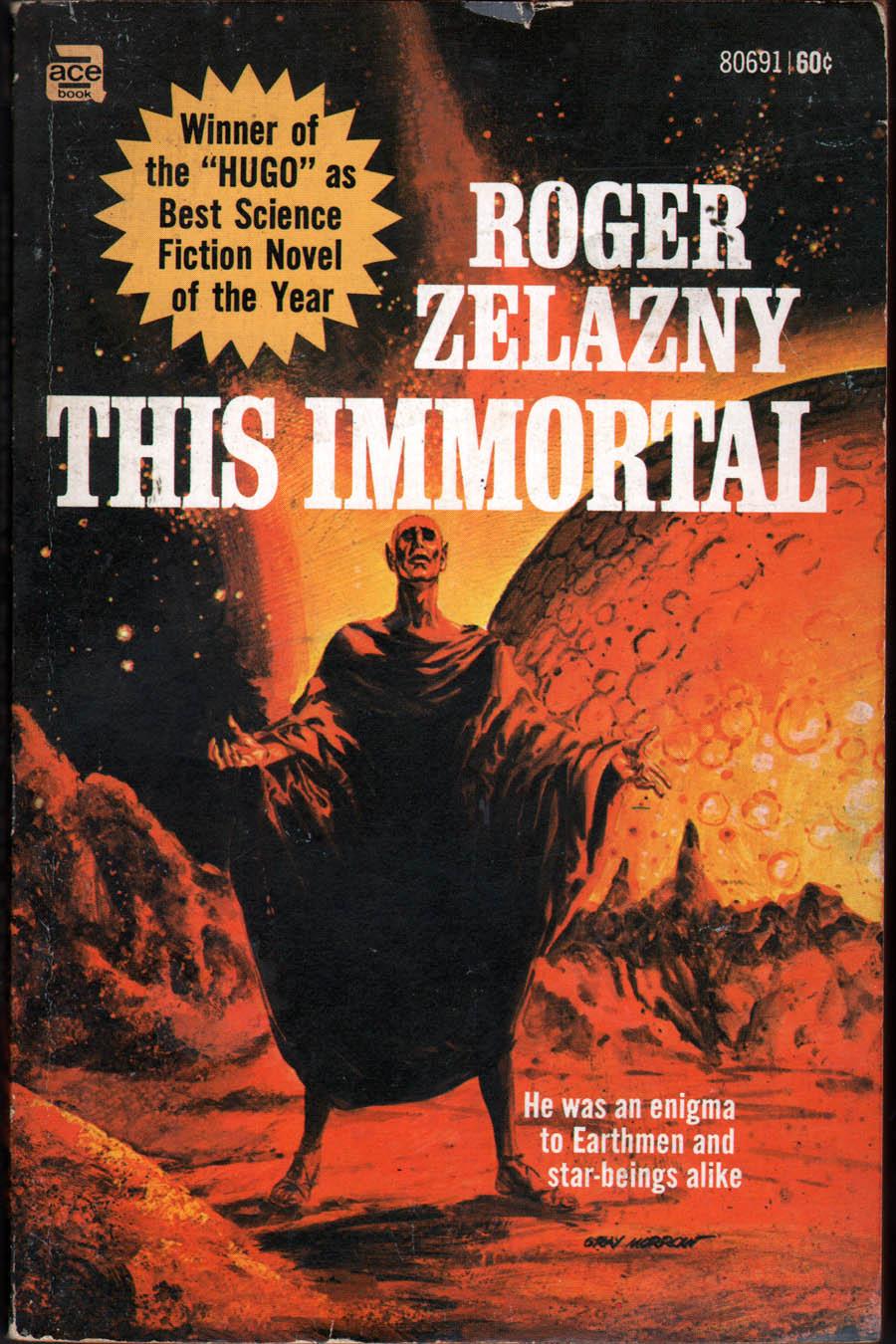
This Immortal (aka ...And Call Me Conrad) by Roger Zelazny


1. This book has a problem: it is referential to a fault. A lot of paragraphs draw parallels to a wide array of references—ancient Greek myth, contemporary 1960s culture, and pop cultural references timed between the ancients and the 1960s. These references are so thick that it easily loses the reader at times. But never for too long. Zelazny always shows what the references mean, rather than telling, yet the references are still too much. They bog the reader down with questions of what the references mean: there are simply too many of them to allow any reader to know all of them. This fault moderately reduces my enjoyment of the book.


2. The other problem is major and can be stated more simply: Zelazny is concise to a fault. The plot is threadbare and the wonderfully witty dialogue almost too fast. Things happen quickly with little or no set-up or rise in tension. This makes everything seem quick and perhaps unplanned. Of course, the last three events—the dead man, the hot spot, and the black beast—are foretold by Conrad’s son Jason. But Jason shows up out of nowhere, the cannibals show up suddenly, and the black beast appears and is beaten before it has any real impact on the story or characters. This fault massively reduces my enjoyment in the book. I wanted to really explore some of the plot points, exist in them for a time, and contemplate some of their ramifications. Instead, I’m left wondering what effect the hot spot had on Hasan; the black beast is a quick, simple battle and I’ve no idea as to its significance to the world at large; the pipe playing happens so fast with no real transition to allow me to properly place the characters. In other words, things happen so quickly I’m still a bit unsure what is dream and what is plot. There is a balance to grasp here, that Zelazny doesn’t: too slow and the reader gets bored, too quick and the reader gets lost, though between too quick and too slow exists a wide gray area of pacing that I enjoy. Zelazny moves too quickly and this book doesn’t hold me the way Lord of Light, Zelazny’s later book, did. This quickness also makes events seem like deus ex machina at times, which is a negative. If he adds something to the reader’s knowledge of the world, you can bet that within ten pages, that new element will come by to save the day.


3. Now that those two unpleasantnesses are dealt with, I can move on to why I enjoyed this book. First, the writing is superb. Zelazny strikes a perfect balance here between beautiful and efficient language that kept me engrossed and enjoying even the referential sentences I didn't understand at all. I loved Zelazny’s writing here, full of consonance and internal rhyme, but not over the top. He also uses a lot of analogy to say things. One example is that the two shots of the elephant gun at the end are likened to the thunderbolts of Zeus. This analogy wonderfully keeps the mood of myth and mystery, while being a worthwhile description of what actually occurred.


4. Second, the characters are engrossing and distinct. Though the book tends towards quickness, ending up more a novella than a novel, the characters are well developed mostly through dialogue, but also through sparse use of Conrad’s psychic power. Zelazny uses dialogue to build the characters, rather than extensive backstory or an omniscient narrator’s description. The book takes the form of Conrad looking back on these experiences, telling them to the reader from his point of view. This let’s Conrad’s exposition of the characters really focus on the dialogue and actions of the others.


5. Third is the plot—it’s both a post-apocalyptic tale and a post-contact story. This combination seems odd conceptually, but Zelazny ties them together enough that my imagination runs wild. Again, the quickness steals some of the satisfaction I should feel at these two tales being woven together well, but there is enough in there that I greatly enjoyed the plot and the implications for planet Earth.


6. The main character is Earth, not Conrad. That’s really the whole gist of the book—what happened to Earth, what it’s like in the book, and the potentials it's left with at the end. This ties into the theme of adaptation. I don’t mean that in the ecological sense too deeply—to me the theme centers around Conrad adapting his tactics to fulfil his goals, and modifying his goals as a necessity. For instance, in the past Hasan, Phil, and Conrad bombed islands and killed the alien invaders in an attempt to galvanize a return to Earth by ex-patriots. However, they both realize that will never work and change their tactics. Phil becomes the consummate socialite, helping to establish and preserve a reason for some to stay on Earth. Conrad becomes a governmental official, helping to distinguish Earth as a unique entity—Earth for Earth’s sake, with all the warts and boils inherent in it. They both have changed to continue attempting to accomplish their goals of making the world better for humans. Their goals also change by abandoning the naive hope to work against the aliens, realizing instead that alien power and influence necessitates working with them. This adaptation requires a realistic appraisal of the situation and some deep changes in the characters. But they end up being successful only by subduing their earlier impulses for bloodshed: they destroy their earlier efforts in order to create a new balance.


7. This book is a wonderful read, partly because it is so short. Any longer and the quickness with which it dispatches plot points would’ve been overly trivial. The characters are strong: Conrad is a superhuman anti-hero, as is Hasan; Earth is a vibrant and damaged, the damage adding to the diversity and vibrancy; George the single-minded scientist; Ellen the socialite flitterer; Red the neophyte of a past iteration of Conrad. What little plot there is grips the reader and provides abundant space for the reader to fill in the blanks and spin their imagination to fantastic places. It’s all a single chapter, start to finish, and Conrad follows the action pretty closely. A worthy read, but not great. This shared the Hugo for best novel in 1966 with Dune, which is a better novel to me. But for a novella, this book is fun—especially the writing; for that writing I will forgive a lot. The novella category was added to the Hugo awards in 1968.

20 September, 2015

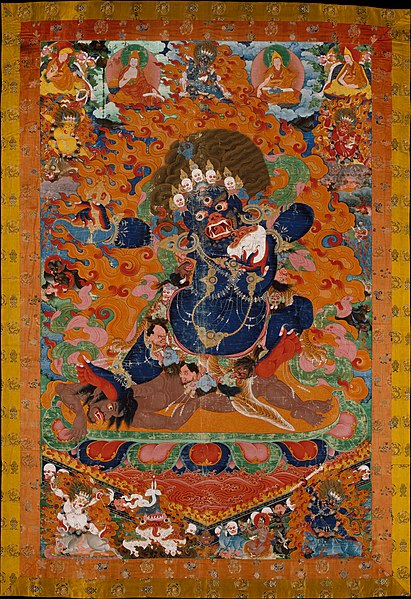
Lord of Light by Roger Zelazny


1. The coolest thing Zelazny structurally does is to make Sam fail constantly. Sam shoots from the hip an awful lot, and mostly misses: he frees the demons and becomes possessed, he attempts to steal the thunder chariot and gets taken captive, he battles the gods and loses—there are more examples. Though Sam loses battles, he messes up in ways that he can turn to his benefit: by being possessed, he befriends the demon; by being captured, he has opportunity to proselytize the gods; by battling the gods, he sews doubt in their minds and in man's. He takes what comes to him and finds any advantage to draw from it. This isn't a pulp trick though: it's not John Carter falling while fighting, then sitting and stewing until some deus ex machina frees him, then going straight back to the fighting. Rather, Sam risks and loses, but makes the most of it, turns it to his advantage in a way that doesn't rely on hitherto unknowns or outside forces, but through the characters themselves in an honest way, not shying away from what would be a corner a lesser writer would've written themselves into. Something is lost and something is gained. Afterwards, instead of sticking to the same plan in the same way and trying again, that plot element is concluded and Sam moves on. This tactic of Zelazny's is subtle, but a big difference. This is not cheap storytelling. It comes off sophisticated and complex. Brilliant. (Though a counterpoint would be the mother of the glow, which is a deus ex machina)


2. The world building inspires awe. Zelazny starts right in with the characters in the world. He stays with them throughout. It's all the characters, and through them the world-building happens. For instance, in the opening of the book Yama operates a prayer-machine. The reader has no clue what a prayer-machine is other than the clue the name itself gives. This machine and the way the characters interact while using it gives a sense of the world. He doesn't stop the action to explain the technology, but he does give the basics: what a machine does, why the character is using it, and some context of whether the machine is for mortals or gods. These explanations arise naturally, are not overly wordy, and are not overly complex—they only give one more layer to the depth of the technology, keeping the focus on characters and plot and ideas while intruding as little as possible into the narrative. Some of these explanations arise in dialogue, as does much of the fictional history: two characters referencing a shared experience while introducing it to the reader. This is how the world-building is accomplished: the focus stays on the characters, goals, and actions rather than the technology or traditional world-building by narrator. With the prayer-machine, which is quickly explained, he builds trust in the reader, and I trust him to explain things as needed from there on. By not intro-info-dumping, he draws out the world building throughout the novel, which keeps the reader discovering new ideas. By the end I have a great sense of the world. Again it's not cheap or pulpy, but incredibly sophisticated: he focuses on the characters and uses them to build the world naturally and slowly. He doesn't use this tactic to excuse any deus ex machina later. (Except the mother of the glow)


3. But the structure isn't all perfect, unfortunately. That ending drags on in a way that feels like Zelazny lost his path. It's longwinded and introduces new characters and continents in a wild proliferation of plot threads spreading out and too heavily indicating a sequel, which was never written. Six and a half chapters of this novel are structured perfectly, while half a chapter drags.

4. The main structural risk is starting in the middle, then backtracking to another starting point in the past, then surpassing the original starting point to an ending point in the future. This works, but I think it could have been a bit more clear. I initially missed it and was quite confused for a couple of paragraphs.

5. I had a hard time keeping some of the minor characters straight. Because everything flows so well and keeps on moving without major pauses, some of the characters are not clear before the tale moves on, causing minor confusion. Plus, each character has so many names. Their myriad-names convey the serial nature of their mind transfers, sure, but also obfuscate who is who.


6. The novel happens in stages of action and reflection, attempting to meld the two and mostly succeeding. What I mean is that a lengthy action passage will be followed up by a lengthy passage where not much physically happens, but it reflects on the action that just occurred and the action that is about to occur. The novel is almost a 50-50 split of reflection and action, which fits the setting and themes well.

7. It's refreshing to have any author treat another culture this fairly: he is not stereotyping, he's writing complex and conflicted humans who happen to be Hindu, Buddhist, or Christian. Indian themes run through the novel, but never feel like cheap window dressing. Instead I came away with a sense that Zelazny embarked on a truly massive research project before writing this. He method-writes this, inhabiting parts of the culture to tell this tale.


8. The broad writing tactic mixes science fiction story with fantasy word choices, descriptions, and sentence structures. I wouldn't have thought this possible to this level of success. But Zelazny pulls it off, effectively embracing and illuminating the fantastic inherent in science fiction. He also allows that fantastic and utter incomprehensibility to cause the writing. All things are described as mythical, through deeply paradoxical, incantational, and mystical language. It's a gripping voice. Let me give four examples:
His followers called him Mahasamatman and said he was a god. He preferred to drop the Maha- and the -atman, however, and called himself Sam. He never claimed to be a god, but then he never claimed not to be a god. Circumstances being what they were, neither admission could be of any benefit. Silence, though, could.

The high-frequency prayers were directed upward through the atmosphere and out beyond it, passing into that golden cloud called the Bridge of the Gods, which circles the entire world, is seen as a bronze rainbow at night and is the place where the red sun becomes orange at midday.
"I shall tear these stars from out the heavens, and hurl them in the faces of the gods, if this be necessary. I shall blaspheme in every Temple throughout the land. I shall take lives as a fisherman takes fish, by the net, if this be necessary. I shall mount me again up to the Celestial City, though every step be a flame or a naked sword and the way be guarded by tigers. One day will the gods look down from Heaven and see me upon the stair, bringing them the gift they fear most. That day will the new Yuga begin."

The day of the battle dawned pink as the fresh-bitten thigh of a maiden. A small mist drifted in from the river. The Bridge of the Gods glistened all of gold in the east, reached back, darkening, into retreating night, divided the heavens like a burning equator. [...] There were no clouds in the heavens. The grasses of the plain were still moist and sparkling. The air was cool, the ground still soft enough to gather footprints readily.
This writing is simply fun to read. The names also contribute to this wonderful voice. Zelazny avoids overwhelming the readers with made up, pseudo-historical names by using familiars like Buddha and Shiva, but also by using explanatory names: Lord of Light, God of Fire, Garden of Joy, Purple Grove, etc. These explanatory names are perfect: they both explain and give a sense of the importance that calling a city Keenset doesn't have without the further explanation of Keenset's technological advance and the battle. For instance, Purple Grove implies that it's unique and tells what's unique about it in the same breath. Zelazny's voice here is stunning.


9. The theme is traditional versus advancement, old versus new, the powerful few versus the powerless many. From the very start, with the prayer machine, the reader begins to get a sense of this theme. And all throughout, this theme is drilled home by the plot, the dialog, the monologue, and the setting. The demons are a powerless many, yet they still threaten Sam. Sam fights the gods, not by brilliant battle, but rather by shifting the rules of the game to favor the many, the new, advancement. The theme runs through this entire novel, influencing every word. It's a fascinating look at a space colony gone native en masse, at how pinched resources can affect a whole planet of people and their social structures, at how adopting a pose eventually causes your face to stick that way. It's engaging and has a satisfying depth.