20 November, 2018

The Ringworld Engineers by Larry Niven


Niven returns to the ringworld with information gathered from enthusiastic MIT students who had studied the orbital mechanics of the structure and found that its rigidity meant it didn’t actually orbit the sun, and would instead be unstable and fall into the sun if it got off its path. If that doesn’t excite you, I probably would recommend skipping this book. It’s not quite more of the same, from Niven’s Ringworld series, but it’s certainly similar. It leaves me questioning why I read this book. Not why should anybody read this book, but why did I?
Chmeee snarled, “How much intelligence does it take to sneak up on a leaf?” He flipped the droud to Louis and shambled toward his water bed.

I guess I read this book out of curiosity. I like Science Fiction. I don’t consider this a great book, but it’s good science fiction. It’s obsessed with ideas, and these ideas drive the story: evolution from a common ancestor based on environmental niches that hominid species can fit themselves into; Louis Wu and company arriving as an Excession and trying to discover the truth behind the myths of these regressed peoples; the ringworld falling into the sun. This last is the true focus of the novel, and what most of the novel deals with directly. Niven tells an engaging story about three people trying to save the ringworld from wobbling in its track and falling into the sun. So, it’s an exploration and adventure tale, with a standard linear narrative--though there is at least one flashback here. And I am entertained. Further, this unrelatable idea of a ringworld interests me in a way. It’s a sort of mental puzzle box--the idea seems so fantastic that seeing the shortcomings takes some time.
He was on the flight deck, speaking via the intercom system; and that might or might-not have been significant.

But my main problems with the novel are brought about by social issues that are mentioned but not explored in any illuminating depth. In the same way that Niven uses hard science fiction themes as points to hang the story off of, he also uses social themes like pregnancy free sex (as negotiation method and currency both), electronic drug addiction, insanity, the inevitability of death, kidnapping and slavery, different cultures and species working together or not, etc. But he simply states these social issues and then drops any further exploration of them. The exploration by Louis Wu of this ringworld take center stage, and everything else is a dropped ball. That’s frustrating to me, as the novel raises some interesting issues before rushing past to further pursue the story of righting the ringworld’s wobble.
She stood. “Shall we indulge in rishathra?”

Louis had been expecting that, a little, and it wasn’t Laliskareerlyar’s odd appearance that made him hesitate. It was the terror of taking off his armor and his tools. He remembered an old sketch of a king brooding on his throne. I’m paranoid. But am I paranoid enough?

In Ringworld, Louis Wu slept with every female character in the book. And here, again, it’s mostly the same. He meets a bearded lady and sexes her. He meets a giant and sexes his wives. He gets followed by a librarian who sexes him. Etc. The quote above isn’t even from one of those sexual relations. It’s annoying that Niven doesn’t do anything with the sex, simply describes it and moves back to the adventure tale. Even John Carter of Mars did more interesting things with sexual relations, and that isn’t saying much at all. The sex is unnecessary to the story. The book is simply sex, violence, and a mystery. The violence always results from the mystery, the sex comes in the periods between the violence, and the mystery consumes as much of the book as isn’t sex or violence.
The sun was just past zenith in a nearly cloudless sky. An endless sunlit landscape stretched before them: ponds, groves of trees, fields of grain, and rows of dark green vegetables. Louis felt like a target. A coil of black wire was taped to his shoulder. Now he pulled it free and flung it away. One end was still attached to his suit. It would radiate heat if she fired now.

So, in short, I wanted to read more of an adventure tale that began with Ringworld, and this fit the bill. Without being the introduction of the concept, this novel leaves much to be desired. But I didn’t hate the book and can understand why fans of orbital mechanics in literature would love this book. It wasn’t for me. It’s not good writing, but it’s writing that gets out of its own way. It raises interesting social points then drops them in a way that feels like wish fulfillment. Some of the ideas are fascinating though, and I kept reading for those.

04 November, 2018

Ringworld by Larry Niven


This novel is Niven’s most famous work, but I’ve never been as enthusiastic about it as friends have. Perhaps that’s why I picked it up for a second read. The pacing follows a typical detective-adventure tale’s pacing: it starts somewhere fairly normal, then keeps veering in unexpected directions so that the goals of the characters rapidly shift. I mean, I know they’re just trying to get off of the ringworld, but first they try finding locals, then finding a spaceport, then surviving a trap, then setting another trap, then surviving an ambush, then letting one of their members go, then climbing a mountain a couple of thousand miles high, then escaping out a giant hole. These quickly shifting goals keeps the exploration party and reader on their toes. And it works as well as it ever has, you know? Dumas could’ve written this book for all the structural experimentation done by Niven, but Niven pulls it off well.
“Exercise is wonderful," said Louis. "I could sit and watch it all day.”

One of Niven’s strengths is that when you stop reading to think about the events, cause and effect help these crazy shifts in goals and situations make sense.
—For instance, the wire they need to haul their half-dead spaceship up the mountain and off the ringworld was what they originally ran into to chop their spaceship up and cause themselves to crash in the first place. This mostly saves the ending from accusations of deus ex machina.
—Another example: the exploration party is composed of four characters, three of whom have been manipulated by the other, the one who picked them. So their tension and anger fits well within their context of being hand-chosen by Nessus—unknowingly before the book starts with the fertility lotteries and starseed lures, and knowingly with the actual mission to the ringworld.
—Or Prill, who initially comes out of nowhere, but actually fits well into the larger context of ramscoop ships and the failure of ringworld civilization.
—Niven doesn’t explicitly hammer these cause-and-effect tendencies of his writing down the reader’s throat, but he does mention them briefly.
Gradually he was learning the size, the scale of the Ringworld. It was unpleasant, like all learning processes.

It’s a book of brief mentions: Niven’s writing style forsakes interior monologue and narrative explanations. He trusts the readers to pick up what he is putting down, even when he uses just a single sentence to change the context throughout the rest of the book. Most authors would use a paragraph or two explaining and restating why everything would be different. Not Niven. Niven is more likely to say something like, “Louis laughed, and Teela burst into tears,” instead of explaining why Louis’ laughter caused Teela’s tears. It’s a book that goes beyond trusting the reader’s intelligence in a couple of different ways. First, with monumental shifts in interpersonal relationships and context taking place within a single sentence instead of a couple of paragraphs, Niven requires his reader’s undivided attention to every word. Second, his characters are rational as well. Hyper rational. And that seems to be a fault for this novel. In order to have the reader be able to extrapolate what they need to in order to understand the book, the characters have to be rigidly rational creatures acting rationally. Where Louis seems irrational, there is a contextual explanation for his rationale through the world that Niven builds. So, while in our world it is irrational to leave one’s own birthday party, here, Niven explains how the culture allows this to happen and makes it seem normal for Louis in that time. Anywhere Teela seems irrational, it’s her Luck taking over and driving her around as its pawn, which is shown through Louis’ detectiving out Teela’s story and explaining it to her/the reader. These unrealistically hyper-rational characters leaves their portrayals flat, and makes the book feel more contrived than it needs to. Humans are not always rigidly rational creatures. Except here they are.
“Humans," said the puppeteer, "should not be allowed to run loose. You will surely harm yourselves.”

Of course, when it comes to the ringworld itself, Niven’s sparse language opens up and he spends a ton of time talking about it. It’s an interesting mental exercise, the ringworld, and I think Niven’s enthusiasm is one of the reasons that this book still resonates with so many people. But despite the time spent discussing it, Niven’s sparse language means that the main, on-the-surface, applicable theme is not the ringworld itself. His theme is really about the other place where he spends the most words, where he breaks with the sparse language to explore a concept: luck and planning. It’s a detective novel with Speaker and Louis discovering the plans of Nessa and the nature of Teela. The ringworld itself plays as the setting, the science fictional theme that helps push the book along a path and provides a complex context for the interpersonal detective work. And Niven treats his theme fairly even-handedly. Initially, Niven gives the readers the positives of luck and planning; but as the book goes on, the negatives come to light and start to wrinkle the awe Louis and Speaker feel at Nessus’ planning and Teela’s luck. Both planning and luck are shown as a double edged sword. Teela’s luck keeps her alive, but drives her towards a future fit for her in ways that are uncomfortable to her and her companions. Nessus’ planning is solely focused on preservation of his species, Pierson’s Puppeteers. This focus helps the species survive, but also gives other species a casus belli against them. Some of the tensest parts of the book are when Louis and Speaker discover the Puppeteer acts that have altered their races in egotistical ways. Also, the planning of the ringworld’s builders has created this vast monument, but has also led to its downfall. Because Niven allows his wordcount to explore these concepts of luck and planning more than others in the novel, I believe that these are the main themes of the book.
Danger doesn't exist for Teela Brown.

Subtextually, questions of technology are prevalent throughout the novel.
—For example, these four explorers who can travel anywhere on their worlds in an instant, and who can travel faster than light—something as short as “we were using the wrong theories before we bought the right ones from galactic Outsiders” being the explanation given for FTL travel—are suddenly stuck on a huge ringworld moving at what is a snail’s pace to them. They are forced back to our time in terms of travel speeds. Niven never lays out clear conclusions to this thread, but he examines its effects on the characters through plot point after plot point.
—Another example is that Louis uses sabbaticals to reconnect with boredom. Being 200 years old when the novel starts, he represents a bit of an anachronism in his culture. Is his method of relaxation Niven commenting on technology having a dislocating effect on humans? Niven doesn’t say, but that could certainly be read into the novel.
—The most obvious example is that the ringworld itself is a failed technological marvel. As an artificial thing it offers positives and negatives—this is perhaps his most Heideggerian example about technology within the book. On the one hand, more space allows more people to dwell there—which solves the problems of overpopulating planets. On the other, resources are vastly limited and too fragile because of the artificiality of the world—the solution to overpopulation creates its own problems. In other words, to borrow from Heiddeger, technology will never solve technology’s problem: the ringworld solves certain problems of planets, but creates new problems of its own by being solely focused on solving those planetary problems.
—These questions concerning technology keep popping up in the novel, but Niven doesn’t explain them. As much as I want to hold this up as the best science fictional novel dealing with Heidegger’s great book Questions Concerning Technology, Niven doesn’t spend enough time extrapolating for the reader to make this connection obvious. He does not discuss conclusions, just lays out the situation. These questions are a prominent undercurrent to the whole book, but not the main focus of it.
Heat is produced as a waste product of civilization.

Louis has sex with every human-like female in the book. This is clearly anachronistic to the science fiction of today. Teela is the best sex Louis can imagine, before he meets Prill. This one-note portrayal of human relations bores me. It’s unrealistic and smacks of Captain Kirk syndrome—sex everything. Louis even sells Teela to a local wandering hero with a big sword at one point. It’s too typical of older science fiction to have strong male characters and complex relationships between males, while featuring weak female characters and one-note relationships between males and females. Louis sexing both of the women in the novel comes off like wish fulfillment, and not like a discussion about sexual relationships between lovers.
—While Teela and Prill are sexualized, the relationships between Louis, Speaker, and Nessus are given space to grow and gain complexity. A friendship develops between Speaker and Louis that is touching. Their relationships with Nessus go through distinct phases throughout the novel, and affects their budding friendship deeply. It’s not the strongest friendship in fiction, not the most well developed, but it’s certainly above average and better than Louis and the two women.
The gods do not protect fools. Fools are protected by more capable fools.

As to Niven’s ability to write aliens here, they speak like humans, and are just as hyper rational as Louis. Speaker and Nessus both feature different premises than Louis, premises from which to build their rationality. But these premises are not divergent enough for their alienness to be believable—all out warrior-hunter and calculating coward are both easily understood as extremes of certain human traits. This is a weakness in the novel, a novel with such prominent aliens.
The puppeteer unrolled completely. "Did I hear you call me cute?"

Niven prioritizes showing over telling. I understand that Louis is moderately compassionate and vastly curious through his actions alone. I understand Speaker is a natural warrior-hunter when he bounds off to hunt a ringworld rabbit, or when he steals the weapon from Louis. I understand that Teela’s luck is her driving force through the way she burns her feet, or questions Louis concerning pain. And I think Niven portrays both the positives and negatives of “show don’t tell”. I appreciate the cause-and-effect of the story, but some more interior monologue about technology could’ve really made this novel something spectacular.
The perversity of the Universe tends towards a maximum.

So, in closing, Niven writes characters and human relations poorly, but tells an engaging story well. Cause and effect helps his story make sense, but it requires the reader to extrapolate from sparse hints spread throughout the book. He focuses his words on an interesting mental exercise, the ringworld itself, and really shines when his worldbuilding is doled out to the reader slowly throughout the book. He does a good job, but it’s a book that I still don’t like as much as some of my friends. For a book about exploration, he certainly doesn’t allow his writing to explore enough of the interesting concepts and questions the exploratory party of characters uncovers. I see it as a worthy successor to Asimov, a science fiction author whose short fiction is often great, but whose longer works don’t speak to me because he often just drops ideas in the reader’s lap without exploring them much himself. I like this book better than any Asimov book I’ve written, but they are similar writers and I still don’t really enjoy the hyper-rational characters, the female sexualization, and the lack of believable aliens. Good book. I’ll read more Niven for sure. Not great though.

01 November, 2018

Heaven's Reach by David Brin


The prior two books in this trilogy use many short chapters to slowly introduce readers to characters and situations, often ending with cliffhangers before switching focus to another story, then another, then another, then back to the first again to resolve it. This pace allows a sense of complexity to build throughout the book. By using short chapters, Brin allows details to be fresher in his readers’ heads than other authors, like George Martin, who use a similar chapter structure but much longer chapters.


And then here, in the third book, Harry is introduced. A neo-chimp who has cut ties with Earth in order to work for one of the great galactic institutes. He explores E-Space, which is this zone where ideas are alive—ideas are memetic creatures that have shape and some small material content. Where the characters that I’ve been reading for two books are still given short chapters, Harry’s are long. And for half the book Harry doesn’t relate at all to the rest of the story. It’s a problem of expectations: by starting the whole trilogy stating that these three books were written as one, then leaving Harry to be introduced near the end, I’m more confused than intrigued by his initial chapters. He’s too far off to one side. He eventually connects in somewhat interesting ways, but so much time is spent simply describing E-Space while furious action is going on in every other short chapter, that being asked to read Harry’s chapters is the first pacing problem these books have. Also, his connections seem more haphazard than planned.


The theme here deals with salvation. The Transcendence of the galactics starts to make sense as the reader is given more details through the story. The human concept of personal-salvation and the galactic concept of species-salvation come to some weird place where they almost synthesize but fall apart again. These are some interesting questions. And the science fiction aspect of the stories allows him to approach these questions in fascinating ways. There is literally a supernatural Harrower plucking ships off of hyperspace threads and putting them elsewhere like some old deus ex machina.
Concepts that had eluded him because they could not be shaped with images and feelings alone, but needed the rich subtlety of abstract language to shape and anchor them with a webbery of symbols.

To be clear, I do not think it a problem to learn about Transcendence now, after five other books hinting at this process. It’s part of Brin’s storytelling tactic to focus on what the reader needs to know for his story to make sense. I think that’s actually a strength of his storytelling—he trusts the reader without feeling like he has to info dump or spoonfeed them (the weird situation with him writing sequels for the first time, and feeling like he needs to recap his recaps in Infinity’s Shore and this book being the only contrary example).


But, Harry’s E-Space and the Transcendence questions show that this story has clearly gone from a tale of a few characters going through hard times in an interesting larger context—Brin’s bread and butter and what he does so well—to a tale focused entirely on that larger context, on big ideas as themes, on big ideas as characters themselves, who show up in Harry’s world of E-Space. For what I’ve read of Brin, this is outside the normal track of his writing. I appreciate that he’s experimenting and broadening his writing tasks. But he’s also a bit messy when it comes to the big questions, and he’s not as clear as I tend to expect from him. So, in part, I appreciate the experiment, though I think he fails at it in some ways. But this series is space opera, it’s over the top and excessive and melodramatic and I love that. I would rather somebody mess with these ideas than leave interesting things out of their novel. Brin just didn’t pull big ideas writing off as well as Arthur Clarke typically does.


It’s an interesting novel that ends up not being one of my favorites of Brin’s. His strengths are not played to as a writer, to an extent that it seems to go past experimentation and into some weeds that affect the quality. Harry’s chapters are initially so far out of left field that they pull me away from the other narratives I’m following from the first two books. By the time Harry is tied in with the rest of the book, it still seems haphazard and tenuous. But it’s worth reading for the closure of so many story threads from the first two novels. Probably. I liked it, but it will negatively affect my desire to go back and read this trilogy. I look forward to reading more of Brin’s writing though. His writing is consistently good.

31 October, 2018

Infinity's Shore by David Brin


At the end of my review for Brightness Reef, I wrote that I was excited to read Infinity’s Shore. I immediately opened up Infinity’s Shore, and found myself annoyed. There is no blatant intro info dump here, which is a good, but Brin keeps covering the same explanatory territory in ways that annoy. How many times does he have to explain what Biblos is, what “the peace” is, that this character’s body is hydrophobic, that Herbie is mysterious. Come on, we get it. Perhaps he is responding to criticism that the myriad races were difficult to tell apart in the last novel, but these three novels were written as one, according to Brin. So, by seven-eighths of the way through this second one, I shouldn’t still be hearing, “Gillian misses Tom”, and watching the author again drop that thread right there, as if Brin is introducing me to this for the first time, again. He recaps his own recaps.
Humans wrestled endlessly with their own overpowering egos. Some tried suppressing selfness, seeking detachment. Others subsumed personal ambition in favor of a greater whole—family, religion, or a leader. Later they passed through a phase in which individualism was extolled as the highest virtue, teaching their young to inflate the ego beyond all natural limits or restraint.

But it raises a more interesting question: how much of the sequel should be spent covering aspects of past books, ensuring readers do not miss connections? Too much seems insulting. Not enough seems frustrating to comprehension. So much of speculative fiction explores multi-book themes and stories. This recap question should be forefront on many writers’ minds. According to Brin, this is the first time that he has done a sequel, so I hope he gets better at it in the future. I do not have an answer to that question of sequels as standalones, and it's probably a case by case basis, but it surprises me that it arises here.
Yet egotism can also be useful to ambitious creatures, driving their single-minded pursuit of success. Madness seems essential in order to be “great.”

Brin is typically sparse with his information. It’s one of the things that makes his worldbuilding spectacular: historical events in-universe are hinted at, but not explained.
—For instance, whatever happened in that Shallow Cluster where the dolphin ship found Herbie is never fully explained. Instead, Brin gives a sentence here or there discussing aspects of what happened. But he never goes full info-dump and gives out the whole story via reminiscence or dream. This leaves the reader with concrete facts, but an incomplete picture. Delicious.
—Another example is that of transcendence. This has been hinted at through the other four books in the Uplift series, but Brin explains more each time he touches on it here. It’s like the reader is right there with the characters, understanding more as they understand more.
—This tendency to hint but not explain past events and galactic context shows that there is depth here, but Brin knows better than to focus on that depth because the focus of his story is elsewhere. It’s a fantastic tactic, and one that clashes with his recapping his own recaps.


The theme here is what makes us ourselves. Lark never wanted to leave Jijo, but now he is off-planet and is he still Lark? Emerson is back among his friends, but he has no capacity with words, so the two people he used to be—an engineer onboard the dolphin ship and a mysterious, almost mute stranger—do not apply to this new situation and he is again trying to find where he fits in, who he is. Dwer is stuck with Rety on a spaceship escaping Jijo, yet he is a part of Jijo’s ecosystem in such a fundamental way that he is at a loss to even know what his options are in this new place. Who are we, how do we know that, and why does that change? These are the questions Brin approaches with this novel. It’s nice to see the Uplift universe being used for more than a discussion of diversity, though diversity still plays a big role in this novel.


The story is satisfyingly complex and there is a ton going on. The writing is great: the aliens feel alien in the way they talk. Each character is distinctive. But, being the second of three novels, much is left in the air at the end, leaving it with weak legs to stand on as its own book. So, again, this is a book I devoured as a reader, though I was regularly annoyed with how much repetitive recapping occurred. It left me again hungry to read the next novel in the series.

Brightness Reef by David Brin


David Brin intentionally includes inconsistencies within his characters’ logic in a way that seems to reflect real life. For instance, when discussing where sapient species come from, the galactic community says that self-uplift is impossible. Galactics don’t believe in evolution: no species has gone from single cell to complex, meta-cognitive creature on their own. But—and here’s the key to Brin making this feel like the world reflects reality—that fabled, probably first race that did so much to uplift so many, the Progenitors, may have. This is what I mean by inconsistent logic; these hereditary, patron-client obsessive people believe two different things about the same process depending on their own perception of the time frame involved. Through knowing hypocrisy, thoughtlessness, willful ignorance, lack of examination, or accident, people don’t always follow what they think they believe. Neither do Brin’s characters. And this is one of the main things that makes Brin’s world, Jijo and the Five Galaxies, so convincing. This one move right here helps Brin build a believable world, and helps sew the seeds for mystery and lack of certainty that drive the story onwards.
Creative people see Prometheus in a mirror, never Pandora.

And this example isn’t the only one Brin uses of intentional inconsistencies: humans are progress oriented, trying to leave their children better off than they were, but on Jijo they are trying to downlift themselves through attaining ignorance and reversing their evolutionary track. These two competing drives, this inconsistency, deeply informs Sara’s character. I feel like a lot of people care a lot about consistency in their written works, and it’s refreshing to see Brin reflect reality by intentionally including inconsistencies in his work. It’s something I need to think about more in my own writing. It seems particularly appropriate to larger works.
It was a strange trek — the sullen leading the apathetic, followed by the confused, all tailed by the inveterately amused.

The writing here is quite good. The descriptions are engaging and informative. He has come so far from Sundiver, and he is getting better as a writer. I appreciate seeing an author improve. His best work here is in world building, and character development through making each talk in unique ways. This is a complex world with six species and multiple representative characters from each species. Though at times I get a little lost which of the Six species certain characters represent, I tend to think maybe my inconsistent reading schedule is more to blame than Brin’s writing. This over complexity is partially solved by a drawing included in the book, showing the six races: the drawing helps keep them straight. But they are so interconnected that they each borrow verbal and physical communication skills from each other, further confusing my reading. The need for the drawing seems like it may be a weakness, but I’m not sure it wasn’t just me reading this book in too many starts and stops. Well, the chapters are often short, starting and stopping often after a couple of pages, encouraging my reading pace.
Magic and art arise from an egomaniac's insistence that the artist is right, and the universe wrong.

The themes clearly deal with diversity, while showing positives—creativity, self-identification, and variety of interpretations of events—while also showing some of the negatives—stubbornness, forgetfullness, the ease of schisms developing along species lines, and the variety of a single event’s threat level on differing species. This is one of Brin’s main themes that is consistent across all of the Uplift books so far, having now read the first four. He also focuses here on evolution/devolution, especially relating it to technology and language. And his main idea here is summed up by saying that perhaps language devolution is a sign of progress, allowing more subtle things to be communicated more easily compared to the more rigid Indo-European. Even this interesting observation is tied into the idea that diversity increases complexity, which is often a benefit.
How strange. Humans always seem so much in control. Is it just a grand act, to fool both others and themselves?

This novel is one of the best Brin books I’ve read. To be as clear as possible, this is a great novel. It’s only hampered by being part one of three—at the end, too much is left in the air for this to be a great novel in its own right. But while reading it, I loved it. This book coalesces to sensational storytelling, great writing, a satisfyingly complex plot, and a solid example of world building. I am excited to immediately get on with the next novel in this series.

17 September, 2018

A Voice from the Main Deck by Samuel Leech


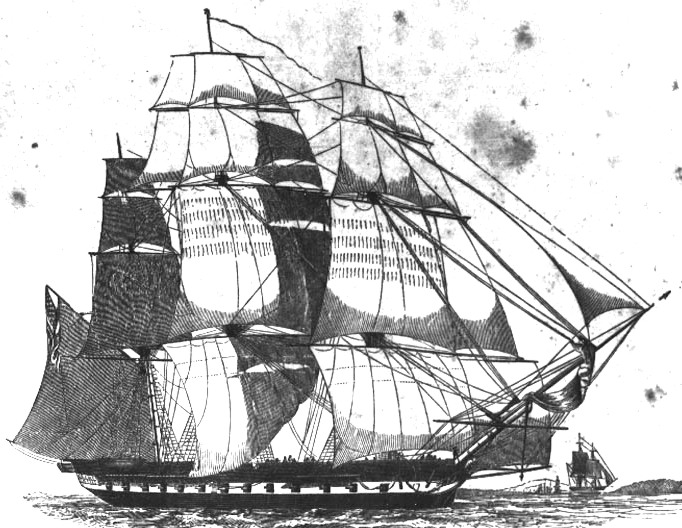
The full title is Thirty Years from Home, or a Voice from the Main Deck; Being the Experience of Samuel Leech, Who Was Six Years in the British and American Navies: Was Captured in the British Frigate Macedonian: Afterwards Entered the American Navy, and Was Taken in the United States Brig Syren, by the British Ship Medway of Samuel Leech. And I take issue with that title: because it advertises itself to be an account “from the Main Deck” around the War of 1812, a war memoir, I bought this book and read it. It isn’t a war memoir. Instead, it’s the life story of somebody who once served on the main deck. The war memoir portions may occupy a quarter of the book, and it’s in the most general terms—Leech keeps telling his readers to refer to newspapers if they’re interested. Seriously. A guy sits down to write his memoirs, and asks his readers to read the newspapers to get a sense of what it was like on the main deck. This undercuts the author’s authority by constantly cutting off when he almost provides insight into the day to day. Clearly not a great tactic. Today it would be like referring the reader to Wikipedia in the middle of your book, because you can’t be bothered to write your own book. In his defense, there are a few interesting paragraphs. I would quote them here so you wouldn’t have to read it, but I’m afraid it would tempt you to try and read the book. Help me help you not buy this book. Even at 99¢.

So, a fair question is what the book actually is about, compared to what it is advertised as? In the end, this book is less about what it says on the cover, and more about the author himself. The author only spends a few of those thirty years advertised on a ship—maybe five or six. The main focus of the book is what pet peeves Leech has: gambling, alcohol, lying, and flogging. He ignores what most Methodists would consider sexual sins, but maybe that’s because he’s trying to make his book “genteel”. He speaks from experience, so it’s easy to spot his biases. But he frames his statements as if he writes the truth, nothing but the truth, and the whole truth. For instance, in the case of flogging—which I am not into, for the record—he states that the public shame ruined every man who was flogged, then launches on a written crusade against flogging. Yet, he consistently gives us examples of flogged people who appear to have come out the other side mentally healthy. He draws a big comparison between the British ships he served on, which flogged heavily, and the American ones—he never mentions any American floggings. Yet, he never deserts from his flogging ships until the last one is taken in war and desertion is set up for him, while he deserts from his American ship later. He talks consistently about his desire to be at sea—most of the book takes place on land—yet takes few steps to get there. These incongruities built throughout the book and I was dissatisfied with my read. I kept reading hoping he would get back to sea, like he talked about, so I could read more about the differences in how American and British ships of the period were run.


The focus of the book rests on the author’s personal transformation from a heathen sailor to a Methodist Christian shopkeeper, and the title is misleading for that. From the Main Deck apparently refers to feeling guilt over buying and selling rum at his shop. Something like Baa Baa Black Sheep by Pappy Boyington has this moralizing element as well, but Boyington restricts himself to a few pages of that transformation, and focuses on writing his wartime memoirs. That’s a much more effective book and writing tactic than the one used by Leech here.


This is a bad book and I wish I hadn’t read it. I hope to someday find an interesting book from the main deck’s point of view in a man of war from this time period. But this author trusts too much in his audience’s familiarity with the normal, and ignores the title of his book in order to spend most of his time shilling for donations for his new Christian outreach organization. It wasn’t informative or gripping. It was rambling and navel gazing.

16 September, 2018

Sundiver by David Brin


I just finished reading Sundiver. This appears to be my first David Brin since 2015, when I read the two novels that come right after SundiverStartide Rising and The Uplift War. Those are both better than Sundiver. But that’s not to say that Sundiver is terrible. I did finish reading it and am glad I did. But I'm not sure I would ever recommend this book to somebody else.


The most interesting part to me is this theme that Brin runs through the whole book: integration into a technologically superior society. It’s a theme that mainly comes out in the worldbuilding Brin does. This novel’s story takes place shortly after human first contact with galactic powers that have been around billions of years. In contact, humans provide an awkward question for these elder species: where did humans come from? As there is no record of who nurtured humanity to sentience, they are known as a Wolfling species, a phenomena that is known but rare. It’s inconceivable to some species that humans evolved without outside influence, and who should be humans’ patrons? But combine their unknown past with two further backstory facts, and humans are not just rare, but unprecedented: fact one, humans discovered galactics, not the other way around; fact two, at the time of first contact, humans were already in the midst of uplifting chimpanzees and dolphins. This places humanity in a unique position that the hierarchical minded galactics have trouble conceptualizing. On the one hand, species who uplift others gain prestige. On the other hand, species who are uplifted by a long line of patron-client relationships, older species, gain prestige. The fact that humans have one but not the other makes them an awkward-at-best newcomer to the galactic community.


As a science fiction setting, this has some interest. But where Brin is brilliant is when he draws parallels to Europeans moving into North America, naming specific Native American tribes and historical figures. He shows how one tribe tried to fight traditionally and lost, another tried to integrate and saved their lives by losing their identity, another tried this, another tried that. He explicates what may be the most tricky political situation yet discovered by man, through using a space-based parallel. Should humans continue doing independent research when so much of the galactics knowledge is now available to them? Should they integrate as soon as possible, picking a patron species and letting themselves be uplifted into the galactic community? Should they retain their independence? It’s a fascinating study on Brin’s part. It’s really burning in my brain at the moment. (The other ideas all deal with human psychology and how we respond to trauma and work in groups. The main point with the human themes seems to be a sense that no matter what the tragedy, our responses should be our responses, not our ideas of how others respond.)


But the book can’t get out of its own way and explore this wonderful premise adequately. Integration is often ignored in the book, as a murder mystery takes up half of the book. And that’s the biggest problem here: the book doesn’t know what it wants to be, and probably isn’t playing to its strengths. There were three points that made me want to stop reading.


First, the writing in the opening couple of chapters isn’t great. It’s downright bad early on, but the story he is telling, and the ideas he introduces, are interesting enough to carry the clunky phrases and awkward sentences. So, though I contemplated stopping my read in the first few chapters, I didn’t. It’s obvious that Startide Rising had better writing, and I thought that writing was not great—but hey, this is his first novel, so it’s understandable that he gets better with practice. Good for him, not good for this book.


Second, the main character is a superman, and the rest are caricatures. Boring. I find that the journey the main character goes through to get over the trauma of losing his wife starts to hint at Brin’s later skill at character creation. But it’s not good enough here.


Third, the split in what this novel wants to be is awkward. It’s part galactic level politics and part murder mystery, both played out in a setting of a solar system research project. But the parts are too separate. After the reveal of Billibub’s crimes, the novel struggles to find its footing again. I looked down at what sounded like the end of the novel, saw that a quarter of the novel remained to be read, and wondered what in the world Brin would put in there. Then I felt that the continuation of the story of the solar ghosts was a bit of a let down after the action and whodunnit of the middle part of the novel. Of course, the murder mystery eventually returns as Brin’s detective got some things wrong, but the novel is still oddly paced. One quarter is about the ghosts, then half is about the murder and detective work, then the last quarter is largely about the ghosts, with a couple of chapters to resolve the murder mystery. This didn’t really hold together for me. It took some effort to get to the end.


In closing, on display here are some interesting ideas, but this book is only for fans of the universe, it seems. It’s a bad book. The pacing is inconsistent and offputting. The writing is painful at points. Plot elements are hamfisted. Yet the story shines in reflection, the pacing just got in its way. And Brin’s later ability to build good characters is almost on display here, but not quite. There is one engaging character thread, but things are not consistent enough to make me enthusiastic. The ideas and world building carry these negatives, for me. But in all, I wouldn’t recommend this book to somebody who does not like The Uplift War.

11 September, 2018

Annihilation by Jeff VanderMeer


A typical writing tactic is to reflect the character’s mental state with the writing mechanics. For instance, when a character goes crazy, the word choices, phrase lengths, and sentence structures follow: they all reflect this by being more imprecise, more inconsistent, and more convoluted. A crazy person’s narrator often pushes the boundaries of grammar and communication. Jeff VanderMeer doesn’t. When his biologist main character encounters the unknown it gets to her. But he doesn’t stop telling the story his way. VanderMeer writes short sentences. This is no Jack London. VanderMeer’s biologist pendulum swings to and from uncertainty throughout, but VanderMeer keeps his writing steady. Instead of using intentionally messy sentences, he uses imprecise terms, like “The Crawler”, to denote the unknown. His writing is precise in description, yet obscure in meaning.


That’s the main thing that stands out to me, his use of language and sentences. This is a story about the main character grappling with an esoteric mystery, and his writing matches. One example is that he applies multiple terms to the same set piece: the tower, the tunnel, two separate descriptions of physical size—one precise and one approximate—and what two different characters see—a biological organism or a concrete and shell built structure. In this way, the main character uncovers what she does of the mystery slowly, over time. As the terms shift back and forth, so does the reader’s understanding of both the set piece and the biologist’s mental state. So, rather than the sentence structures’ repetition becoming boring, the importance placed on the word choices lend inherent interest.


The whole is couched as a transcription of the biologist’s journal. She narrates the novel. Revealed near the end is the premise that these words are her writing out her journal after the fact, sitting up in the lighthouse and trying to communicate the prior few days. Her biologist’s training seems to affect the story as she describes, contextualizes, and attempts to synthesize hypotheses. She samples things and is just as confused about what is beneath her microscope as what is before her eyes. Much of the narrative deals with description. Like a biologist with a new species, as the story progresses, she slowly comes to terms with the unknown and unexpected. Beginning in a mental framework of familiar biological premises, her experiences and explorations lead her to unthinkable ends. It’s a slow process, even for a fringe biologist like herself.


Yet there is another half of the story, involving her now-dead husband. And this half VanderMeer holds away from the reader for the first quarter of the novel. I can see reasons for this: a wish to not overwhelm the reader right off the bat, a desire to allow the basics of Area X to be fixed in the reader’s mind, and the fact that the rest of the expedition is still alive for this part of the book, leading the biologist herself to cover up this half of the story intentionally. But by holding something away from the reader for so long, VanderMeer runs the risk of jarring them out of the narrative when it is introduced. Maybe the husband is a later invention of the writer, put there because of some perceived lack in the narrative, some perceived dissatisfaction with his own writing. Does it jar me? No. But for so much emotional weight and screen time, I’m not sure the payoff is there. Ultimately, the husband serves to set up the sequel. Sure, his presence does add some gravitas and some interest to the main character’s personality and mental anguish, but it seems a lot of effort for too little payoff. And if the main point of the story is the biologist overcoming her personal tragedies, which I don't believe, then the husband needed to be introduced much sooner in the novel.


The Area X part of the story is a mystery, inherently. Why has this shadowy governmental institution, The Southern Reach, shut Area X off from the world, and why are they interested in studying it? What is Area X? All we know by the end is that some sort of symbiotic, assimilatory relationship occurs there that exists outside of the normal human experience on earth. It’s mysterious and esoteric intentionally. The story is more that the biologist is coming to grips with the fact that there is mystery, than understanding any solution to that mystery. Is Area X’s origin and current state climactic in nature? Extra terrestrial? Nuclear or biological disaster? We don’t know. Neither does the biologist.


But what the writing, characterization, and story all work towards is the biologist growing in understanding of something she doesn’t discern at first. The coolest thing here, and the thing that the novel does best, is to show this process of coming to grips with the unknowable. You could read this book as a metaphor for religious experience, alien encounter, or the biologist dealing with the loss of her husband. In other words, any esoteric understanding or situation that changes everything. And VanderMeer portrays this wonderfully. The biologist starts out resisting the thought that things are changed, then she takes that thought way too far, then she reins it back in to what she considers a sensible response, all while she changes fundamentally. It’s a gripping journey, and one that uses science fiction to help explain what is fundamentally a universal experience. In this thread, it reminds me of Embassytown, by China Mieville—a favorable comparison as Embassytown is a great novel to me.


The focus of the writings rests on description and internal monologue. Though there is some action—one chase, one murder, the discovery of two bodies, and one attack by an unknowable creature—most of the story is the biologist either walking around getting freaked out, or sitting down getting freaked out, and thinking about things. VanderMeer uses internal monologue to ramp up the tension and there are more psychological crises than physical ones. More close calls that satisfying action scenes. This ruminatory focus isn’t inherently a problem, obviously, unless he writes physical action better than psychological action. But I did find myself slightly wishing that something meat and ballistics would occur more often than just walking down a set of stairs, or across a beach, or up a lighthouse. Slightly, I emphasize. And probably only because there is so much implied action that occurs off scene. VanderMeer says that so much has happened off scene and does not show it to me. I think I wanted a little more on screen. One or two more actions. Less buildup for actions that are averted. But this story being the biologist’s journal means that VanderMeer probably wants to reinforce the mystery by having the biologist confused how half of her squad died. It works, but may not have been more than a good tactic.


So, since the words focus on what’s happening in the biologist’s head, I should at least mention some of the themes she’s thinking about: mortality, perception, wildlands versus areas humans live, interpersonal relationships, the status of self during upheaval, the ecology of areas between other areas, spirituality (lightly), morality (also, lightly), and the nature of linked relationships like a marriage, or expeditionary squad, or coworkers. These are a lot of themes. VanderMeer focuses on perception and mortality, relationships and self, ecology and mystery. And I am curious about where he will take these themes. But the main theme here is how humans approach mystery, how we categorize and dissect the unknown, and how we react when our normal processes don’t pay off. VanderMeer shows that to approach something sublime necessarily changes us, like the biologist left alive at the end of the book, or we try our best to ignore it, like the murdered surveyor.


In closing, this somewhat Lovecraftian tale is good. It’s dark and tragic and I’m not sure I want to read more in this series. There are two other books dealing with The Southern Reach, but I like the mystery so much that I’m not sure I want to know more about it. I appreciated his writing and will probably read another novel by him, but not next. I usually appreciate more complex sentences than this. I would compare this novel to Embassytown in humans approaching the unknowable, and The Moon is a Harsh Mistress in the main character narrating the tale. But I find Mieville to be something I want to reread more, and Heinlein allows his characters more influence over their tale. This is a good book, but not great.