05 September, 2019

Cuckoo's Egg by CJ Cherryh


A unique alien child raised by a warrior and judge learns about his past, the culture that surrounds him, and himself. A childhood spent training mentally and physically prepares him for a future he doesn’t know until the end of the book. He doesn’t grasp the true importance or nature of his difference with the people around him. He struggles with his lack of knowledge, mistakes, and strict upbringing. Yet there is tenderness and a deep humanity in the middle of all of the political maneuvering, conspiratorial violence, and eventual war. His context dawns on the reader as it does on him. The obvious needs stated here: this is a book about a humanoid race called the Shonunin, who resemble cats in their violence, appearance, and mannerisms.
When I lost the most of my hand, I thought I would never play. I recovered that. Other things I lost. You gain no virtue from loss you never know.
Again, Cherryh holds her cards close to her chest for much of the novel. But here it doesn’t annoy me because the coming-of-age story that takes over for much of the novel engages me better than the rudderlessness of Voyager in Night. And a big part of that engagement arises from Thorn’s unusual childhood. It’s part master-pupil, part father-son, part teacher-student. As Cherryh establishes and explores these aspects of Thorn’s upbringing, hints and clues drop about the context. Dunn’s reticence doesn’t pull down the novel like the aliens’ reticence did in Voyager in Night. Cherryh strikes a useful balance between the known and the unknown that keeps the reader engaged. She does this through Thorn’s thoughts. He’s a curious, intelligent child trained to think critically, and his reactions and observations speak volumes at what’s happening behind the scenes of this novel. From that early hint of Dunn’s political power, “I’d remind you that you promised me anything [Ellud],” to the suddenness of the civil war and reveal of Dunn’s long-prepared plans, the reader knows some context exists that will shift the entire narrative from a coming-of-age story, and is just as curious as Thorn about it. Yet she drops enough hints in Thorn’s thoughts and Dunn’s enigmatic ways to keep the appetite whetted.
There's always something left to lose. When you think there's nothing more you're a fool, Thorn; there's something till you're dead. And after that⁠—gods know.
And even that civil war reveal shows Cherryh’s power as a writer⁠—it takes another span of pages for the questions to be answered, even while she actively fleshes out the context. Instead of revealing the answers and then putting the context into focus, Cherryh uses the context to help Thorn come to grips with the answers before the answers arrive. This shows Dunn’s character, the complexities of the context, and Thorn’s nature, helping the reader come to grips with the importance of the answer before receiving it, instead of just giving them the answer and then trying to make it important after the fact. Brilliant storytelling again from Cherryh.
"Exactly. Wants to play politics. On the issue the whole thing's gone sour." Ellud made a helpless motion. "Duun, hard as it is to think anyone could be shortsighted enough⁠—"
"I don't find it hard at all. I have a very fine appreciation of venality. And stupidity. Tomorrow doesn't come and a stone cast up doesn't come down."
This novel shows how Cherryh tells a story without doing an intro-info-dump. On page one an alien baby is dumped on Dunn’s doorstep. The only context we get is that Dunn could be called four things, and then the coming-of-age story takes over. I hate intro-info-dumps, and Cherryh is prone to them. But she begins this story without one, and it helps me care about the characters before being asked to care about the names of places and aspects of the context. This novel helps show how starting in media res instead of in explanation is always a strong tactic.
A world that had just reached out into space⁠—and all of a sudden⁠—discoveries that shatter it. Energies that, gods help us⁠—we're still unraveling, technologies with potentials we're not ready to cope with, with all that means.
This book engages with mystery in a way that I appreciate. Sure, Thorn is a baby and we see him growing up, so he sort of acts like the cliché amnesiac. But instead of having a character explain everything to Thorn⁠—really explaining everything to the reader⁠—Cherryh lets the reader ride along as Thorn figures things out from hints and clues dropped by Dunn and by Thorn’s own experiences. This method of exposition mixes showing and telling in a way that works much better than Jason Bourne’s amnesia.


Developing her characters, Cherryh takes the same approach. She both shows and tells the reader about Thorn and Dunn, while Thorn, the focus of the novel and this period of Dunn’s life, is allowed interior monologue throughout the book. Because he is such a curious, intelligent character, her tightly-focused third person narrative isn’t as important to the story⁠—she is really explaining a lot more in this story than she usually does. But as much as I adore Cherryh’s typical voice, the lessening of it here doesn’t lessen the power of the novel. Rather, she choses to use some telling to explain a complex society of competing guilds, classes, and corporations. And the fact that Thorn is being taught helps the reader understand why so much information is coming at them.
"There are three kinds of people I've found: those who think the universe is good, those who believe it's corrupt, and those who don't want to think about it any more than they can help. I prefer the first two. The last can be hired by anybody."
The themes of this novel explore nature-nurture, authority-hierarchy, destiny-desire, change, and exclusion of potentials. Instead of being anything he wants to be, Thorn is created, cloned, in order to serve a specific purpose for his culture. But how much of him is defined by his duty? This changes throughout the novel as his understanding of his duty and who he serves changes. He grows up serving Dunn, then serving the wider culture of the Hatani guild, then serving the whole culture as ambassador to an alien species. Yet how much of Thorn’s alienness is in the clone, and how much of the Shonunin is there? This is a question Cherryh explores from the start, and she clearly communicates that nurture can superseed nature, but not entirely. As he changes from within, the context also acts upon him to change him from without. He takes one step, and the context moves in to shove him a couple of more steps. This applicable theme shines throughout the novel.
"Change is your world. Flux and shift."
The science fiction theme here shows a first-contact situation, one that has gone wrong. Humans discovered this star system, but their scout ship was destroyed by the natives, who managed to clone a member of their expedition as an ambassador to attempt to rectify their earlier reckless aggressiveness. It’s interesting to read a first-contact gone wrong story, and something I relate to in my professional and personal lives. Cherryh’s voice often leaves much to the reader’s mind to puzzle out, and that’s one of the reasons that I read her books. Cherryh here manages to show the cascading effects of a bad first impression, partly through what’s shown and told in the novel, but also through the reader’s mind working on hints she drops about the even wider context of these Shonunin in their place in the galaxy.
We know a lot more now-what the cost of a ship like that is when you have to develop each part and joint as a new technology; the social cost of changes. It's made us rich. It's made us capable of blowing ourselves to hell.
Why the sudden shift to civil war once Thorn is shown some human porn? Well, I don’t think it’s the porn or any others of the tapes he was shown. But rather, I think the realization that he has started to understand led Dunn to the conclusion that the time for explanation has come⁠—and the moves of their enemies certainly helped push the timeline forwards. This I understand, taking a step and not realizing the full effects of it and being surprised by some of the consequences.

I hope that I’ve said enough to show the deep humanity of this alien first-contact tale, where only one character is a human, and even that mostly physically. Thorn is the experiment, the scientific oddity, the alien, but the story is told from his perspective. His human nature is sketchy at best, being raised as a Shonunin. Yet by flipping even this cliché on its head, Cherryh communicates more about humanity than the tired old cliché of a captured alien typically does. The pacing might be a little slow in Thorn’s upbringing, but I never tired or grew bored reading, so I hesitate to mention this most minor of niggles. Really, this is a great novel, and I hope she writes a sequel at some point.

30 August, 2019

Voyager in Night by CJ Cherryh


This strange book holds its cards too close to its chest for too long, for me at least. When an excession ship (something vastly outside of human tech limits) visits Alliance-Union space it abducts a sublight mining ship with a brother-sister and her husband. The husband and sister die in the aliens’ examination of their physical bodies, through the process of the ship taking a full scan of their persons⁠—memories, postures, preferences, atoms, everything. It converts all three to computer programs who can project their forms throughout the ship, and it causes a conflict long-simmering to come to a head with the passengers and runners of the ship, who are program constructs themselves. It's an abduction that takes place after humanity has already reached the stars.
The supervisor hesitated from one foot to the other, wiped his face. The stationmaster was off-shift, asleep. It was hours into maindark. The supervisor was alterday chief, second highest on the station. The red-alert button was in front of him on the board, unused for all of Endeavor's existence.

The story deals with two themes, eventually, and another throughout the book. The first and most apparent theme shows humans trying to come to grips with the unknown. The three construct abductees face the sublimity of a senseless, manipulated, blacked-out existence; getting reset and coming to terms with death again and again; being experimented upon by the alien software. The live one is faced with the broken pieces of his ship and the nature of having a perfect copy of himself in Rafe Two, a construct that diverges more and more from him as their life experiences change; and with his brother-in-law and sister who are constructs of the computer system, a fact not known but eventually reasoned out by the characters. This theme relies upon the psychology of the humans pushed into this crazy situation, as their emotions yo-yo realistically to extremes. Cherryh does a great job creating three different characters, but having them all react to their shared situation in ways that echo each other, but also distinguish each as separate characters. She even manages to make Rafe and his construct feel distinct! This character creation amazes me. The responsibility obsessed ship captain, Rafe. The brother-in-law Paul, who lives up or down to the people around him. The pissed off Jillian, stubborn and self-reliant. The story offers a believable glimpse of what Cherryh imagines a group abduction would really feel like. As much of their agency is taken from them, this comes off very much like an Asimov story where dialogue reveals the plot, capped with a fight at the end. Yet Cherryh has characters instead of Asimov's typically flat people, which works brilliantly. As strong as this main theme is, it tries to carry three-quarters of the novel, and it lags a little for me. I don’t think enough is being said about humans out of context to really carry this much of the book. If more had been said from the alien point of view, it could’ve given away too much to the reader and stolen the power of the struggle the characters undergo, but as it is I feel overly lost and get bored a little—and I do mean a little. I like this book.
Dead, Paul reminded himself. You're already dead. Quit worrying. Time's short. And he wished that death was all.
Two further themes do not occupy the novel until the end, and these are slightly more interesting. One is the relentless search for knowledge. The ship is some sort of explorer, scientific discoverer, sacrifice set to wander the stars endlessly—something that cannot be expressed in human terms. They will never bring their knowledge back to the society or societies that sent them. Cherryh shows how this search for knowledge stales over time because it is pointless. I think she's trying to say that the search for knowledge can lose its zest, is not enough of a motive to make good people. The political infighting that comes to a head when the humans are picked up portrays an ugly side to the search for knowledge. The alien characters turn against each other when the humans arrive as potential tools in their long rivalries.
"We're its soft-structure. Its enablement. We're alive individually and collectively. We've been running, and growing, for a hundred thousand years. That's shiptime. Much longer-in your referent. That we're partitioned as we are was accident. It's also kept us sane. It provides us motive. In a hundred thousand years, motive's a very important thing."

The other is what life is worth. And this one is quite interesting to me, but it only occupies the last little bit of the novel, as Rafe is faced with a choice to abandon the two people he really cares about, his family turned constructs, for another chance at success in human space, or stay aboard the ship and be converted to a construct to maintain that familial connection. He chooses to stay, meaning there is now Rafe One and Rafe Two permanently on this unnamed ship, but Kepta also sends his physical body back to human space in the epilogue. The question is what is life—are these constructs that are identical to the humans they’re based on? Or are they just programs? In more broad terms, is life being set adrift, alone, in a life-pod, in a new system of humans Rafe doesn't know, but being still in possession of a breathing body? Rafe comes down on the side of construct with family. Cherryh supports this late addition of theme by having the alien AIs finally open up a bit and discuss how purpose is the only thing keeping them going, and it’s not something inherent, but something chosen.
"Passage of time-negates all motives. Survival is still intact. So is curiosity."
The writing supports the first theme through having symbols instead of names for most of the alien AI characters, though names do occur. These symbols go so far as to replace words like he, she, my, they. Stuff like "< / >y turn to be captain of the ship" is strange to see on the page, and helps alienate the reader like the characters are alienated. Experimental writing done well.
"It was <>y nature then," <> said. "Perhaps O've grown."
"Only older," < / > returned, gaining more of <>'s territory.

Too much of the novel relies on that first theme, where it begins to feel like a short story carried on too long. If this is really about the human psychology, then why did Kepta take so long to offer Rafe the choice? Why did Marandu take so long to discuss purpose? There’s a sense of "what’s going to happen next" because of the delay in reveal, but sometimes it becomes a sense of "what’s happening?" I like mystery in a novel. I like writing that helps the reader empathize with the characters. This takes the mystery a little too far, I’m a little too lost as a reader, like the characters. Maybe it's too effective without enough payoff.
"There's never translation of motives; only of acts."
I liked this book though, but not as much as some of Cherryh’s other works. This isn’t horror, it’s psychological thriller—in the sense that I don’t feel terror reading this, just the frustration and annoyance and specific fears of the characters, and there isn’t much physical action until the end. I think horror relies on more general terrors. The whole thing is sketchy on details and action, and if you need a book where you know what’s happening, don’t read this one. But if, like me, you enjoy searching through a dense forest of emotions to find some loose story and context with which to make up your own mind, this book is quite good. Better than most of Asimov, though doing similar things with the way the story is told. The characters' realization is masterful, and the sense of mystery is thick.

22 August, 2019

Port Eternity by CJ Cherryh


This horror novel by CJ Cherryh deals with the crew and owner of a spaceship getting drawn into a parallel dimension unexpectedly. There, they face a new reality outside their context, and attempt to come to terms with both it and themselves. But this situation makes extreme this daily need to fit into new situations. Partly inspired by Tennyson’s Idylls of the King, in the Arthurian tradition of English literature, Cherryh shows humans both choosing and being forced to overcome their nature. The setting is a 50-50 blend of science fiction and fantasy, with the ship and its inhabitants forced by the ship-owner’s fancy to rely upon swords and spears for defense, but all while wearing a spacesuit and worrying about their life support.
The thing out there in the dark, the chaos waiting whenever we might grow confused enough to let our senses slip back into the old way of seeing⁠—this living with death so close to us, was that different than our lives ever were? And didn't born-men themselves live that way, when they deliberately took chances?
Cherryh establishes the horror tone through three methods: the context of the environment, the situation the ship finds itself in, and the reactions of the characters. The unfamiliarity of the environment, where time and space is distorted, sets up the mind-states of the characters. Their usual modes of reference and perception do not apply here, and that understandably makes them edgy and unsure and scared. Especially for the Azi characters—all but two on the spaceship. But even the born-men, Dela and Griffin, are unable to integrate these new experiences using past experiences, so they too are off-kilter. Second, as soon as they arrive, their technology doesn’t work, and something starts banging on the walls, trying to get in. What a great horror setup—a small group of people trapped in a spaceship outside of time and place, and something is trying to get in. But the reactions of the characters seals the tone of the story by their fright. They react to every new impetus with surety that all is bad. They gather decorative swords and spears for the coming battle. They plan defensive tactics. And the situation, from their perception, keeps going from bad to worse. Unexpected entrance into an FTL jump state, trapped against a huge object in same space, key technologies not working in same space, knowing they will die once they run out of food or air, something trying to get in, then trying harder to get in. And their personal struggles also go from bad to worse as the Azi tape-training frays and their psych-sets—the blueprints for an Azi’s reactions and priorities—shift out of whack. While the overall plot shows people trapped in the unknown with the unknown trying to break in, the chapter-by-chapter scenes show the characters unravelling through rivalries, thefts, conflicts, and misunderstandings.
If this was death, I kept thinking, remembering my lady's mad hypothesis, if this was death, I could wish we had not tangled some other creature up in our dying dream. But I believed now it was no dream, because I could never have imagined that sound out of my direst nightmares.
Cherryh doesn’t use traditional horror language though, or does so very sparingly. And that strong technique does two things: it gives those words power when they do come, and it doesn't show the monster, it let’s the readers themselves come to grips with the tone, let’s them create the worst possible situation from the sketchy context that Cherryh’s brilliant, narrow, third person voice achieves. Cherryh only mentions what the characters see, know, and imagine, instead of letting the narrator fill in some blanks. This serves to keep the mystery fresh and intense, and gives the reader plenty of room to imagine for themselves. This doesn’t read like Lovecraft, where I sometimes feel like he’s talking directly to the reader trying to convince them that what he is writing is really horror—Lovecraft seems to tell way more than he shows, and he’s not the greatest at telling. Rather, Cherryh shows the characters’ mind-states and let’s the reader draw their own conclusions.
Terror had acquired a kind of mundanity, had become an atmosphere, a medium in which we just went on functioning, and did what we were supposed to do until somehow our Death would get to us. I reckoned that tired as I was it might not even hurt much.

But two things intrude on this effective horror tone: Cherryh’s other works, and the title. The title implies that there is some port, some space station, known to somebody as Port Eternity. It turns out in the book that this is more Flying Dutchman or Avalon than Port Mahon or Port Angeles. So, the whole time that the characters are struggling to come to grips with their new location snugged up against this giant torus stuck in jump-space, I’m thinking, “This must be Port Eternity.” And it is. So, the tone is subverted somewhat by the title. But also, Cherryh’s other works always contain some optimism. As she says herself about her own writing, “I am an overall optimist. I believe that if there’s something broke, we can fix it, we just have to apply ourselves to that problem. And that is the attitude behind my writing.” So, while the writing seemed to try and convince me that everybody was going to die, I thought that Cherryh wasn’t likely to do that. Rather than waiting to see if some of the characters were going to survive, I was waiting to see how they would. And that’s a big difference.
Old was not a territory I had mapped out for myself.
The Azi: these Cyteen-produced humans are second class slaves in Cherryh’s universe, killed at 40 as their personalities start to fray. And the common conception of their soullessness keeps the novel firmly in the realm of science fiction. Their struggles to adapt are made more poignant by the context of their built-men status, instead of being born. Most of the ship are Azi and are made for one specific purpose—friendly encouragement, sex, accounting, and ship’s crew. When the ship stops working, and the mistress takes a lover, and they’re stuck in a place where accounts no longer matter, these Azi are stripped of their purpose. And the book is from the point of view of one of the Azi, her voice guides the reader throughout. Elaine is the focus. So their struggle lies front and center of the narrative. I’ve wanted an Azi-centric book since reading Cyteen, but by reading the Merchanter books first, I missed out on this one and regret that. This book gives me understanding about them, but transcends fan-service by the deep discussion of the theme of this book—humans overcome and adapt.
When I thought of it, I couldn't answer why we tried. For our born-men, that was very simple, and not so simple, if there was no hope. It was not in our tapes⁠—to fight. But here was even Vivien, clutching a spear across her knees, when I knew her tapes were hardly set that way. They made us out of born-man material, and perhaps, the thought occurred to me, that somewhere at base they and we were not so different⁠—that born-men would do things because it leapt into their minds to do them, like instincts inherent in the flesh. Or the tapes we had stolen had muddled us beyond recall.
The theme here explores whether the Azi are human or not, and it comes down firmly on the side of human. All of the characters, but especially the Azi, are pushed and prodded out of their comfort zones, are forced to change, are forced to grow. Vivien, the one who has the most pride in her work, is the last to grow, but even she does. The Azi and the born-men both overcome their natures. And this is something that is relatable—the Azi were created for specific purposes, yet their new situation subverts some of those purposes. From being drug- and tape-addicted, stable humans, they grow into an independence that the reader watches happen, with all the awkward growing pains of adolescence along the way. Some of these changes they choose—love, fighting, new tasks to complete. And some are forced on them—creativity, tactical thinking, the natures of the people they were named after from Arthurian legend, and desperate struggles for life and death. To some extent, that’s an explanation of life—a series of changes to our psychology, some forced on us and some chosen. In the end, these Azi subvert their tape-training, their psych-sets, and start identifying themselves as human. The born-men also overcome their natures, but due to the focus of both the novel and Cherryh’s voice being on the Azi, the two born-men characters’ changes occur on the outskirts of the story.
She struggled to be more than she was and narrow as she was, it threatened her sanity.

One thing she does brilliantly here is bait and double hook. For instance, the crisis of Mordred is baited when all the other Azi react to learning the Arthurian legends they are based off of, but Mordred seems not to. When he sends communications to the outsiders, expressly against orders, like he’s been asking to do for the whole book up to that point, this causes conflict on the ship. So I was baited and hooked. But wait, there’s more, says Cherryh as the crisis of the unknown trying to gain entry comes to a head at the same moment. This rapid shift in focus works better than a cliffhanger when done well, and Cherryh does it well here.
In one part of my mind⁠—I think it was listening to the wrong kind of tapes⁠—I was glad of a chance like that, that we might do some terrible damage to our attackers and maybe put a hole in the side of the wheel that they would remember, all those scaly bodies going hurtling out among our fragments. But in the saner part of my mind I did not want to die. And oh, if they should get their hands on us. Hands. If they had hands at all. If they thought anything close to what we thought. If, if, and if. Bang. Thump.
Cherryh’s effective foreshadowing shows another strength here. Sticking with the same crisis of Mordred, the existence of the tape shows the possibility well before he views it. The changes evident in the other Azi who viewed it show that change in him is likely. Then his insistence on attempting communication throughout shows the possibility of his going off the rails in that way. Foreshadowing allows his actions to be unsurprising—I mean, it’s surprising that he sends the message against orders, but it’s not a surprise from completely outside the realm of possibility. Then, his beliefs about the unknown outsiders are hinted at throughout the novel, so when the outsiders show up and some are not the horrific beasts the characters have been dreading, it doesn’t come off like a deus ex machina, rather it comes off like a misunderstanding. This is brilliantly summed up by Griffin, the warhawk, turning to Mordred, who advocated for communication and diplomacy throughout, and simply stating, “You were right.” That statement, supported by Cherryh showing that the actions of the unknown invaders do not line up with pirates bent on murder, allows the whole switch at the end from horror to happily-ever-after epilogue to be read as well within the realm of possibility. This isn’t deus ex machina, just a long-term misunderstanding on the part of stressed-out characters taken well outside their comfort zones with no means to immediately communicate to the unknown outsiders.
I knew my lady Dela, that she had high purposes, and she meant to be good, but as with her lovers and her hopes, sometimes she and her high purposes had fallings-out.
So is this a great book? Yes and no. It certainly shows Cherryh effectively trying something new in her writing—horror—and has a deep applicable theme that I appreciate immensely. But at the same time, Cherryh’s tendency to have the context affect and be affected by the characters of her story shows up mostly at the end, and the setting of this cut-off society out in an alternate universe seals this whole story up into a sort of not mattering. Maybe it’s that I didn’t care about these characters as much as some others, but I’m left thinking that this was a fun experiment, successful at what it tried to do, but I appreciate Cherryh’s writing more when she’s talking more directly about humans in a large society, not this small society of nine people. Is that me or her? I’m not sure. But I’ll keep reading her works and try to find out.

21 August, 2019

Norse Mythology by Neil Gaiman


I ended up with the audiobook for this before a roadtrip with my wife, and we loved it. I listened to the opening parts of it, read the rest, and all around enjoyed my time with this book. Gaiman here retells some Norse Myths, claiming that these are stories he means to read to his children before they are advanced enough in reading to get to the Eddas and Sagas. But, unlike retellings that shift the time period, Gaiman keeps everything in the mythical past. Where the BBC ShakespeaRe-Told: The Taming of the Shrew makes the titular character into a British Member of Parliament in contemporary times, Gaiman simply leaves Thor and Loki in the past. I appreciate this decision of his, not because the context of the myths prove overly important to them, but because the objects and natures of the characters are important—Thor’s hammer, Fenrir the wolf, the snake that drips venom onto Loki. Gaiman chooses to leave the stories in their original context to keep these aspects true, and retells the stories so that modern audiences can understand their importance through his explaining their powers and natures.
“Because,” said Thor, “when something goes wrong, the first thing I always think is, it is Loki’s fault. It saves a lot of time.”
Gaiman tells these stories well, with sensibilities helped by his comic book past. He uses episodic presentation to pace his book. Each chapter stands alone as a short story. But by the time the reader reaches the second half, these stories start to meld together into a larger whole—earlier stories start to affect later tales as characters come up again and are still angry over what happened before, political dealings between characters play out, objects of importance arrive and depart in the narrative. This reads like a comic book without the art—and it does so wonderfully. This episodic structure benefits the narrative through strong pacing. Gaiman knows how to write a comic book, and by approaching these myths with similar sensibilities, he tells the story well.

He is tolerated by the gods, perhaps because his stratagems and plans save them as often as they get them into trouble. Loki makes the world more interesting but less safe. He is the father of monsters, the author of woes, the sly god.
Where Gaiman chooses to linger with his language helps pace these stories. It effectively billboards important moments and effectively communicates emotions. For instance, when Loki is bound below the snake, the extended focus on that scene helps get across horror, pity, and the importance of that event. The result is brother fighting against brother in the future, and the rational is already apparent to the reader when that scene is reached.
He said nothing: seldom do those who are silent make mistakes.
But also, where Gaiman chooses to use sparse language helps foster a sense of wonder. When describing the mythological places, he often uses a couple of opposed general descriptors, and fewer specific ones, then moves back to the actions and the characters quickly. This not explaining, not exploring the physical scene, helps keep the physical scene mysterious and my mind loves that, adores the unknown. By pairing effective descriptions of characters and motivations with sketchy and paradoxical descriptions of place, Gaiman allows the reader both a solid base to stand on, and enough mystery to engage the mind.

The Norse myths are the myths of a chilly place, with long, long winter nights and endless summer days, myths of a people who did not entirely trust or even like their gods, although they respected and feared them.
Though these stories are intended for a younger audience, I personally find them engaging. Their conclusions about motives and human nature apply to everyday life, and constitute the theme of this book. In the Aesir’s relationships, the ever-present debate between the optimism of future hope and the pessimism of history come to the fore. Loki is a trickster, but by hoping that he has changed, by believing that he will change, the other Aesir fall into their traps. Yet their beliefs that he is a trickster blinds them when he does things for good motives, causes suspicion and resentment where gratefulness should be present. People change, and people do not change. Perception and discernment help determine the right course of action.
That was the thing about Loki. You resented him even when you were at your most grateful, and you were grateful to him even when you hated him the most.
This is one of three Gaiman books that I have read that I enjoy. It makes me interested in rereading the Sagas and Eddas again. This retelling does not supplant them, but through rephrasing, helps explain them. It’s a sibling piece to those original sources, and one that I recommend reading to a wide variety of people. Where I initially thought the title was a bit full of itself, after reading the book I understand why the title is so simple, and agree with titling it this way. I end up hoping to find similarly engaging treatments of other mythological traditions. One last reflection: Loki comes off looking a lot like Lucifer in Paradise Lost—the sympathetic anti-hero.

13 August, 2019

Alliance Rising by CJ Cherryh


In this 2019 novel, CJ Cherryh achieves much of what I look for in fiction: relatable tension, interesting questions being pondered, human psychology, a wider world being affected by and affecting the characters. And she achieves what keeps me coming back to science fiction: meaningful technology changing the way cultures work on a fundamental level, the necessity of wrapping my head around the different priorities and minds of others, contemplating potential human futures. I read this book in two days. I look forward to reading it again. This novel details the rise of the merchanters’ Alliance, and cliffhangs the breakout of Sol system into the rest of the FTL-enabled galaxy of human settlements. It appears a sequel is coming.

To get them out of the way, two potential problems spring to mind. First, Cherryh has a tendency to intro-info-dump. Here, she certainly does front-load the long first chapter with exposition. But instead of some dry, wikipedia-esque, unrelated information pushed at a reader who hasn’t been given a chance to care yet, this felt more interconnected, more building of tension, more part of the first chapter instead of an intro. Into this springs the surprising and unknown entry of a large ship from FTL, and the immediate fallout of this is fascinating to watch in that first chapter, as we are introduced to two of the main characters. So, not the best opening to a book I’ve read, but a good one that sets the tone for the novel to come, and rises above the usual pitfalls of the intro-info-dump.

Second, does this novel stand on its own? Always a question with works in a series. Should it? Where Regenesis certainly would not stand alone, I feel like this one stands alone better. The characters are largely new, the ships and families may be known, and some of the technology, but the characters, time period, and situations are new. Cherryh’s tightly focused, third person narrative fits well if she is trying to make this novel stand alone: by denying the reader a lot of information that other authors would spend chapters explaining, Cherryh uses her voice to get the action on-page and start building from there. She focuses on what the characters need to know to move along, not on what the reader could know about the universe. Strong.

And those are the only two nit-pickings I can find in what has fast become one of my favorite Cherryh novels⁠—and that’s saying something because she has written some great novels. This book isn’t for somebody who isn’t heavily interested in intricate, psychological, political drama. Indicative of a lot of Cherryh’s work, this relies on bedroom and boardroom diplomacy and less on adventure tale. To me, that tendency is a positive. I’ve read a ton of space-chases, and this rigid focus on what’s happening and known in and directly around Alpha station allows Cherryh to extrapolate the context of the drama to a rarely seen depth.

And that’s the key to this novel’s success: I feel the thick tension. She spends a couple of hundred pages building up the threat of the blue-coated ECE, then ignores them for forty pages. Talk about building the tension! The family hosts a meeting and decides to risk their lives. They check out of their hotel, they walk to the mast their spaceship is docked on, they check the coordinates in a private office at the bottom⁠—Captain, and all three Nav seats getting a peek. They agree to the job. They crack some nervous jokes. They shake hands with the station chief they leave behind. They say goodbyes. They ride the lift. They enter the airlock. They enter their ship’s airlock. They enter their ship. They sit down and start the undock. BAM! The guns come out. How much more could you build the tension? She takes the present, onscreen threateners and then puts them off-screen for forty pages. I was sweating and dreading every page turn. And the payoff does. CJ Cherryh knows how to structure a story. She doesn’t pull the antagonists back off the page right off the bat, or halfway through; but by three-quarters of the way through the novel, I understand they’re the baddies and their sudden lack of presence communicated, “they’re up to something”. Masterful. The tension throughout this novel, from the first page⁠—"Three hours and counting, and still no update"⁠—entrances. Instead of always telling readers, “tension here”, or pulling a gun out on every page to try and ramp up the tension, the tension dawns on the reader as situations and characters develop, until the ending is just a breathless rush of crazy action and politicking.
“We’re all fools, men and women. Or capable of being. You don’t get more callous with the years and the ports: the anger and angst go, but the feelings come on, with all the experiences heaped high. Good thing for us all that wisdom generally comes with them, and you can lead our Fallan just so far, but he’s the prankster and hard to catch."
Of course, CJ Cherryh writes wonderfully as well. She uses sparse language throughout, clipping sentences and words to help give the mood and tone of the place. But her mix of narration and dialogue tend to benefit her books⁠—when the dialogue starts you know you’re in for something you thought you knew changing, speeding up. It’s quite unlike Asimov’s tendency to ask his readers to sit back and relax and watch the expository dialogue pass. This is better writing, in every way. If you appreciate good writing in speculative fiction, read CJ Cherryh. It’s that simple. She’s one of the best writers of speculative fiction alive, consistently. Her tight, third person, internal narrative is brilliant and fresh and exciting.

The themes here are based on the premise that outsiders giving orders from afar⁠—in both distance and time⁠—simply doesn’t work: America during the war of independence, other colonies of European powers, and even Spokane/Eastern Washington, where the author lives, and Seattle/Western Washington, where the government resides. The resentment and good faith applied to the outsiders’ orders show the character of the people in the novel, but fundamentally the situation will not change without Sol giving up their overbearing nature, without Sol understanding what the stars are like. In other words, Washington Drysiders helped Washington Wetsiders pay for Seattle’s monorail in the 60’s, but they’re still salty about it⁠—they helped, and that shouldn’t be overlooked, but they also understand that it was a burden on them with little hope of direct benefit. The way characters respond to outsiders giving useless and damaging orders from afar helps define them as people. All-in? Lackey. All-out? Romantic. This premise of outsiders giving orders from afar underlies the three themes.

First, the on-page, obvious theme of sovereignty. The book is an extended battle, political and physical, for control of Alpha Strip, the docking area and spacer-serving bars and restaurants on Alpha Station. Alpha station’s civil authorities had control of it and want it back, the Earth Company Enforcers take control of it, and the Spacers/Merchanters are their own side in the fight: all want different things from the Strip, and they all take steps to ensure that the Strip includes their priorities. This plays out in bloody fistfights, tense standoffs, trickery, and backroom dealing. When dealing with space travel, sovereignty doesn’t tend to apply as easily as it has to a land-based border. And the merchant ships themselves, which operate autonomously between the stars, their attempt to gain their sovereignty gives the novel its name. It’s, in a way, a partial decolonization narrative.

Second, a discussion of doughnut and edge cities as applied to space colonization. In urban planning, a doughnut city is the state of a downtown core growing too expensive, forcing residents to the suburbs, amenities follow, then jobs, then a belt road, and pretty soon the downtown core is depleted of economic vitality, as all the action is happening around it, not in it. Edge cities follow a similar pattern⁠—see Bellevue, Redmond, Kirkland, and the other Eastside towns in Western Washington around Seattle. She applies this to early space colonization in our future. Namely, as people move farther and farther away from Earth due to having more opportunities farther out, and an easier time finding jobs, the same thing will happen with Earth⁠—it will become a forgotten, powerless aspect of the human experience in space. The new settlements will develop technologies that further outpace Earth and contribute to the alienation of the “downtown core” of Earth in this system of human settlements. This critique strikes a chord with me.

Third, the death of small towns. As mechanization takes hold of more jobs, the stations that were established first are superseded by later stations with more advantages, farther away from Earth. These first stations then undergo a shrinking, some getting mothballed, while farther out Pell and Cyteen expand rapidly. In some ways, this reads like the novel version of BH Fairchild’s poems. It’s a present worry in America, and it’s portrayed here brilliantly.

In terms of an applicable, human theme, Cherryh explores the idea that humans don’t really change. Despite their priorities changing⁠—between Sol, Alpha, Pell, Cyteen, the EC, the forming Alliance⁠—the ways that people pursue those priorities are human ways. EC priority is control, so Hewitt and Cruz attempt to control as much as they can immediately. They do this through strongarm tactics, hiring station residents’ unemployed teenagers and giving them purpose, dismissing considerations outside of their short-term goal of getting Rights flying as soon as possible. These are human techniques, some good, some bad. Alpha’s priority is survival, so Abrezio spends time planning current actions in light of future potentials. He even lies to Hewitt to ensure the safety of the strip, the merchants that keep his station supplied, and the residents that he is executive over. Abrezio too, both moral and immoral actions. JR might be the most morally consistent character, but by stepping into a situation on Alpha that he doesn’t know, he smashes toes and scares people to action in ways he doesn’t anticipate. The Alliance’s priority is sovereignty, so JR does every little thing he can to further that goal immediately, without betraying his morals⁠—which would damage his goal in the long-term. But even though accidental, he ends up screwing up a few times. Abrezio, Ross, and JR, the three main characters, tend to come off as both good and bad, depending on their understanding of the situation. And this is a strong writing tactic⁠—characters with wrinkles who are not perfect specimens of competent men. But her overall point is that humans don’t fundamentally change. Context shifts their priorities, so their actions to specific inputs do change⁠—things that would have merited an over-reaction before no longer matter much, so little response is needed. However, their tactics will remain the same, even when their priorities shift where those tactics will play out.

In short, this is one of my favorite Cherryh works, and it helps further solidify her as one of my favorite authors. It’s a spectacular novel. It touches on so many aspects of humanity, culture, and potential futures that I found it fascinating. But despite being filled with interesting ideas, it is a well written, well constructed, good story, and what more could you ask for in a book?

05 August, 2019

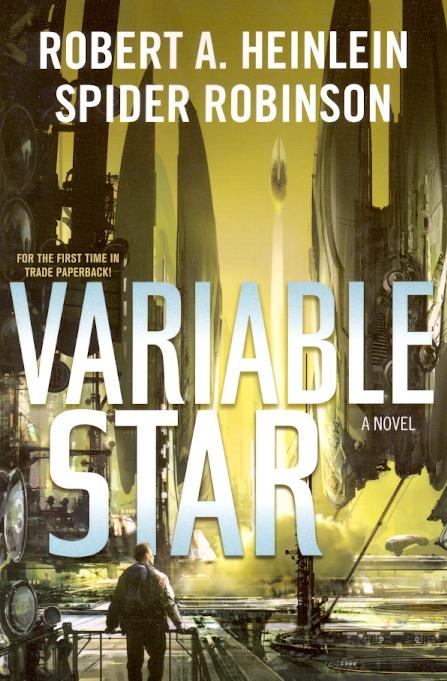
Variable Star by Spider Robinson


This novel was partially plotted by Robert Heinlein, who died before writing it. Spider Robinson was selected to tell the story Heinlein left behind. Initially, I think this was intended to be in the Heinlein juvenile novel series.

First and foremost, this novel kept me up at night reading. I enjoy reading most of this novel, and have picked up other Spider Robinson books as a result of this novel. It is very good. Though my notes below will raise some questions, I hope my liking of this book moderates any criticisms. This was given to me by a friend. It really feels like a funny Edgar Rice Burroughs.

A brief synopsis of the plot will serve to illuminate a few points I want to make about this story. The opening chapters detail the mental anguish of an 18 year old who finds that his betrothed is the heiress to the wealthiest corporation in the galaxy⁠—though she lied to him about it throughout their dating life. Being 18 and heartbroken, he runs away, all the way away to an expedition to found a new colony lightyears away from Earth. Onboard the colony ship he starts to integrate into this new society, gain fame and renown for his musical abilities, and help in his small way to save the ship as each new crisis comes. Ultimately, he tries to save humanity from extinction, and it’s implied, does a pretty good job.

As the synopsis shows, there are three parts to the story: Terra, Colony Ship, and Post-Colony Ship. However, the ratios are a bit strange, in the reading. At the end of Terra, like Joel, the reader has little to stand on, as suddenly all of the characters vanish, and the novel starts again on the Colony Ship, with only Joel keeping on. The rest are new characters being introduced and explored. This feels like two-thirds of the book. And again, after they leave the Colony Ship, it’s a new start to another novel, though this one only plays for a few pages acting as a sort of epilogue. These massive shifts in narrative direction may annoy some readers, as the effort the reader puts into the first part is fulfilled only by, “and then he runs away” instead of those stories resolving. Then when those stories from the first part do finally resolve it is an epilogue at the end of the novel. Two things would’ve taken this plotting from good to great: first and foremost, more foreshadowing. The Colony Ship comes up once or twice during the first part, but not enough for me. I want more discussion about it before Joel signs up for it. Though the lack of discussion about it does help build Joel’s character, other tactics could’ve built his character and not left the reader feeling rudderless at the change. Second, this would’ve been helped by a “Part 1: Terra” style billboarding of the narrative shifts. At the end, I can see the whole structure, but even a single sentence saying, “I thought that was the last time I would ever see Jinny and Evelyn and Conrad of Conrad,” would’ve been a blinking light telling the reader that their roles in the novel would continue eventually, after the crises of the Colony Ship. To be clear, this was a good novel, but this minor annoyance could’ve been avoided and helped this book attain greatness.


Another tactic I would like to question is the referential nature: Ricky and Julian from Trailer Park Boys, Smithers from The Simpsons, George RR Martin, artist Alex Grey⁠—there are probably a dozen name-drops in this book to friends of Spider Robinson and famous people. These also include in-canon references to Heinlein novels. This tactic seems weird. I don’t read science fiction to hear somebody else’s interpretation of Smithers’ sexuality, but this book gives that to me. If I don’t know Ricky and Julian from the TV show, do I understand their characters in the novel? Archetypes become shorthand⁠—Herculean, Promethius, Einstein⁠—but when basing them on pop-culture, their effectiveness diminishes because their universality lacks. I didn’t mind these as much as this paragraph makes it sound, but it’s certainly not a tactic I use or appreciate in writing.

Another problem is the humor being too present. This is a funny book and I love literature that makes me tear up from laughter, which I did here. But the humor is taken too far as tragic moments are not free of punny witicisms⁠—even the extinction of 43 billion humans and the entire solar system elicits a couple of humorous one-liners. That seems more tone-deaf than anything. By that point in the story I already understand the main character to be a jokester, and don’t need it reinforced. I think it would’ve been more consistent with his change to maturity to leave some of those jokes behind. But, again, only about two percent of the jokes are misplayed. In the main course, I love the inclusion of so much humor here.

As a writer, Robinson can really construct some sentences well. There are a couple of awkward moments and weird changes of person that should’ve probably been rewritten. But I can only think of three or four parts where this applies. In all, the book is well written by an author that clips words from the English language to reflect how people speak more than how people write, without losing legibility for the most part.

The theme of the novel seems to orient around mental health and dealing with the hope and despair of life. Meditation and exercise and psychology help Joel go from punk kid to functioning adult. And Robinson does a good job of splitting the telling and showing of this change⁠—enough of a good job that the jokes around the extermination of the solar system fall flat. Yet interesting ideas like Religion and Group Marriage are mentioned but not explored at all.

There is another inherent theme: humanity needs to escape the solar system to survive. And this is an interesting discussion, even drawing in Fermi’s Paradox to the narrative.

But the story still struggles to find a footing. Robinson is a big Heinlein fan and was a friend to the man. This leads me to question what happened here in regards to Heinlein’s rules for writing. He states that there are five types of stories, and this novel seems to try all five at once: it starts out boy-meets-girl, then goes all the boy who learned better, then it’s the little tailor, then a human interest story, and the gadgets underlie the whole thing, driving the plot every time a Relativist breaks down. I don’t necessarily take Heinlein’s divising of five story types to be prescriptive, but I wonder what he intended with this story.

Regardless, Spider Robinson turned in a novel I really like here. And I intend to read more of his work in the future. This story straddles the line between Heinlein’s adult fiction, with their deep dives into themes and ideas, and his juvenile adventure novels. I like pulp fiction, and this is good pulp fiction that kept me up at night reading from sheer joy.

31 July, 2019

Foundation and Earth by Isaac Asimov


Superhero Trevize, Intuition Man, tries to find Earth, getting up to all sorts of adventures in the attempt. He’s intuited that if he finds Earth he will know why he chose Gaia at the end of Foundation’s Edge. Trevize, Pelorat, and Bliss find five different human planets, then Earth. And, as is usual for a science fiction journey narrative, each of these societies shows off some aspect of humanity, extrapolated to a logical conclusion.

Gaia: The book starts on Gaia to give a reminder of the kind of wholistic oneness of all life and time that Trevize has chosen. Then the journey begins.


Comporellon: A Soviet analogy, but also with some puritanical leanings⁠—Victorian Soviets. Trevize and friends are trapped, but end up getting out through sexually satisfying their captor. The idea being communicated is that this repressed society bases power on taboo and might-makes-right. By flipping the power structure on its head (apparently Trevize is fairly demanding of his seduced, and rough, something she typically is to her lovers, and he impresses her) their captor cannot help but let them go⁠—Trevize bested her in her strongest suit, therefore he’s too dangerous to keep around. What if he realizes that he’s better and tries to manipulate her into doing his will? He cannot stay. These taboo societies cannot integrate any excession from outside their scope⁠—instead of integrating Trevize and friends, the idea is to ignore Trevize and friends by sending them away. Where Gaia is inclusive, from the littlest pebble to the most complex mind, and humble, Comporellon is exclusive and proud.


Aurora: Ecological disaster. At first everything appears alright, pastoral even. The husk of a robot is discovered, giving hope. But then packs of wild dogs appear. Made possible by mismanaged ecological balance on Aurora in the past⁠—basically, pets weren’t regulated and when humans left dogs were already everywhere⁠—these dog gangs threaten the heroes. Using weapons, the heroes escape back to the ship. The idea that on this dog-eat-dog world, a weapon capable of inflicting major pain can control the out-of-balance ecology, shows that past human error is dangerous to present humans. Here this idea applies ecologically to show the stupidity of unbalanced environments⁠—even this slight unbalance of having no real predators for the dogs, who breed rapidly and overrun the planet. Where Gaia involves an understanding of the wholeness of the complex systems of an environment, Aurora forgot to limit dogs and ended up going to them wholly.


Solaria: Individual isolationism taken to the extreme. These fine physical specimens, super-human really, with superpowers of controlling vast energy flows, shun all personal contact and are able to breed with themselves, without a partner. Their isolated nature makes them paranoid and only the unexpected power of Gaia through Bliss saves the heroes. They also take away a child, Fallom, who would be dead if not for their intervention. Obviously, this planet bears out the old Aristotelian adage that “humans are by nature political beasts”, and to change that too much too widely is deadly, even with tranhumanistic biotechnology. Yet this planet raises the most interesting questions concerning Gaia, as Bliss is forced to kill twice, an act which Gaia doesn’t typically countenance. The necessity of death is well within Gaia’s comfort zone, but this double killing in self-defense and other-defense is a gray area that Asimov explores. This is where I started to really enjoy the novel. Bliss becomes a bit of a character here, conflicted over the killings she did, but unconflicted over the result⁠—their escape and saving of the child Fallom. Gaia is all community, Solaria is all individual. The one forces the other to kill.


Melpomenia: A dead planet, the only life of which is a rapidly colonizing moss that feeds on traces of carbon dioxide in the thin atmosphere. The heroes overcome this infection through technology, and end up finding the coordinates for all 50 of the original Spacer Worlds, using them to project a sphere, at the center of which they believe they will find Earth. The idea here is that even a normal society⁠—with civic structures, appreciation of the past, and a library⁠—can turn their world dangerous and uninhabitable, yet technology can overcome the environmental danger. Where Gaia exists on a continuum, looking forever both forward and backward for guidance, by abandoning Melpomenia humanity has damned it, forgetting the future for the short term-comfort of abandoning a deteriorating, hard to live on planet.


Alpha: An idyllic, peaceful water world with a single island on which topless women live. This is a different type of isolationism than Solaria⁠—this is isolation of a community. Though they have advanced biotechnology and weather controls, they live a simple life and enjoy music and good food and community. They are paranoid that their existence will be known by the larger galaxy. Sex, music, conversation, good food, customs, tradition. But with a dark side of the isolated community distrustful of outsiders trying to murder the outsiders. Trevize’s liaison with a local woman saves them as she falls for him and warns the heroes to leave before the hour of their death. Gaia, on the other hand, is open to the rest of the galaxy and actively trying to integrate all of the galaxy into itself, without the paranoia that leads to attempted murder. This episode shows that even advanced biological and weather technologies will not save humanity from itself, though it may help overcome some of the problems on the other worlds.


The Spaceship: In the spaces between these stories, life on the spaceship is examined and also found to be wanting. The superhuman Fallom doesn’t understand its own powers or place in the galaxy. Pelorat is lost in the past and present, ignoring the future. Trevize clings to his individuality and worries at trying to take that away from future humans. Bliss attempts to bridge all these gaps, yet is coming from such a different perspective that she cannot be fully understood by any of the others. In contrast, on Gaia everything is understood in community, and shared in the wholistic oneness of being. However, this snapshot of how that community will relate to the larger galaxy tends to show that it’s a process which will take both sides coming to terms with temporary measures in order to achieve the future utopia. In science fiction, this willingness to show the between-times, between one state and another of existence, showing the amount of work needed to bridge the gap, is rare and well appreciated here. However, the point is to show that if all were already Gaia this whole process would go much smoother.


Earth: Of course, Daneel shows up, explains all, and Trevize’s mind is laid to rest. Obviously Gaia is better than what the galaxy currently has to offer, and Trevize is convinced that if aliens from outside the Galaxy invade, Gaia becoming Galaxia is the best defense for humanity. So he agrees to the community oneness of all life in the end, but it was already quite obvious Asimov was leading him there: through political, historical, ecological, societal, and logical processes.

The theme, the discussion of the whole book seems to be fear of the other: extra-galaxials eventually, but also the dogs fear others, the Comprolleans imprison others out of hand, the Solarians kill outsiders and each other due to fear of others, Melpomenia serves to show the heroes fear of the unknown outsider of the moss, the people of Alpha fear others but have no fear amongst themselves, and even Daneel fears that others will guide the galaxy in a different direction than he intends. Gaia, the ever present counterpoint, serves to show that more understanding and context and history will overcome the needs that lead to these fears. It’s an interesting argument that this book lays out, and nothing like any other Asimov I’ve read before. I hope I can find more like it. This book is the first Asimov novel I really liked. He writes poorly still, but the storytelling carries the poor writing.

20 July, 2019

The Secret of Santa Vittoria by Robert Crichton


This book made me laugh, a lot, and often. But it also tickled my brain a lot, and it excited me. It’s a rare work to do all three—be funny, intelligent, and exciting. Some of my favorite books and authors do this regularly, and I may have found another favorite book.

As a writer, Crichton’s strength rests in:
—His ability to make the dialogue sound unique for most of the characters. It’s a rare talent and one I always look up to wherever I can find it.
—He uses dialogue to snap off these witty one-liners and then explore opposing views briefly. For instance, “there is no cure for birth.” That’s a brilliant one-liner. I love that.
—As a writer he uses language sparingly, in the sense that the word “fuck” is only used once, which gives it a certain type of power in the novel. He takes care in his use of words, playing to their strengths.
—His language is concise and roundabout. Where Asimov tries for the greatest clarity he can, Crichton plays with words more, stretches sentence forms more, and comes up with a voice that is good to read. He’s not going for direct clarity, he is going for building language in interesting ways.


Then, as a storyteller, I think his skill shows through clearly. He uses humor judiciously—it’s not all slapstick and irreverently punny. But he puts bits of wit and jokes in to lighten the mood, set the overall tone, explain and explore characters. He refrains from overburdening the novel with humor—the notable torture scene has no humor, which is a strong move as a storyteller. The humor successfully assists the novel in its overall arc.

The characters are not characters though. To me, this novel is an allegorical philosophy, all wrapped up in an adventurous comedy. Nietzsche (Von Prum) versus Sartre or Diogenes (Babbaluche) versus Machiavelli (Bombolini) versus Kant (Tufa) versus romanticism (Fabio) versus Engineering (Luigi) versus American Optimism (Roberto). These philosophical allegories play out in the day-to-day of the hillside villagers, as they approach situation after situation. The grand gesture is the rightful province of the post-modern. Organization falls to the duty-bound Kantian. Inward exploration by the Nietzschian leads to self deception. Machiavelli was right about human behavior, but a heartless bastard. Fabio is the frustrated romantic lusting after the romantic gesture. The Engineer gets things done but is only useful on such a narrow scope that he is useless for much of life, and sits drunk all day and nobody minds. And American Optimism can see outside the box easily, but doesn’t ever see the whole picture. There is no traditional winner in this novel, it's more a compare contrast allegory than one with a champion.


These types of tales tend to be organized around journeys where the philosophical protagonist visits arguments in turn on a physical journey. Small Gods, Piers Plowman, Foundation and Earth, The Pilgrim’s Progress—but Crichton keeps his focus on a single place, the small town of Santa Vittoria, instead of traveling all over. And I think this is because there is no real protagonist to the arguments, no champion of the author. Instead, this is an extended compare and contrast of various philosophies and concepts through facing situations that face the townspeople.


The central question is what is life worth. “It is better to live one day as a lion than 1000 years as a sheep,” said Mussolini. And this is the central question of the novel. What do you risk your life for? Work? Your effort to produce? Family? Country? Honor? Duty? Von Prum is willing to give up his life to do his duty. Bombolini the clown tries to commit suicide in order to atone for the wrongs of his past and because his wife has taken his purpose of selling wine from him. The mayor Bombolini risks his life for his people’s life’s work, the hiding of the wine, and most of the minor characters agree. Fabio risks his life for the grand romantic gesture—both in trying to save Bombolini and in joining the resistance. Babbaluche gives his life for the good joke, for the end of his choosing. Tufa, that damaged fascist, thinks that by avenging his honor on his cheating woman, he can atone for what he did to people in the war. If there is a conclusion, I think the conclusion has to be that no one philosophy can explain all of reality, tradition and upbringing underpin every human, and you had better examine what you're willing to risk your life for before it's too late. Is it worth it to sacrifice to live ten more hours, when those hours will be spent uselessly? Why not take pleasure in the here and now, within moderation?
The story is the same, over and over, only the facts are different and the names and the places.
I find this a thoroughly post-modern book: tropes and cliches are both comedically sent-up while simultaneously shown to still retain some power. Like Pratchett, Vonnegut, and Heller, this is a sensational tactic and book. The flipside is that the characters are sketchy, not deep, and they seem to come and go randomly. But reading this as an allegory really unlocked it for me and I love it.

15 July, 2019

Foundation's Edge by Isaac Asimov


Foundation’s Edge is the first novel in the series that started with short stories, then progressed into novellas. This is one of those books where the author relies upon the conclusion. I mean Trevize travels around, a master of intuition, and the thrust of the travels changes over time: go to Trantor, locate the Second Foundation, find Earth, find Gaia. And then, at the end, it’s all revealed to be a ruse as Gaia has been guiding his path all along, towards itself. This is a dangerous tactic—it can easily leave the reader feeling like the story missed the point and started way too late in the book, like the earlier chapters are a waste of time. Yet here, I don’t feel that way. I feel that Asimov knows where the story is going, and guided it there in a meandering but intentional path. Though the destination remains hidden, the amount of foreshadowing taking place makes me think Asimov had a firm grip on the overall tale, if not all of the details.


The foreshadowing mostly pertains to three aspects: Trevize’s gift of intuition, the Second Foundation’s manipulation, and the two mysteries slowly revealing themselves as the same mystery—the Second Foundation’s conundrum and Gaia. These aspects are brought up consistently, with the reader clearly knowing more than the characters, leading the reader to understand that something is going to happen with these foreshadowings. It creates a sense of anticipation, a kind of wondering how Asimov is going to tie all these together—although the flip side is wondering how in the world these three relate at all. Yet, a little trust in the author leads to an interesting, if far-fetched conclusion.


The conclusion clearly lays out three options. The novel already laid out these three options, though the purpose of laying them out is unknown until the decision point comes.
—First, the Foundation and “normal” parts of the Galaxy. Seldon’s Plan is to allow the Foundation to take over the galaxy, to establish a Galactic Empire, to shorten the period of dark age warring between the first and second Empires. Trevize, Pelorat, Gendibal, and Branno start the book off, and they clearly explain the Foundation, its goals, the negatives of its current state, and the early drive of the book—a belief in the existence of the Second Foundation leading two of the four desperately trying to search for it. They then travel off to explore part of the Galaxy outside of, but still related to, the Foundation, which shows the context of the issue at hand.
-—Second, the chapters of the Second Foundation show the complacency, lack of drive, and factional infighting of the Second Foundation. Instead of this almost all-powerful guardian deus ex machina—like they were portrayed in the earlier books—the Second Foundation is revealed to be breaking down. With no real crises to struggle against, their energy turns against themselves. However, their underlying beliefs show them becoming masters of the First Foundation when the time is ripe, a sort of mental aristocracy that can guide the ship of the war-born Empire.
—Third, when Pelorat and Trevize finally reach Gaia, the third option is fully explored. The planet Gaia is a hive-consciousness composed of animate and inanimate beings, all contributing to the sentience of the whole. Two avatars of Gaia drive this exploration through Asimov’s typical explanatory dialogue: Bliss and Dom. Gaia abhors early death. Since everything is a part of Gaia, the necessary death of things provides the necessary sustenance of everything else. In other words, Bliss may die, but her death and burial will feed the micro-organisms that compose the super-organism of Gaia. Her eating the plant life of Gaia is a sort of reincarnation of that plant life because it is already a part of Gaia, as is she, so it’s a transformation more than a death. This hyper-spiritualism, ecological consciousness, and hive-mindedness is the third option. Gaia’s goal is to transform into Galaxia, or a similar super-organism spanning the whole Galaxy.


By the time the decision point comes, I understand that the issue under discussion is the future of humanity. More Empire of force, a new Empire of the mind, or a wholistic embracing of all life, animate or inanimate, as a part of a larger whole wholeness. And that’s a bit farfetched, not only in the equating of the “lifespan” of rocks with rocks having a “life”. What themes can I draw out of this for my day-to-day life? This question still rolls around in my mind. Biographically, this is about the time Asimov was becoming an advocate for ecological issues facing Earth, and the book is a call to ecological action to prevent catastrophe. But the inbred intuitive superpower Trevize has is still slightly weak, and tends to undercut this ecological theme a bit (as well as the simply strange aside about the Eternals?). Trevize himself doesn’t understand why he chooses Gaia as the path forward for humanity (hence the next book in the series, of course). He’s the intuitive master of the Galaxy, which is explained in-world as “he has mysterious mental powers that would have been Second Foundation worthy.” And sure, maybe that works for some people, but it is a little weak to me, and in a book that relies so much on the conclusion, a little dissatisfaction with the conclusion magnifies across the whole novel. The future of humanity is a strong theme, but of the three options given, only one could really come to pass as far as we know—mentalist mind powers and super-organistic hive-minds are unknown at this time, in terms of human experience.


But I don’t want to belittle this book too much. I liked it. That opening is sensationally good. Trevize and Branno facing off over the question of the Second Foundation, the mayor in her moment of triumph, the councilman in his quest to question the nature of reality. Both are conflicted characters who are misunderstanding each other—and this is fairly rare for Asimov, who relies on same-sounding characters whose conflict comes from without. Here the conflict comes from within and it’s even explored a little. This is a better Asimov than anything I’ve read. It still has the conspiracies, the wild logical leaps, the backfilling of information, and the political intrigue, but by trying to work with actual characters, it all works better because I understand them more.


The feeling I have throughout isn’t, “where is Asimov going with this mess?” but, “I wonder what happens next?” And I think this feeling comes from the effective fore-shadowing, and strong chapters that are almost self-reliant. In a way, each chapter is a short story and this novel is a linked series of inter-related short stories telling an overarching story, like a pulp fiction novel. It’s a strong tactic that Asimov uses to its strengths here: he doesn’t even mention what the overall story is until everybody arrives at Gaia to let Trevize choose. That technique of telling three distinct stories that are all coming closer together in each chapter is one that I have enjoyed in Iain M Banks’ works, and Asimov does it well here too. So, I think the two main reasons Asimov’s novel doesn’t fail through a disconnect between the overall story and what’s actually on the page through most of the book are these: each chapter excites—especially that first one—in its own right; the foreshadowing is effective and consistent; and the reader can see the characters growing ever closer together physically and can easily sense that some showdown is coming. I think Asimov mainly avoids the dangers of these types of tales through these three techniques.


In all, this is a good book. Almost great, but the late switch to this far-fetched future of humanity through hyper-spiritualistic environmental consciousness is a bit too jarring because the switch is predicated on Trevize Intuition Man, the superhero. Intuition being an aspect that is mentioned consistently in service of foreshadowing the story, but never really explored. However, after “The Mule” and “Search by the Foundation” were such strong stories, this strong story made me genuinely excited to hit the next book in the series. Asimov has gotten better as a storyteller, and he was already strong to begin with. As a writer, well, he still leaves a lot to be desired. But for pulp fiction, he actually tackles some interesting themes and ideas. So I’m happy I’ve read this novel.