0. I treat these two books as one because that was how they were written: Lois McMaster Bujold wrote them as one story, then split them for size and publishing reasons. And it’s obvious in the reading: the first ends with the paramours riding away from their wedding, towards Dag’s family, with no sense of things being tied up—except with Fawn’s family. The second ends with almost everything tied up except for three questions. Also, the writing is indistinguishable between the two. Therefore, one set of notes. Well, as it turns out, only one note.
1. I consistently approach books and films with as much of a blank slate as possible—watch no trailers, never read the back of the book, look at no reviews. I appreciate surprise and exploration above many things in life, and I find going into books blind more informative than taking pre-conceptions with me. This novel starts out as fantasy, building a complex and engaging world about ancient evils that periodically awaken to steal the life-force of things around them, growing stronger and stronger until killed by a magic knife that has captured the death of a human. This life force is called ground and certain people can sense it like gravity, or hearing. McMaster Bujold does a brilliant job introducing the reader to this concept simply, by spreading the explanation out over a couple of chapters.
—She begins by building characters: initially Fawn Bluefield, who is a Farmer, a term for those who cannot sense ground. Beginning with what is familiar to the reader—Fawn is like us. This helps the fantastic elements find their place in the reader’s mind by having something pre-existing to relate them to. This reference point and her questioning persona help build the world through dialogue. I find it works well.
—Then she brings in the fantastic elements by introducing the other main character, Dag Redwing. He is a Lakewalker, somebody who can sense ground, and a patroller who patrols for malices—those ancient evils periodically waking up. He and his patrol encounter evidence of a malice’s slaves and start hunting the malice, showing plenty of glimpses of ground-sense in action, but no real strong explanation—whetting the reader’s tongue.
—Then Fawn gets captured by some of those slaves and Dag ends up rescuing her. Their time together allows her questioning to get explanations out of Dag in dialogue, telling the reader more than they could infer from the actions already shown. This is where the heavy-lifting of the fantastic elements of the world-building occur. And it’s an effective tactic, using dialogue to tell after actions have shown.
—Then together they kill the malice and the story would typically end here with the heroic deed done. But McMaster Bujold continues writing, talking a lot about what comes after the heroic deed. And I am terribly interested, hoping that she explains the world more fully in what is essentially the paperwork and party after the heroes act heroically.
—But what comes out of left field is the sex. There is a romance set up already, but this is real bodice-buster stuff using words like "stroking". The rest of the novel is a fantasy quest tale with one more malice kill tied into a lot of romance and sex. Having set up such an interesting and deep world—with its own mythology, customs, and history—McMaster Bujold does give the reader more of that world, but it is also a romance novel with explicit sex scenes. The novel reads eighty five percent like a great fantasy novel, and fifteen percent like a romance novel.
—If I had known it was a mashup of romance and fantasy, I would have been waiting for the romance and felt the other shoe drop at its arriving. Not knowing, I was surprised, and that's the novel not standing on its own. Other than Jane Austen, I haven’t read any romance, but I don’t really enjoy the romance here. How it compares to most other romance I don't know, but it’s not as enjoyable to me as Austen. The way the opening was written, I didn’t expect the romance and wasn’t looking for it. Therefore, it felt like a short story—a really good short story ending after the malice kill—that she then decided to tack a novel onto. It felt disjointed: after the malice kill, she has to reintroduce the reader to the second part, which takes up the rest of these two books, which deals with the romance and the families of the two paramours. I don’t find this restart to be smoothly accomplished: she paid so much attention to world building in the first part, that the second part switches tracks too awkwardly. This is my main complaint with the novel: not that it’s poor romance, but that it starts out as fantasy-adventure, dips into post-adventure fantasy, then becomes romance-fantasy. I love Pixar films because they set up the premise right at the start—toys have their own lives when we’re out of the room—and if you buy that premise, everything else follows logically. This book sets up a premise, stretches it into an examination of what happens after the heroic act, then switches premises to romance. Like Ernest Hemingway’s A Farewell to Arms, I found it blundering and discongruous. The rest of the novel, at least the eighty-five percent that adheres to the original premise, is good fantasy. That fifteen percent is always ill-fitting though.
2. And that’s my main take-away from this novel. She set up the world and story so well, then added other things in too late that didn’t inform or add anything to the characters or novel other than fan service sex scenes. If that’s what somebody wants, this is the novel for them. I mean, I finished reading it. I will certainly read more by McMaster Bujold because I enjoyed that eighty-five percent so much. But I wont be reading more in this series because it’s split down the middle and can’t decide what it wants to be: there’s not enough romance to be a romance novel, and too much romance to be a fantasy novel.
15 July, 2016
The Sharing Knife: Beguilement and Legacy by Lois McMaster Bujold
Labels:
2006,
2007,
Fantasy,
Lois McMaster Bujold,
Romance
14 July, 2016
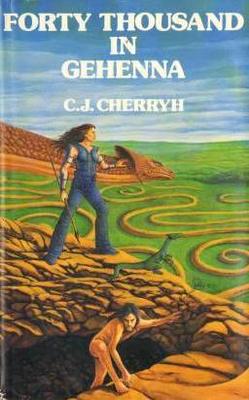
Forty Thousand in Gehenna by CJ Cherryh
1. Unlike Cherryh’s typical character focus, this novel discusses a situation over a long time-span of 305 years. The situation is a new colony on a habitable nut little understood planet. The book starts with it being founded, flourishing, and collapsing. Then being rediscovered, studied, and collapsing again. Then, between the on-screen scenes, being rebuilt and thriving. In Cherryh's universe, the science fiction theme clearly test-runs theories of first contact, and studies how azi and humans react to collapse. In this way, I think this is the most space operatic novel I’ve read by Cherryh, though her whole Alliance-Union universe tends towards this sub-genre as all the books are so interlocked.
From Section D: Mission Report by Dr. Cina Kendrick
Intelligence is not, as indicated above, a scientific term. [...]
Two considerations must be made. First, that an organism’s behaviors may be survival-positive in one environment and not in another, and second that its perceptive apparatus, its input devices, may be efficient for one environment but not for another. The quality imprecisely described as intelligence is commonly understood to describe the generalization of an organism, ie, its capacity to adapt by the use of analogy to a variety of situations and environments.
On the contrary, even the concept of analog is anthropocentric. Logic is another anthropocentric imprecision, the attempt to impose an order (binary, for instance, or sequential) on observations which themselves have been filtered through imprecise perceptive organs.
The only claim which may be made for generalization as a desirable trait is that it seems to permit survival in a multitude of environments. The same may be said of generalization as part of the definition of intelligence, particularly when intelligence is used as a criterion of the inherent value of an organism or its right to life or territory when faced with human intrusion. Generalization permits migration in the face of encroachment; and it permit one species to encroach on another, which adds another dimension to natural selection. But when extended to intrusion not over another mountain ridge within the same planetary ecology and the same genetic heritage, but instead to intrusion of one genetic heritage upon another across the boundaries of hitherto uncrossable space, this value judgment loses some credibility.
2. However, this novel isn’t all situational—well-developed characters still fill the pages. But it’s character by mindset more than specific individuals. Characters who take a non-interventionist policy oppose those who take a more helpful role, and both camps contain exploitative characters. These ideas are spread through the novel: from Union’s first contact with the Calibans, to Alliance's first contact with the Gehennans, to Gehenna's first contact with the Unioners, to Farsider’s first contact with a Gehennan.
—First, the Union colonists’ ignorance leads them to assume that the Calibans are stupid. This allows catastrophic destruction of the Union mission—both in the slow trickle of children away from their control, and the base being physically undermined and collapsing.
—Second, the Alliance comes in slow and indecisive—non-interventionist in word, but not so much in deed. Their base is way too close for comfort and their observation post changes what they observe. Their confidence in their space-based surveillance is similarly poorly placed—they can see the whole, but no details and are just as ignorant as to the meaning of the whole. Like when McGee heals Elai’s leg, it’s half-assed through indecision: in her own misplaced confidence and self-conflicted desire to save a child’s life, she doesn’t search for or get out the near-fatal bone-spur. This fumble sets her mission back fifteen years, until Elai’s mother dies. The Alliance's indecision as a whole leads to war, death, and the destruction of half the Gehennan culture. Finally, both the Alliance and Gehennans decide to educate and put their pride aside enough to be educated, and that seems the right track. (I read McGee’s pattern as a clear step in this direction.)
—Third, the Union comes in hungry for knowledge and offering trade. Elai rightly recognizes that the Union needs nothing from her, and calls their bluff. This is entirely the wrong foot to start out on for the Union: the wary reaction of the Calibans—leading to the Unioners further fear-based reaction—illustrates this. The Union is still ignorant to the point of not knowing how to engage their potential teacher, and this ultimately loses them their final influence over the colony.
—Fourth, the Farsiders appear to find the Gehennan curious, but the knowledge they do have—from videos and reports—allows even the rough docksiders to avoid an incident. Similarly, the Gehennan and Caliban pair chosen for the visit are appropriate for the high number of strangers they expect to run into.
—McGee, Genley, Elai, Pia, Jin, Jin Younger, Jin Elder, and Scar are the main characters, but the mindsets clearly steal the show from the people. These are well constructed, interesting characters; but they are not as important to the novel as the mindsets.
—And I find this discussion of the mindsets of First Contact to be the theme of the novel. First Contact here is a metaphor for the other. In our day-to-day lives we are consistently pushed outside of our normal comfort zones to deal with unfamiliar people, opinions, situations, etc. There are two ways this typically goes: fear or understanding. Education and embracing the unknown—quite literally in McGee’s case—leads to an inclusion that grows knowledge and culture. Fear leads to death. That’s Cherryh’s point and she makes it well throughout the novel by focusing on the mindsets—though she doesn’t lose sight of the individual characters in a way that shows how small acts have large consequences. Humanity will survive because it has generalization, but that's not always a good thing when the situation or environment pushes us, even on an easy, habitable, fruitful planet like Gehenna.
3. Cherryh set herself a hard task in the various writing tactics of this novel. She includes memos and portions of scientific papers to show the affect actions have on the whole.
I propose that, instead of arguing old theories which have considerable cultural content, we consider this possibility: that humanity develops a multiplicity of answers to the environment, and that if there must be a system of polarities to explain the structure around which these answers are organized, that the polarity does not in and of itself involve gender, but the relative success of the population in curbing those individuals with the tendency to coerce their neighbors. Some cultures solve this problem. Some do not, and fall into a pattern which exalts this tendency and elevates it, again by the principle that survivors and rulers write the histories, to the guiding virtue of the culture. It is not that the Cloud River culture is unnatural. It is fully natural.Another aspect is researchers’ notes:
Is even childhood one of our illusions? Or is this forced adulthood what’s been done to us out here?And memos also fill the pages, at least one going through draft after draft showing McGee’s mindset and final words, exposing much about her character and her dissatisfaction with the powers over her. Further, the Union, Alliance, Styxside, and Cloud River cultures all have their own voices, and the latter two communicate also via hand gestures and drawing patterns. It’s a plethora of writing tactics, causing Cherryh to switch gears consistently in a way that keeps the writing all fresh and exciting. It’s not all one voice, though Cherryh’s typical tightly focused voice is on display fully.
Us. Humans. They are still human; their genes say so. But how much do genes tell us and how much is in our culture, that precious package we brought from old Earth?
What will we become?
Or what have they already begun to be?
They look like us. But this researcher is losing perspective.
4. Many of these memos and papers take the place of actions and interior monologue in a way that makes the novel seem a little slow. There’s a lot that happens over these three hundred and five years, but most of the novel is people reacting to those changes and settling in as best they can. The action is usually fast—a couple of pages—and decisive, leaving the bulk of the novel to unraveling the meaning of those actions and what they signify. This isn’t necessarily a negative as I was enthralled throughout, but covers that show a human riding on a dragon-like creature mislead and that first edition cover (at the top) is the most informative as to what the novels feels like. Not sedentary, but also not rollicking, despite what the following cover wants you to believe:
5. This is a good novel. I wanted a bit more action and a bit more psychological depth—Jin Elder and McGee are really the only two who have any depth. But then, maybe that is me projecting on the novel too much of Cherryh’s other works, kind of like how Union and Alliance project on the Gehennans too much of their empirical data. I like seeing Cherryh trying a new method of storytelling with the time span that disallows her usual deep individual psychology, but I think her strengths primarily rest in the other way she writes. That’s not to say this isn’t a wonderful novel, because I really enjoyed it. It’s certainly better than other situational novels I’ve read, like The Plague by Albert Camus.
Labels:
1983,
Alliance-Union Series,
CJ Cherryh,
Science Fiction
08 July, 2016
Finity's End by CJ Cherryh
1. What a tour de force! This novel is Cherryh sticking to what she does best—not ignoring any experimentation, but slightly modifying what she does well: an opening to introduce the characters, set the context, and get the story rolling in a quick, engaging way; deep introspection throughout for Fletcher, a slightly damaged main character trying to come to terms with a new situation; a supporting cast of actual characters who have their own philosophical insights, instead of being set-piece-characters; illuminating a central act through spaced out near-repetition of it, adding more to the reader's understanding each time; believable change within the characters that could only come from what happened within the novel; word choices and sentence structures modifying to fit the factions within the story; pacing that allows both rumination and action; and that wonderful, tightly focused voice that never allows the author to spoon feed the reader. In the rest of the Company Wars novels, Cherryh explores and focuses on some of these things, and here all that work pays off in a novel that clearly demonstrates a refinement and perfection of her skills. I just have one small complaint.
2. That ending is too pat, too tied up, too tidy. Sure, the Hisa stick is no deus ex machina—it has significant other importance to Fletcher, James Robert Sr, James Robert Jr, Jeremy, Satin, Elene Quen, and the whole of the ship Finity’s End throughout the novel. It’s final importance to the Alliance is being unveiled slowly as Fletcher matures and thinks his way through his past—so it’s no deus ex machina. But when Fletcher decides to search for the stick at the importers, I feel this is going to be a typical Cherryh ending: part tragedy, part triumph, all interesting puzzle to roll over in my mind for a few days after. In the end, it feels like the cost didn’t measure up to the victory gained. Sure, Fletcher being put in his place regarding Jeremy is a big change, but because he’s already gone through that—with his mother, Pell Station, Patch, Melody, Satin and the whole downer culture, Downbelow Station, Bianca, the rest of the crew, and his last foster family—this latest break isn’t a surprise, it’s a repetition. Things are different now in the sense that Fletcher is accepting the ship, with all its faults, with Jeremy’s actions, and more importantly with his own actions. But just explaining the ending in a minute to somebody makes the novel seem like a happy-ending too pat for any interesting thoughts. Thinking about it more and more, I realize that it isn’t, but it does come off that way. Cherryh could have better illuminated the cost to Fletcher at the end, and I think that would have helped. As the novel slowly pieces itself together in my mind after the fact, as events come into hindsight focus, the whole makes a lot of sense and the actual cost becomes clear, which is why this is only a small complaint.
3. Otherwise, this novel is perfect. I love it. I wish I would have written this novel. The most intriguing bit is, of course, Fletcher, the main character. This novel is Fletcher learning to look past himself and recognize reality. Even the time-dilation of the spacers points this out prominently, when Fletcher initially mistakes Jeremy for a twelve year-old. But what’s so intriguing here is that this realization of reality goes through a lot of wrong steps before Fletcher finally finds something solid to stand on. He wants to find a family, then he gets disgusted with humans and wants to work with Hisa, then he wants to change policy so he dreams of being administrator to Downbelow, etc, etc, until he realizes that he cannot stand on his own first impressions and ends up apologizing, trying to make right, and doing something good for the ship. He’s not fixed at the end, but he is on the right track finally. (In this sense, the end makes perfect sense: he finally breaks enough to be useful to others, and he is quite useful to the whole Alliance.) It’s not optimism, his desire to bring the stick before the Alliance, but it is the best in a set of bad possible decisions, and he goes about it the right way, for once. This growth, this acceptance of reality and his need to work within it, is the theme of the book, and the triumphal ending drives home Cherryh’s point successfully.
4. JR is a fascinating character. In many ways he is the foil to Fletcher within the novel. Where Fletcher is distrustful and destructive, JR is comfortable and committed. JR has it all figured out, and what he doesn’t have figured, he knows where to find. However, Fletcher’s arrival and the ship going off of a war footing, shoves him out of his comfort zone and he cannot quite find the right tactics to deal with this new aspect to his reality. Where Fletcher has trouble dealing with reality at all, JR has a hard time integrating new pieces into it, and tells himself that his caution is a virtue. He retreats to his current reality, hiding from the new of Fletcher. However, by the end, he too has grown, has changed, has taken a few steps of his own, on his own initiative, and come off fine for it. These two characters are, unlike other Cherryh novels, the only two main characters in the book. But the book doesn’t lack for that because by focusing herself down to just these two, it allows Cherryh to get deeper into their psychologies and philosophies in a worthwhile way.
5. This novel feels like the philosophical point the rest of the Company Wars novels are trying to make. All the discussions about the past come to a head here, refined. The pacing and depth are spectacular. The writing is satisfyingly varied in word choices and sentence structure. What more can I say? This is perfect.
02 July, 2016
Tripoint by CJ Cherryh
1. My question here is this: does this book stand on its own? I don’t know. But this question will guide these notes.
2. What a wonderful novel. This book carries on the quality of Hellburner: a well paced story that doesn’t forget to stop and take a walk in the woods; engaging, damaged characters overcoming themselves as much as others; there is no such thing as a free lunch -esque interpersonal relationships and politics. But this novel definitely is its own thing: Cherryh engages that broad political scope that affects her macro focus on the characters in a more direct, more explanatory way. In Hellburner, she focuses clearly on trying to get the ship to work. In this twenty years revenge tale, the context is everything that has occurred over the last twenty or so years at Mariner, Viking, Pell, Tripoint, the Rim Stations, Sol, and on the two ships that are the focus of the novel: Sprite and Corinthian. The characters respond to the big political shifts, but being free merchanters, they know more and discuss more of the broader politics. This wide angle perspective and narrow character focus creates an intimidatingly intriguing novel and it reminds me of The Fifth Season by NK Jemisin in that way. But I’m not sure that somebody who hasn’t already gathered what Tripoint is from Cherryh’s other works, should read it. The intricate relationships and political maneuverings within the Alliance play a most important role here, but they are alluded to in other novels that I have read, allowing me a familiarity that may have helped me understand more than the novel gave. I’m not sure, but it’s a possibility that reading at least Downbelow Station first really helped make this novel superb for me.
3. The writing here is superb, some of the best I’ve read from Cherryh. She manages to communicate things the reader must imagine, but in a way that makes them still strange. For instance, a portion of Tom’s story involves the spacer-sin of staying awake during jump.
They say you don’t come back sane, you leave a part of yourself out there in the chaos of the parallel universe. Well, among the Mazianni, it’s a mark of a good navigator to grow used to that place, to learn to read the sights and sounds of it, to literally feel themselves passing by masses, to feel starships around them.This military necessity creates a sort of mysticism in certain circles, and Tom runs into Capella, described perfectly as a “lend-lease navigator” from the Mazianni fleet—which has fractured into at least three parts: The Fleet, Mazianni, and Signy. Capella is from The Fleet and initiates Tom into this activity of staying awake when all else are tranked out—initially from pure lust and later for emergency purposes. Her guidance allows him to remain sane. But more profoundly, because Cherryh’s voice doesn’t allow a ton of description until a character sees something new or in a new way, it allows wonderful and beautiful descriptions:
He lay still—he thought he was lying down, Saby lying near him, but whether it was light or dark didn't seem relevant to his eyes. He saw, somehow, or something like. The brain kept shifting things around or the walls truly ran in streams of color. Things just were. Couldn't see Capella, then shivered at a strangeness as her hand met his body.But these are framed stunningly—Cherryh just drops them on the reader from nowhere: a lengthy, semi-erotic dream sequence describing jump to a tranked out human is strange, then gets stranger when he wakes up and the reader just doesn’t know until later what happened:
Pale, then. Capella's blonde, brazen flash and try-me attitude, Capella standing there with her bare arms resting through bars he recalled he wasn't dreaming, with the bracelet of stars evident on her wrist. It wasn't the freedom of the docks he was in, he was in a box he couldn't get out of, and an exposure that let the whole ship come and stare at him if they liked.It’s fractured and seeming nonsensical. But by the end of the book, the reader has a pretty good idea what being in jump would be like—unfathomable as a whole, but bits of it parsable.
Capella gave him an I-don't-give-a-damn rake of the eyes, leaned there, enigma like the fatal holocards. Her hands were death and life together, the serpent and the equation that cracked the light barrier, the bracelet no honest spacer wore…
Colors washed to right and left of him, red and blue and into infrareds and ultraviolets, a tunnel at the black peripheries of his vision. He daren't come any further. Christian wasn't his friend. This woman wasn't. This dream was destructive. He could make it go away.
He felt the loneliness, and the cold. Then… just felt/ smelled/saw the colors a while. And vast, terrifying silence. He tried to move, then. He couldn't feel things. Couldn't tell up from down. He leaned into space, flinched back toward solid limits, and thought he was falling.It’s these sentences—short, declarative—that jump around and don’t seem to fit together, but sometimes they do in a rambling, rolling way: the sound of it reminds him of music from another time, but he can’t remember time. But then Cherryh also allows phrases to shift out of place: something looks green but tastes purple and orange, and smells blue. These experimental steps are phenomenal, and her description is astounding. She spends a lot of pages to do what she does with jump, and I loved every second of it.
Arms were there. Caught him. Hands showed him where level was.
—However, without the context of the other Merchanter novels setting up that aversion to not tranking for jump, I’m not sure this exposition of what that experience is like would actually fly. It’s maybe a third into the novel when Tom wakes up in a jump, and I feel like I wouldn’t have bought how insane some people go when that happens if I hadn’t read the others. It’s as if Cherryh is saying it’ll drive you crazy while showing a character or three who ends up coming through it alright. A bit of a contradiction.
4. There are a few main characters: Tom, Marie, Austin, Christian, and Capella. And each of them gets portions of chapters devoted to them in a way that tells the story from multiple points of view. It is Tom’s story, but it’s told from the perspective of others as well as his own, and it grows out of others’ stories—kind of like how our lives do. This challenges the reader to make up their own mind about the story and characters within, instead of spoon-feading the reader opinions to hold about characters. I like this tactic when George RR Martin does it, and I like it here.
5. On one hand this is a revenge story and the theme is Marie’s revenge for rape. But the real theme is Tom's coming of age, his realization of reality. The book takes place twenty years after the rape and Tom’s still trying to find a place, a group of people he can belong to. And he finds it in the unlikeliest place: on the ship of the rapist, his father. But it’s not because Austin is his dad, but because Saby and Tink befriend him, accept him, support him in a way his mother and her ship never did. Yes, he hates his father. But he wants a new start and it's really the only place, the only choice he has. This theme is all tied up with ignorance and codes of conduct in a way that really strikes home for me. And Marie's rape echoes where each echo adds some to the reader's understanding and keeps drawing one deeper. This theme is applicable and understandable to somebody who never has read any other Cherryh.
6. I love this book, a lot. On the one hand the theme allows the book to stand on its own while the political context is probably a neutral influence—it may or may not help to have read her other novels. Taking the jump awake almost certainly relies upon the other novels to set the stage, but could potentially be grasped by a new reader—which I think is unlikely. So, on the whole, the book probably doesn’t require one to have read her other work, but it certainly doesn’t hurt. And for that, despite this being a real treat of a novel, it doesn’t quite stand on its own. But that’s the nature of a long series like this—seven novels in this Merchanter or Company Wars branch of Cherryh’s broader Alliance-Union universe. So I love this novel, a lot, but can’t quite recommend it as easily as Downbelow Station.
30 June, 2016
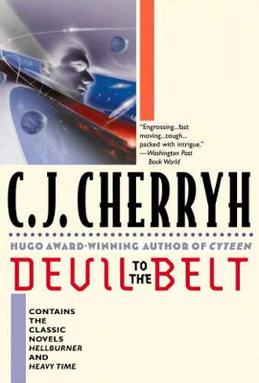
Hellburner by CJ Cherryh
1. A few months back, a friend and I lamented our agreeing perception of bad quality military science fiction today. We also reminisced on some of the big points in the genre: War of the Worlds, Starship Troopers, and The Forever War. This novel by CJ Cherryh is also military science fiction: four characters being trained in a program involving a specific spaceship that is difficult to fly, the program is failing, and political and fleet maneuvering try to save it from failing or hurry it on its way. Like Cherryh typically does, this is a novel based on interpersonal interactions first, political maneuvering second, and damaged people trying to find their way. So if you’re looking for military science fiction with depth, try here. There isn’t a stitch of combat until the end, but that ends up just being a test run. I do not think you need to read the prequel, Heavy Time, to understand this sequel or the characters, but Cherryh advises that you do.
2. There are five main characters in the novel: Meg, Sal, Ben, Dek, and Graff. And all of them change significantly throughout the novel.
—Graff sort of runs the show—that “sort of” taking up a bunch of the plot. He’s constantly uneasy at absentee management and that his direct superior in the program is not a part of his branch of the military. At the beginning he is sure of himself, but that’s quickly destroyed. By the end, as the scope of his influence spreads, and more importantly, as he realizes that it spreads in some ways and contracts in others, he is much more comfortable and effective in a wider variety of situations. For instance, the Graff at the beginning would not have been able to be so smooth in the press conferences at the end. He has changed throughout the novel to reflect the influences he comes under within the novel.
—Dek, recovering from an assassination attempt and heavily drugged up at the beginning, slowly gets his feet under him and learns to filter things out better. This is an ongoing process for him: coming to terms with the death of his team and their replacements, who are from an earlier point in his life he has cut off. By the end, he’s able to accept simple luxuries because he finally believes in himself.
—Ben begins by running away from hands-on work, believing he’ll be happier in some lab somewhere in Stockholm. But the fleet co-opts him and he finds uses for his skills that help his friends. He goes from an asshole who needs nobody to a man who comes to rely upon his friends deeply, and justifies their relying upon him as well.
—Sal is the one who doesn’t change much within this novel. She changes from the last novel to this one, but most of her change was in the prior novel, and this one helps solidify those changes in her. However, off-screen, between the novels, Sal’s greatest change occurs. At the end of Heavy Time she became a Shepherd, her goal. But eventually, between the novels, she realizes that Meg is more important to her by now, so she follows Meg into this novel. Coming to terms with this change in her is her story arc.
—Meg begins by being the egotistical, slighted political reformer and pilot. But through the training program, realizing her own age, the social situations on the station, and Sal’s kindness in coming with her—she eventually comes to a stable, happy place in her life. Some of that anger burns out, some she discards, the useful anger she keeps. And she becomes the first at something, proves herself to herself, echoing Dek’s journey but with specific points that are unique to Meg.
—These changing characters are the central focus of the novel. The plot supports their changing throughout.
3. And these changes are the theme here. By their changing and growing understanding of each other, the whole war effort is benefited through the program they save. In other words, improve yourself and many of those around you will also improve; find a place to fit in and don’t be surprised when you need to change to fit it too; and find a way to fit your situations without betraying your self. Tanzer’s method of leadership—anger and regulations—doesn’t fit who he has under him, and so he fails. Porey’s method of threats and grace in equal measures also don’t succeed. But this group of five people who ignore the chaff to learn to work with each other through understanding and kindness end up saving the whole program from ruin—and themselves in the process. This theme of communication leading to understanding leading to discussion leading to success is central and there are many, many smaller examples of this: Keu almost loses Graff’s efficacy through Keu’s lack of communication, but Saito and Demas pull him back; the first communication between Dek and his mother ends up averting a major political situation and more riots; Rob communicating a simple handshake to Dek helps diffuse a powderkeg; etc.
4. Again and again Cherryh changes her writing to fit the plot and characters of her novels, like she does here. This is a military training facility with military characters, and it reflects that. A lot less situations are gray areas while a lot more end up being black and white. Chain of command, word choices, training, regulations, gratuitous language—these all fundamentally change Cherryh’s writing. Meg and Sal, as they acclimate to the situation, are less flashy and more military by the end, and this change spread throughout helps set the tone of the novel. This tactic is incredibly effective at world building and drawing the reader into the novel.
5. And really, I don’t know what else to say. This novel is fantastic. There is no intro-info-dump, no last page reveal, no slow start, no wasted scene or word, no extraneous character, and no hint of deus ex machina. But of course it isn't just some list of how she writes: it's what she writes. This list just indicates which tactics she uses and which she avoids, indicates how much she respects the reader's intelligence rather than spoon feeding them, indicates the craft of her writing. The writing could pay a little more attention to description, but the payoff in world building with Cherryh’s tight voice is certainly worth that niggling lack. And the description of the ship from Meg’s eyes is wonderful. This is clearly one of her better works and, despite what she says, I think it does stand well on its own and can be read without first reading Heavy Time—though that’s not to say that Heavy Time is bad. This is a novel first, and a sequel second—which I couldn’t say about Regenesis. So far, I think it’s one of her best.
“The enemy of my enemy,” Demas said, and took the bottle up, “threatens both our livelihoods.”
25 June, 2016
Heavy Time by CJ Cherryh
1. The book begins with mining partners Bird and Ben stumbling across a distress signal in their Company assigned sector of the solar system’s asteroid belt. Obviously, because so much book comes after this first chapter, they don’t find something simple. Entering a ship identical to their standard, ubiquitous mining craft, they find a man named Dekker—not the only cyber-punk pun in here. Dekker’s physical state requires medical intervention and a quick trip back to home base, Refinery 2. While heading back, they realize Dekker is psychologically broken. Dekker has floated for 71 days with minimal life support after his partner and lover died on a space-walk. Dekker is convinced Cory was run down by another ship, a Driver who was trying to jump their claim. Ben responds to Dekker negatively, taking a typical Belter attitude towards something perceived as inefficient—insanity, in Dekker’s case—and trying to either stop it legally or dispose of it illegally. The inefficiency is what the problem is to Ben, and he sees Dekker's insanity as simply that. At the same time, he convinces himself Dekker’s ship will become his and Bird’s valuable salvage. Bird, being a blue-skyer, a human from earth, responds positively to Dekker, deciding to try and help this poor miner as much as he can. And this set-up, all in the first couple of chapters, introduces the central story elements that the rest of the novel revolves around. Dekker attempting to come back to reality and heal, Bird and Ben trying to get the salvage on his ship, Meg and Sal helping and attempting to secure the first place in line for leasing the potential new ship, and the political intrigue of this very messy situation with the Company, the proto-Mazianni military using the mined materials to build their carriers, the other freelance miners and Shepherds agitating for better conditions and pay, and the diverse political scene within the solar system. Throughout the novel, everybody is piecing together what happened to Dekker, even Dekker, and figuring out how to use his situation to get the Company to screw its employees less. Every chapter or so, Cherryh repeats Dekker’s basic situation and adds a little each time, expanding upon the basic personal trouble of the first couple of chapters to include the wider political context. And as strong as this tactic worked in Merchanter’s Luck, it works brilliantly here. I think it works better because of two reasons: the political context is much wider and more foundational to what the reader probably already knows from other novels, though it is still very much behind the scenes; and the addition of a honest-to-God earthman, Bird, gives the reader a familiar face, a point of reference to understand the rest from. Bird is extremely useful to the reader in this role, especially with Cherryh's tightly focused voice.
2. Kind of like Bet Yeager in Rimrunners, Bird, Ben, Sal, Meg, and Dekker are low-life freelancers, similar to gold miners during the gold rushes. They enjoy dark bars and dangerous living. They're skirting the law and trying to get rich. Where Bet was an ex-soldier, these are career miners. Sal, Dekker, Ben, and Cory want out, want a better life eventually, but while they are in, they embrace the low-lifestyle of the almost criminal underground.
—But the politics, mostly behind the scenes, keep poking influences into their lives. The Shepherds are using Dekker’s situation to try and strongarm the Company into making their employees’ lives better, and they're doing it through Sal, who wants to be a Shepherd. The military uses it as an excuse to take over the Company and restructure it to more efficiently give them the materials they need to build Mazian's fleet. The Company tries to keep it quiet and cover it all up to keep the status quo and their power. All of these influences drive the central five characters in the story, forcing them into situations and repercussions that are unforeseen by these people at the bottom of this chain of command.
—Like Cherryh typically does, the novel matches the story of these characters through word choices which embrace space mining shorthand, scenes which require the characters to respond in ways that only criminals and revolutionaries would, and their ignorance about the political currents which are driving their lives. This tactic of conforming the story and writing to the characters really works wonderfully to make a rigorous and interesting novel. But it also leaves big elements all-but-out of the novel: like the characters, the reader is confused about why certain things are happening until all is revealed in the final chapter.
3. Cherryh utilizes a variety of voices in this novel to define certain classes of people. Meg is a revolutionary and is always deprecating the Company. The miners are no friend of the Company, but they’re more understanding than Meg. Sal and Ben are scientists and end up being more cut-and-dry, talking statistics and logic. The doctors and orderlies have bedside manners that don’t quite communicate clearly. And each smaller group—military, security, traffic control, corp-rats, shepherds—has distinctive characteristics as well. The Corp-Rats speak in precise ways that utilize words from their operating manuals. But Cherryh’s typical tight third person voice also affects dialogue, spitting it at the reader without stopping to explain and leaving the reader to imagine the characters’ responses. This can be confusing at first, but it all eventually makes sense as the characters mull over their situations and explain things the reader may not have gathered at first. However, the variety of voices does help the reader define the speakers in the novel very quickly and efficiently.
4. Dekker’s chapters engage in some experimental writing utilizing fractured sentences and a deeply unreliable narrator to communicate both the story and Dekker’s state of mind. This writing effectively shows and tells simultaneously. The most impressive part is the balance she draws between information and the unreliability of Dekker as narrator. She manages to both communicate and obfuscate simultaneously. It’s fantastic and strange.
5. Because the reader and miners don’t really know what’s going on until the final chapter, the pacing ends up a little slow in the novel. The reader isn’t sure what’s going on for much of the novel, so it raises the question of whether all the scenes add to the characters or story or argument or world-building. That last-chapter reveal explains most of the scenes, but I’m still left with the impression of being lost for much of the novel. For such a short novel, this isn’t too much of a negative, but it does make it drag on a bit.
6. The theme here is Bird’s helpful nature versus Ben’s selfish one. Neither are perfect, but the combination is effective. It’s a microcosm of the political changes the solar system is undergoing at the time, within the story. But it’s applicable to the reader as well, as each of us needs to find our own balance between trying to help or protect oneself to the extent of the law, and allowing forgiveness and helpfulness to temper our actions and open us up to vulnerabilities or to an unrealistically optimistic and trusting way of life. It’s clear that understanding reality is important, but Ben is constantly unsure whether Bird has his head in the clouds or is acting in a safe way among the Belters. Bird’s natural helpfulness is not a problem only when it is tempered by reality, and Ben brings that tempering influence in order to make the whole partnership work well. Similarly, Ben relies too much on the laws and bureaucracy to be a well-liked member of society, but his association with the well-liked Bird helps him overcome this. Together, both will live longer in the Belt than either would being in a partnership with somebody who agrees with them.
7. There is no intro-info-dump here, but the last chapter reveal is moderately annoying—as it is in comic books. In order to avoid it, Cherryh could have spent a lot more words on this story, including characters from other stratas of this society to show the political influences more clearly and keep the reader tracking closer to the plot. But that would have demolished the meandering tone of the novel that, as slow and frustrating as it is, effectively communicates what the life of a space miner on three month shore-leave, known as Heavy Time for the influence of gravity, would be like. I haven’t really seen her try this meandering style of storytelling before, so it’s fun seeing her try something new. I like this novel, but it’s not her best. I think she found the breaking point for her voice where not enough is on-screen to really keep the plot moving. The novel stands on its own well, but by having read some of the others in this series that take place after this novel, this novel is also a fascinating look into a part of the story I hadn't come across yet. Good stuff, not great.
18 June, 2016
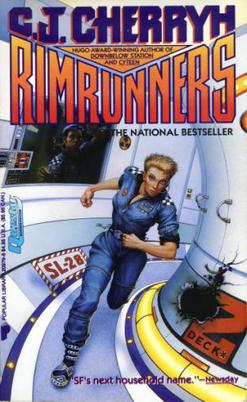
Rimrunners by CJ Cherryh
1. And the intro-info dump returns. It’s still not the best way for Cherryh’s writing, but at least this one is short, like three pages short. There is that. Alright, I’ve complained about this way too much, or not enough, so let’s move on.
2. This novel, unlike any of the other Cherryh novels I’ve read, focuses on one character, and that character isn’t at the top of a corporate or governmental body. Bet Yeager, the main character, begins the novel homeless and starving, in the midst of criminal activity caused by desperation, sleeping in a public restroom and washed up on a dying space station where she is the victim of sexual violence twice in the novel itself. She is a spacer and, as the novel progresses, the reader slowly finds out that she used to be a Marine on the Mazianni ship Africa—a low position on board, and she was just a sergeant, mostly because of time and experience. Then she gets a job on Loki, a mechanic position. Loki is a spook ship that sits around transfer points in space to gather information, then sells it—not exactly glamorous or trusted. The point is that where other Cherryh novels tell their story from a top-down perspective, showing the heights of society struggling to guide their society—even if it is just a washed-up captain who owns his own ship as in Merchanter’s Luck—this novel is about a low-life who was left behind by her ship during the events of Downbelow Station—expendable and expended. The every-woman focus fascinates and provides a picture of Cherryh’s world that I hadn’t yet seen and it really adds to the world-building of the whole. But in the specifics of this novel, it remains admirably rigorous to its focus. The characters of other novels are sometimes talked about by these plebeians, when their decision impact Bet, but they never show up. The captain of lowly-Loki only shows up twice in the novel, reinforcing this focus of Cherryh’s.
3. And Cherryh’s writing, as always, changes to fit her characters. Here the rougher dialogue helps illuminate the characters, the topics of conversation fit their desperation and ignorance, and the methods of interaction are more cut and dry, less polite and politically correct. The colloquialisms used by her and those around her reflect general shipboard colloquialisms, rather than the specific, esoteric colloquialisms of Reseune or Pell Station. Bet makes mistakes, big ones, and is punished immediately. That’s not to say there isn’t any politics—one of the points of the novel is that politics affect every strata of a culture. But Cherryh realizes her story and changes her writing to fit that, to support that, to reflect that. She doesn’t change everything, just modifies word choices and sentence structures to fit the people she is talking about. It’s a tactic that more writers need to adopt.
4. Instead of her typical third person, she loosens things up a bit and writes in second person quite often—a few times in each chapter. This helps the reader identify with the characters because there is a similarity there: advice and wisdom are often given, to oneself or others, in the second person, and most of the second person sentences are advice or wisdom. For instance:
But past is never past, man, past is, that’s all; all you can ever get at is what is now and will be.This example of the writing shows how her voice and her writing changes in this novel to fit the characters who people her novel. This second person voice adds to her typical voice, not replacing it. As such, it strengthens her writing.
5. The theme here is about the past and how it comes back to haunt us in unexpected ways—a similar theme to Merchanter’s Luck, sure. But Cherryh doesn’t repeat her earlier book, she uses this theme and adds to it by saying that kindness can overcome a lot of the past’s repercussions. For instance, being an ex-Africa trooper, Bet doesn’t want to take a position on a ship heading towards Pell, where ex-Mazianni are reviled and actively hunted. So she stays on at Thule and ends up having to kill a couple of people to protect herself. In other words, she makes a decision attempting to protect herself from likely repercussions for her past, and ends up still being in danger. Later, on Loki, she befriends another social outcast and worries what he will do once he learns of her Mazianni past. But on Loki her kindness protects her from the worst of the ravages of her past. Oh, she gets beat up pretty badly, but she doesn’t die, she doesn’t have to kill, she ends up fixing some situations onboard through her direct actions. And what allows her to have that influence is the kindness she has sown throughout the preceding chapters.
6. Cherryh writes political intrigue at a rigorous psychological depth. When talking about Reseune, she told the psychology and showed it. But here, with a plebeian as a main character, the psychological depth resembles pop psychology through the colloquial language used instead of scientifically specific language. She shows the psychology here, rather than telling it. This works well and allows the reader to interpret the story in terms of their own experiences and similar experiences they’ve heard from others.
7. I like this book a lot. Yeah, there are uncomfortable instances of sexual and physical violence, but those are used to build the character that the whole book is focused on. This focus on one character allows Cherryh to get to a depth in building Bet that really works. The story, being focused on her, excludes the greater political picture except in how it affects Bet directly. Even in Merchanter’s Luck, a book about a loner, the greater political picture bleeds into the story some. Here however, it all but doesn’t: this is a snapshot of the life of a normal citizen in the Alliance—well, as normal as we've seen. Bet has a past, but in this post-war situation, who doesn’t? It’s a great story and good, good book.
14 June, 2016
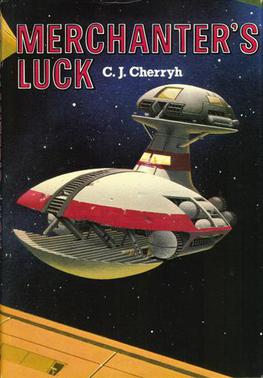
Merchanter's Luck by CJ Cherryh
1. This short, 208 page novel resembles none of the other three Cherryh novels that I have read so far—Downbelow Station, Cyteen, and Regenesis—but it also sort of does resemble them.
—This is an adventure novel. It’s a straightforward narrative with rising tension and a resolution after the crisis. It’s almost pulp fiction and can certainly be read and enjoyed as such. However, being Cherryh, it still delves deeply into the psychology of Sandor and Allison. They’re both merchanters, the smallest and biggest sort, respectively. Sandor has lost his family and is alone on his ship, going crazy in the blackness of space from: the stress of no job prospects, mounting debt, less and less friendly places being open to him, the constant threat of pirates or Mazianni, his past haunting him, and, most of all, simple loneliness and paranoia—some of which is justified throughout the novel. Allison is under different stresses: overcrowding, lack of advancement opportunities, self-doubt through knowing she is untested, and routine boredom. Cherryh focuses on the most applicable psychological stresses: loneliness and self-doubt. That psychological focus and discussion matches the amount of adventure in here, making the whole as literary as it is all tied into that pulp plot and pacing.
—No intro-info-dump accosts the reader’s first lines. And this absence makes me really happy because I was worried that all of Cherryh’s books would feature that oh so awkward of openings. But here, she fills in the backstories of the main and minor characters skillfully throughout the novel—taking moments when they are alone with their thoughts to reflect on how their situation now differs from their past lives. For instance, the whole story of Sandor/Ed’s dead family is not fully revealed until the last chapter, but most of it is revealed early and revisited throughout with additions to the story every time it comes up. It’s a great tactic to show Sandor as a character really well: he keeps reliving the horror of his past, and as it comes up again and again, with more detail each time, the reader is shocked and sympathetic to this character who is actually quite unlikable. He’s understandable, and his reactions are logical from his screwed up base, but I wouldn’t want to hang out with him—until maybe the end, that is.
—In these two ways, and others like them, I see Cherryh as both writing to her strengths and trying new things in this book. It adheres to Cherryh’s typical storytelling, but also deviates from it in a way that provides an appreciable variety. The new things she tries are done well, and the old things too.
2. This is a book of contrasts. Wealth and poverty are paired together in Sandor who owns his own merchantship outright and alone, but has no money to speak of. Skill and inexperience pair in Allison who is trained and practiced in simulations, but untested in reality. The main characters cross the Line between Union and Alliance, and then Alliance and Mazianni. Through these contrasting points, the novel is able to show how some contrasts strengthen the whole, some weaken them, and most do both. This theme feels complex enough to support a longer story than Cherryh chose to tell, but even in this short length she creates some interesting conclusions that got my mind working.
3. The writing here is great. I’ve already praised the storytelling tactic of revisiting Sandor’s family’s death—a tactic engrossing to both Sandor and the reader. But I think it works so well because the writing is a retelling where each retelling adds details and wrinkles the repetition to make the whole story more and more horrifying. It echoes itself throughout the novel and it’s a relief when the resolution hints that Sandor can start a new family. I like repetition in poetry—Yeats does it so well—and this is repetition in prose done right. It’s not a direct repetition, but a re-explanation, like when a teacher restates something the students don’t understand at first. I fully intend to steal this writing.
4. One thing I didn’t enjoy is the stupendous achievement Sandor makes in time from Viking to Pell. After it’s done, Cherryh explains how impressive a feat it is. But before that, I didn’t understand how impressive. Cherryh could have done more to explain during the journey what is so unusual about the action: but with the worldbuilding not setting the stage appropriately and her voice, that tight third person narrative (explained in point three of my notes on Regenesis), she is backed into a corner here because Sandor is tranquilized during the speed run, so he isn’t quite able to make sense to the reader. We also have not yet seen a normal journey of this length, so it’s unclear what makes this one unusual until it's over. I thought maybe this was how all journeys went when a ship had a solo crewmember. She does a good job of explaining it later, especially with the journalists' and Reillys' responses, but some more foreshadowing would’ve helped here.
5. However, Cherryh's use of her voice is not a mistake in the rest of the novel. For instance, when Sandor is on the dock at the start, there isn't that much description given because he isn't thinking about it—at least not until he chases Allison into an unfamiliar, expensive bar the likes of which he has never seen. But then, when he gets back on his ship, the intricate way that Sandor is shown thinking about his ship both describes it and communicates his utter love for it. Sandor's ship is a big part of the whole novel's plot: Allison wants it, Mallory wants it, Australia wants it, Sandor wants to keep it, Viking dock wants to detain it, Pell wants to shoot it out of the sky, etc. And Cherryh has foreshadowed the importance of the ship itself through this contrast in description at the very start. By the time Allison gets her idea, I've well understood the importance of the ship and Cherryh doesn't need to explain it to me. Wonderful stuff.
6. I enjoy this novel a lot. It’s a quick read, an exciting adventure, but there’s still some political backstabbing, interesting psychological discussion, and enough intrigue to prove that this is a Cherryh novel. It’s solid and engaging. It taught me that repetition in prose can be a really strong tactic to build characters and stories around.
12 June, 2016
Regenesis by CJ Cherryh
1. This sequel to Cyteen starts near where Cyteen left off and discusses another year in the life of these characters. However, Regenesis assumes that the reader has already read Cyteen to the point where it doesn’t stand on its own very well. In a sense, this novel is a character study of Ari. This character study is driven by two things: Denys Nye dying provided the opportunity for Ari and the kids to take control of Resuene and organize differently than Ari I had; secondly, Ari II is different from Ari I—how different can she be without straying too far from Ari I while still retaining the benefits of her predecessor? These two are intrinsically linked: without being different, Ari II wouldn’t want to change things; and without things being changed around her, Ari II wouldn’t be different. These intertwined twins of conflicts propel the novel from being simply a chronicle of Ari to being an engrossing story in its own right. Also, Union’s post-war economy and politics have changed, and that rapid and unexpected external change is what these characters are dealing with. By the end, one realizes that it takes hard work, long study, and a lot of stress to retain the power of the parent in the younger child, no matter the privilege. This theme gets satisfyingly in depth. Ari reaps both benefits and detriments from her predecessor/parent: her predecessor was powerful, but not well liked. Ari has to deal with that while she is coming of age. It’s a satisfyingly complex and diverse theme and story that remains interesting and applicable throughout.
2. The structure here perfectly matches and tells the story.
—By slowing down the novel for the action—spending more time and words on the violent or complex days—Cherryh inherently signposts that those portions are important: the extra description of them, and reading time spent on them, communicates this. But she reinforces their importance through the chapter titles that tell the day and time of the chapter’s beginning—down to the minute. This labeling is a reference point, a landmark for the reader: even though the novel is chronological, pointing out the gap or lack of gap between documented portions of the story helps the reader keep track of the story. Again, like in Cyteen, this is a structural tactic that I rarely see used well, but Cherryh does by using it to cut out scene-setting in a novel that has a lot of scenes over its 592 pages.
—Simultaneously, she does not ignore the down-time. Cherryh uses it to allow a natural place for rumination, for the characters and the reader to reflect. She even summarizes actions of the last few chapters at times, in the characters’ minds, ending with a sort of, “What a day” conclusion. This helps explain the importance of the important bits, helps the reader know what’s going on and why the characters care. But more importantly, it allows Cherryh to draw meaning out in a way that feels honest to human psychology—sometimes the moment is too chaotic to fully understand the implications, but a little reflection can unlock a lot of wisdom.
—She paces the book well through this structure in order to not overburden the reader with too much rumination or too much action. Rather, the action and the rumination are split, like in normal day-to-day life, but the book is constantly going back and forth between the two instead of being all action for the first three hundred pages, and all rumination for the last. She doesn’t keep the pace up too high for too long, or too low for too long, instead allowing the chapter breaks to switch gears within the story and bring in a slower or faster scene—or to continue directly from the last chapter to increase the tension within the ongoing scene.
—This structure makes this book easier to follow, especially with Cherryh’s typical voice. Like in Cyteen or A Song of Ice and Fire, most chapters are self-contained and it’s a strong tactic.
3. Cherryh uses a third person narrative that typically focuses on one character. Her voice is so closely tied into the character’s thoughts that Cherryh will not describe what the character is seeing fully—if the character has never ran foul of security, they will not notice the security around, and the reader will not know if security is around. Or if the character does notice something, it’s probably important because it’s new, unusual, or a problem. This is something that I adore about Cherryh’s writing because it keeps the story moving along: through this voice, Cherryh focuses on what’s important—the actions, dialogue, and thoughts of the characters—rather than what isn’t—the specifics of the technologies, the mundane, and the non-informative stuff like going to the bathroom. There are things that are unimportant to stories and Cherryh’s voice is a perfect way to exclude them.
4. The writing allows places of beauty and places of efficient prose. This use of prose is common and Cherryh does it well here: the description of the new apartments are incredibly effective at communicating beauty through beautiful images and language. But other parts are efficient prose that concisely describe things that are not beautiful with more normal language. This variety is key to my enjoyment of Cherry’s novels because as it’s constantly changing, I am entertained by the variety.
5. Cherryh deals with the characters changing well: Justin and Ari are perhaps the two most significantly changed by the events in this novel. And though Justin is a new man by the end, part of the administration that was his antagonist for so long, he is still Justin and still influenced by his time as a consistent suspect. Ari is finding herself through the intense expectations on her and her otherness in being partly her predecessor and partly herself. By the end she knows which parts are her and which parts are Ari I, and she takes a number of conscious choices throughout the novel to utilize the best of both and become a middle ground that she desires. This example shows Cherryh using the science fiction cloning technology to make the coming-of-age narrative explicit. It’s a fantastic use of science fiction to take something we almost know and make it strange in order to explain it: here Cherryh illuminates how we deal with the beliefs of our parents as we come into our majority, discarding some as old fashioned, some as ill-fitting, and keeping what we agree with after we’ve had a chance to reflect on our own experiences. Justin and Ari are not the only characters that experience these changes—especially from the start of Cyteen to the end of this book—so this is a theme explored more than just how it relates to Justin and Ari. Cherryh does a great job at changing the characters in fundamental ways, but keeping enough of what was before that it feels psychologically honest.
6. There are a couple of points where the story seems to forget threads that are not resolved, but these specific dropped threads do not bother me because the book is a character study of Ari—let me explain.
—I could complain that the unrealized looming visits by people who were sent away during Ari’s childhood creates a dropped plot point, but I don’t think they actually do. The important thing to the novel is Ari’s realization that she isn’t that little kid anymore and these people have lived their own separate lives for more than a decade: they were not placed in existential limbo by being separated from her, they are complex humans who she does not know. This realization is incredibly important to the novel because it shows Ari that she isn’t the little kid anymore, as much as she is needled by Justin calling her a kid. It also slaps her in the face with her own ego: she is just a dim memory to them and her obsessing over them for years is a sign of her strangeness. It reinforces the coming-of-age theme and signals the beginning of the end of that process for Ari.
—Similarly, Yanni and Hicks are suspected of malfeasance by Ari, but are cleared in ways that are not as complex as some of Ari and Justin’s changes. But again, the book focuses on Ari, not Yanni and Hicks. Ari realizing that Yanni is not a threat is a big step in explaining Ari and her growing up. She shows that she is able to contextualize a person and realize what that person is in a way that children do not. Yanni is neither enemy or friend, but he’s his own person and agrees with Ari in some ways while disagreeing in others. To me, since the novel is a character study of Ari, this reason for dropping suspicion of Yanni satisfies the plot point of suspicious Yanni sufficiently.
—So even where the story seems to forget things or drop threads, they are used for what Cherryh is doing in the novel, for what is important to the novel. They are not forgotten, they are used and moved on from.
7. In all, Regenesis is a fantastic book, but it’s only a sequel—it assumes the reader has read Cyteen and it doesn’t stand well on its own. The fact that it’s not as popular now as Cyteen was twenty years before is a sign of how times and science fiction have changed. Nearing the end of the Cold War, this Eastern Bloc focus was on everybody’s mind, but is now not thought of as often.
—Meanwhile, science fiction has begun to reflect the political correctness of the culture today, and that means that the Azi, the human clones that are essentially a second class within the society, or slaves by most reviewers’ reckoning, are just not popular today. People have a problem with Cherryh not explicitly stating that she is against this slavery in the novel. She says that the specific people trying to save the Azi are more earnest than wise, but the morality of the Azi/Citizen culture is a big sticking point for a lot of people. Her voice is partly to blame here: her characters make money by selling Azi for altruistic reasons that their culture politically agrees with, so it’s somewhat understandable that they don’t want to question the morality of it—like Heinlein, her characters run away with the novel. As deplorable as their ignoring the issue may be, people do it every day and we should discuss it: wearing clothes made by slave labor, buying products when the store isn’t adequately compensating the provider, working for companies engaged in adverse business practices—these are things we all deal with daily. Cherryh tackles the mindset, not the specific problem. Shouldn’t we be conscious of these things and thinking about them? They’re important issues. I don’t think I should deplore the book because Cherryh’s characters live in and support a culture that I disagree with. I should react to their culture in healthy ways.
—But I think the issue is deeper than self-deception: the Azi are a necessity for the population booms needed in space expansion on the scale of this novel—people don’t want to move from their comfortable positions, so Azi fill the role of pioneers and their children become the citizen base for new cultures at new space stations or planets. Yes, Cherryh doesn’t include what could have been the interesting implications of the Gehenna situation and its international relations fallout; but on a smaller scale she deals with those issues throughout the novel. Also, the Azi inherently reflect the citizens’ beliefs and wishes and as they create problems—Paul with Jordan, Kyle with Gerrard, or Abban with Ari I—the author might be making a moral statement: Azi are an efficient political necessity, but too little thought went into the premises of that necessity argument to allow them to be problem free—especially in military Azis’ reintegration to society, but even in small things like Caitlin not realizing that Justin calling Ari a kid may be disturbing to a natural human of eighteen who has a crush on Justin. Olga Emory is deplored for the military mindsets she pumped out over a century in the past. Who is and is not frustrated in the plot probably indicates the author’s point of view.
—In closing, if science fiction isn’t where we can discuss a culture like this and learn from it, then where can we? I’m obviously not advocating more slavery in science fiction, not by any stretch of the imagination. But I am advocating freedom for authors to discuss ideas they find important through cultures that are different than ours.
—Where Cyteen was notable for gay main characters, Regenesis is deplored for Azi slavery, and that critical and fan response is a perfect snapshot of how science fiction has changed from 1989 to 2009. This is a good book, a great sequel, and I thoroughly enjoyed spending too much time reading it and not enough time doing my chores or being social. These are important issues and I’m glad Cherryh is bringing them up. She probably means to rub the reader the wrong way with them, and I love being asked to think about things.
Labels:
2009,
Alliance-Union Series,
CJ Cherryh,
Science Fiction
Subscribe to:
Posts (Atom)