28 August, 2016

Last and First Men by Olaf Stapledon — Reread

0. This is my first reread where both reads occurred after I started taking notes. This second read was for TOOL, so will stray from this site's stated purpose to discuss ideas more. This book is available to read freely online here.


1. Three things impress me the most about this book, from a writing perspective: the structure, the tone, and the imagination of the author.
I can say only that the occurrence of mentality produces certain minute astronomical effects, to which our instruments are sensitive even at great distances. These effects increase slightly with the mere mass of living matter on any astronomical body, but far more with its mental and spiritual development. Long ago it was the spiritual development of the world-community of the Fifth Men that dragged the moon from its orbit. And in our own case, so numerous is our society today, and so greatly developed in mental and spiritual activities, that only by continuous expense of physical energy can we preserve the solar system from confusion.
—Structurally, the organization successfully keeps the whole project legible and varied—which could be a near run thing based on the scope of this book. Brilliantly, he starts with the familiar: you and I are the first men that he spends 37.5% of the book on. In that opening, he’s setting up reference points that he will get back to in later men, allowing us to have a way to understand those later men. He’s also slowly stripping away characters and narrative traditions to embrace the biological or anthropological reporting the rest of the book will be patterned on. He spends a lot of time on the first men: even the intro to the version I read advised the reader to skip the first four parts due to their repetitiveness and their placing the book so specifically in 1930. Eventually, he continues in bite-sized steps to the eighteenth men, the structure of steps allowing the reader to keep track of how we get there, one step at a time. More time is spent on the first, second, fifth, and eighteenth men, all Stapledon's favorites except the first. Some of the later variations only receive a sentence or two of description. Let me break down the pacing:
•the first 6 chapters are given over to the first men;
•chapters 7-9 to the second;
•chapter 10 to the third;
•chapter 11 to the fourth and fifth;
•chapter 12 the fifth alone;
•chapter 13 to the sixth, seventh, and eighth;
•chapter 14 to the ninth, tenth, eleventh, twelfth, thirteenth, fourteenth, fifteenth, sixteenth, and seventeenth;
•and the final two chapters, 15-16, to the eighteenth men.
HP Lovecraft believed it a "disproportionate acceleration of the tempo towards the end." This pacing struck me two ways: either Stapledon is not being as fair and evenhanded with his philosophical opponents in the second half as he was in the first, or he ran out of steam as a writer. You know when you try and fit a word onto a poster and you kinda run out of room so you mash all the letters together there at the edge and it's obvious that you ran out of room. That's what this "acceleration of tempo" feels like. This disproportion between how much time is spent on the first men, and how much time is spent on the tenth through seventeenth men, is frustrating as a reader. It feels like a little more planning or pruning could have helped.


—He never loses sight of wonder in his writing. He fills his pages with life, beauty, horror, and tells all with this tone of wonder that is necessary to the readability of the dryer philosophical theme. He chooses to repeat this biological reporting form for his organization, and it's a big risk—writing a book without characters for the reader to relate to. But Stapledon's descriptions allow wonder to carry the whole thing:
The sky turned black. The Arctic summer became a weird and sultry night, torn by fantastic thunderstorms. Rain crashed on the ship's deck in a continuous waterfall. Clouds of pungent smoke and dust irritated the eyes and nose. Submarine earthquakes buckled the pack-ice.

A year after the explosion, the ship was labouring in tempestuous and berg-strewn water near the Pole. The bewildered little company now began to feel its way south; but, as they proceeded, the air became more fiercely hot and pungent, the storms more savage. Another twelve months were spent in beating about the Polar sea, ever and again retreating north from the impossible southern weather.
—The imagination of the author is the other impressive aspect—and probably the most influential. He packs a lot of science fiction ideas in here, and the structure is what allows that variety. After all, he’s building at least eighteen worlds over two billion years. That’s a lot of room for ideas. Some are explored in the depth of paragraphs, others mere phrases. The influence of these ideas has been widespread: the fifth men are exactly Iain M Banks’ Culture Series, the moonfall that destroys them is Neal Stephenson’s Seveneves, Arthur Clarke’s 2001 is obviously inspired by the whole thing, Bradbury seems to have read this before writing “The Fire Balloons”, CS Lewis admits to stealing from Stapledon in his Space Trilogy—and the list could go on for days. So, Stapledon had an imagination that could run this wild, structure his book to allow his imagination to run this wild, and then let his imagination run this wild. Some of these ideas seem prescient when you realize the book was written in the 1920s. Staggering.


2. But that’s not to say that the theme of his book is these ideas. The theme is very clearly what makes us human. He has set up some really fascinating tensions within the book, and they reflect what make us human: Science and Art; Spirituality and Religion; Physical and Mental Environments; Heritage and Legacy; Ingenuity and Rationality; Mysticism and Empiricism. His project is a philosophical one—he was a philosopher whose books were not selling, so he started writing science fiction instead in order to expose more people to his ideas. He tries to show what makes us human, examine what we could be, and then show a path to his utopia—a utopia which even he admits ultimately fails, but it fails in instructive ways. The list of all eighteen men will help illuminate this theme:


•He begins by describing us today, the first men. But we are too short-term in our thinking, our priorities are wrong, and we embrace every new thing that comes along without proper consideration, which eventually kills us.
•The second men are one of his three favorites in the book. They’re the colloquial great men of the first men. They’re godlike, aryan giants who have more empathy, better perception, more intellect, better skills at science, math, and philosophy. But they are too much in their own heads and the horror of existence within the natural world dooms them. Heads in the clouds, they are destroyed by practical considerations. Well, practical consideration and the martians, those hive mind, radioactive, industrial fascists.
•The third men are Rousseau's wet dream. Sexually liberated, mystical about pain, focused entirely on music and the natural world. They are cunning more than intellectual. Eventually, they realize their deficiency in intellect and sciences, have an existential crisis, and end up creating their successors using the only science they know—biology.
•The fourth men are the artificial Brads: big brains living in their own towers. They are pure intellect, with no “normal instinctive responses,” to quote Stapledon, though they are natively curious and telepathic. The telepathy is a result of using some martian genetics. They have no sexuality, no community, no exercise, no values. Eventually they stagnate scientifically and create their successors.
•The fifth men are one of Stapledon’s favorites. They are Aristotilian in their balance in all things—including emotions. Their self-repairing bodies are long-lived and filled with pre-taught instincts developed from experience and reason, but they die at the proper time. They are a balance between the academic fourth men and the nature-obsessed third men: they value the influence of the natural primitive, but focus equally on art and science. They are telepathic due to martian genes, but they still disagree on a short-term basis. They recognize the reality of futility, but can only integrate it through religion. They are so perfect they unlock the secret to accessing the memories of our ancestors directly. But this leads to the infiltration of the imperfections of those past men. Through their inability to integrate futility and the influence of the past’s evils, they begin to unravel. Suddenly the moon falls in on them. This isn’t explained during their section, but a later chapter (15.4) mentions that mentality influences physicality and the perfection of their “spiritual development” pulls the moon in on them. However, they’re still great enough to escape to Venus, where they discover the Venerians, who are a base-three species instead of the human base-two. The fifth men murder them all as their only choice is suicide or murder.


•The sixth men are the first born-on-Venus ones. Part are sea-based seal kings that get wiped out by the land-based portion. These are essentially the fifth men at first, but without telepathy their disagreements are more common and they devolve to the first men. Eventually their martian genetic leftovers almost wipe them out because man is not made to be martian, duh. In Stapledon’s words, they were undone by what was inherent at their beginning. They manufacture their successors before succumbing.
During the next two hundred million years all the main phases of man's life on earth were many times repeated on Venus with characteristic differences. Theocratic empires; free and intellectualistic island cities; insecure overlordship of feudal archipelagos; rivalries of high priest and emperor; religious feuds over the interpretation of sacred scriptures; recurrent fluctuations of thought from naïve animism, through polytheism, conflicting monotheisms, and all the desperate "isms" by which mind seeks to blur the severe outline of truth; recurrent fashions of comfort-seeking fantasy and cold intelligence; social disorders through the misuse of volcanic or wind power in industry; business empires and pseudo-communistic empires—all these forms flitted over the changing substance of mankind again and again, as in an enduring hearth fire there appear and vanish the infinitely diverse forms of flame and smoke. But all the while the brief spirits, in whose massed configurations these forms inhered, were intent chiefly on the primitive needs of food, shelter, companionship, crowd-lust, love-making, the two-edged relationship of parent and child, the exercise of muscle and intelligence in facile sport. Very seldom, only in rare moments of clarity, only after ages of misapprehension, did a few of them, here and there, now and again, begin to have the deeper insight into the world's nature and man's. And no sooner had this precious insight begun to propagate itself, than it would be blotted out by some small or great disaster, by epidemic disease, by the spontaneous disruption of society, by an access of racial imbecility, by a prolonged bombardment of meteorites, or by the mere cowardice and vertigo that dared not look down the precipice of fact.
•The seventh men are the bird-men. They’re back to Rousseauian naturalism, but with Aristotelian balance applied—orgasmic ecstasy in the air, pragmatic practicality on the ground. They accept futility. They are practical and artistic. But they are also undone by their inherently unscientific nature. They assign their flightless, overly pragmatic cripples to make their successors, then they go out in the noble mass racial suicide into an active volcano.
•The artificial eighth men are giant engineers, warlike but still civilized in the sense that they don’t wage total wars. Strife is a cathartic religious experience for them. They’re industrialists who create their own successors because the sun is expanding, and they have to move to Neptune.


•The artificial ninth men are way too artificial to survive—hastily designed, fragile and miniature. But they do spark evolution and evolve extensively into the tenth men.
•The tenth are evolved naturally, so they are getting back towards the mysterious influence of nature. They’re manipulative rabbit tribalists who know no science, so they are killed by microorganisms.
•Through evolution, the tenth branch into the eleventh, the tusked men and their hunter-trappers. These are the shortest described by Stapledon, not even getting a name:
One of these early species, crouched and tusked, was persistently trapped for its ivory by an abler type, till it was exterminated.
•The twelfth are also evolved. They’re squatters with long muzzles. They’re sedentary, social, and industrious, but destroyed by a warrior kind.
•The thirteenth, the warriors, are as broad as they are tall. They are erect and bloody minded, which keeps them from progressing as a society, and they eventually just wear themselves out.
•The fourteenth are the thick-set big brains who get back to the first men’s levels. They invent a religion of love, but they are undone by imperfect spirituality and destroy themselves.
•The fifteenth are amazing again, another second men, sort of. They work closely with their environment to gain power through geo-thermal means. They are united as a culture. Their spirituality is about fulfilling human capacities. Their main goal is to abolish the five evils: disease, suffocating toil, senility, misunderstanding, and ill-will. They realize that they’re imperfect inherently, so they decide to create their successors, not because they need to, but from their spiritual desire to perfect and exceed.
•The artificial sixteenth are analogous to the fifth men, who Stapledon loved. They have a human telepathy now, instead of the disastrous martian one. Ingenious rather than rational, they have better perception and finer motor control. They determine to abolish personal ego as the mental illness it is. They again enter the past minds, but take the past’s problems as something to solve, not something to influence their day-to-day lives. They advanced as far as man could outside of group minds, but they are still stymied by three ancient problems: time, the mind’s relation to the world, and loyalty to life versus dispassion. They are unable to solve these three, so they choose a noble sacrificial leap over stagnation, and design their successors.


•The seventeenth are the first group mind men, but being designed by single men, they’re only partially successful. The realities of group consciousness is so out of context to single men, except Stapledon himself of course, that they fail. But they step aside after making the eighteenth men.
•The eighteenth men are the perfection of the group mind, and damn close to that of all humanity, nay, all the universe, according to Stapledon. They are both more human and more animal, in their own words. They dispassionately accept reality and futility and fate. Relation with time is significantly different: time is cyclic, not repetitive, an abstraction. They are more minutely tied into their environment on both a universal and microscopic scale. They are cyborgs with ninety-six member sexual and mental groups, that can then form larger and larger groups until the whole race is united through extreme intimacy, tempermental harmony, and complementariness. They think man is perfect only in how nearly it can get to aping the universe itself in organization—and the agreement of the group minds fulfills the cosmos almost perfectly. That almost is key. Their imperfection infects stars themselves with a disease and they are doomed (This is a reach, but since the disease portion is near the fifth men pulling the men in on themselves portion, I don’t think it’s an unreasonable stretch to make). This imminent death undoes them by giving them a defined goal and deadline. They lose their dispassion in chasing their goal. They desire to spread nineteenth men to the stars and try to continue mentality, but they have not enough of the zeal of primitive man to achieve their ultimate goal. There is not enough time left. This tears them apart. In other words, Stapledon wants us to get to a place where our morals are less limiting to our intellect, where we appreciate the well done good and evil act alike, and where the only things left unanswered are what the future holds and what happens after death. But he’s afraid we’ll never get to be there because there is too much in our past that we have learned the wrong lessons from.
The ether ship is in a manner symbolic of our whole community, so highly organized is it, and so minute in relation to the void which engulfs it. The ethereal navigators, because they spend so much of their time in the empty regions, beyond the range of "telepathic" communication and sometimes even of mechanical radio, form mentally a unique class among us. They are a hardy, simple, and modest folk. And though they embody man's proud mastery of the ether, they are never tired of reminding landlubbers, with dour jocularity, that the most daring voyages are confined within one drop of the boundless ocean of space.

Recently an exploration ship returned from a voyage into the outer tracts. Half her crew had died. The survivors were emaciated, diseased, and mentally unbalanced. To a race that thought itself so well established in sanity that nothing could disturb it, the spectacle of these unfortunates was instructive. Throughout the voyage, which was the longest ever attempted, they had encountered nothing whatever but two comets, and an occasional meteor. Some of the nearer constellations were seen with altered forms. One or two stars increased slightly in brightness; and the sun was reduced to being the most brilliant of stars. The aloof and changeless presence of the constellations seems to have crazed the voyagers. When at last the ship returned and berthed, there was a scene such as is seldom witnessed in our modern world. The crew flung open the ports and staggered blubbering into the arms of the crowd. It would never have been believed that members of our species could be so far reduced from the self-possession that is normal to us. Subsequently these poor human wrecks have shown an irrational phobia of the stars, and of all that is not human. They dare not go out at night. They live in an extravagant passion for the presence of others. And since all others are astronomically minded, they cannot find real companionship. They insanely refuse to participate in the mental life of the race upon the plane where all things are seen in their just proportions. They cling piteously to the sweets of individual life; and so they are led to curse the immensities. They fill their minds with human conceits, and their houses with toys. By night they draw the curtains and drown the quiet voice of the stars in revelry. But it is a joyless and a haunted revelry, desired less for itself than as a defence against reality.


—I’m sure I haven’t caught everything he’s saying and arguing for, but the journey was fascinating. I enjoy how much he lets his opponents talk, before he eviscerates them. There are points I agree with: acceptance of reality is key, reality is futility, balance is beneficial, science and art are nothing without each other. But other points I disagree with: Stapledon’s statements in support of balance in all things contradict his attitude valuing dispassion above all; the group-think and unity trends contradict extreme complementarianism; and the idea that fulfilling human capacities through group-think and copying the stars seem to undermine the basic individuality of humanity.


3. In short, this is a fascinating and important book. All these ideas spark new ideas on almost every page! But it's importance is that this book is the hinge point between the scientific romances of Verne and Wells, between the space operas published by Hugo Gernsbeck, and science fiction as we know it today. This isn't a great book: it's a slog to get through and I think the anthro-report format is useful but boring. However, this is an important book. By reading and re-reading this, I realize the impact, the influence, and the shift Stapledon brought about. Of course, he's not operating in a vacuum, but he is cutting edge for his generation. What it most reminded me of, the second time through, was Edward Bellamy's Looking Backward, with less characters.

20 August, 2016

In the Slopes by China Miéville

0. "In the Slopes" is one of my favorite short stories from China Miéville’s short story collection, Three Moments of an Explosion, which I already wrote notes about here on this blog in September of 2015. Back then, commenter Boru raised a point that got me thinking about this story more. I find I want to dig deeper into this one story to exhume the tactics and tendencies that make this a favorite of mine. I want to learn from Miéville. But not being willing to go back to school to take classes from him, I have only his written works to study.


1. Miéville uses a third-person voice throughout. It focuses tightly on McCulloch, the character whose perspective the whole story follows—except for the few paragraphs after the reveal, where Miéville offers about a page of info dump. My question is whether his voice is as tightly focused as Cherryh’s typical voice. My knee-jerk response is that the two voices are similar. But how?
—I’ll start with an example—Miéville’s description of the island’s central volcano: “The dead volcano sat sulking, hunch-shouldered.” Here, Miéville describes the mountain without describing the concept of mountain anew. He doesn’t begin at the start, talking about piles of stones, magma in the crust, the Pacific’s ring of fire, etc—he simply states it’s a volcanic island and it’s hunch-shouldered. I understand that it’s a shield volcano, but I’ve no idea which ocean it’s in. And I don’t need to because it doesn’t relate to the theme. Additionally, the description of the mountain shows how McCulloch views the thing—I bet that Soph or Will wouldn’t describe it as “sulking”. In this example, Miéville’s voice reminds me a lot of Cherryh’s. The whole story uses this voice, not just that one example. I’ll give one more example to drive the point home: after reading this story multiple times, I’ve little idea what McCulloch’s shop looks like, or his home. And I really don’t need to. The details he does give—McCulloch watches TV while at the counter, the whitewash is peeling, and the door-bell is on the fritz—show the slowness of McCulloch’s business and life, as well as his character and priorities: he can’t be bothered to fix the bell or whitewash, maybe because of the slowness, maybe because of apathy.
—What I like about this voice is pretty simply explained: it does four things for the reader that I appreciate in prose. First, it trusts the reader to figure things out, rather than spoon-feeding all the information. Spoon feeding often comes off insulting, while this voice seems like Miéville trusts his own writing and his readers. Second, it focuses on the theme rather than focusing on the context—which keeps the ideas, characters, and story moving and changing quickly. Third, it helps explain the characters through showing what they notice. For instance, when McCulloch enters the bar, which he’s been in many times before, he notices everything anew because he’s looking for Soph and Will. That helps show his mental state. Fourth, and this is most important, it allows me to fill in the blanks with my own imagination. Like the old adage “don’t show the monster”, this tightly focused, third-person voice trusts that the reader will fill descriptions in with details more effective to themselves than Miéville could ever dream up.
—At the same time, Miéville allows himself a paragraph or two here and there—or a lengthy section like the info dump after the reveal—to break with the voice and add a little context. For instance, on page five Miéville describes a little more of the nature of the culture, from a narrator’s point of view, rather than McCulloch’s. But he focuses it all on why this information is important to McCulloch, rather than leaving it out there as unimportant details. And that narrator's voice shows how his voice is different than Cherryh’s: where she allows extensive interior monologue, he frames his breaks with the voice of a narrator who consistently refers back to McCulloch. If you squint, you could say it’s summarized interior monologue. In that fifth page example, these thoughts are not being thought by McCulloch in the now, but these past thoughts and decisions are influencing his actions in the now—it seems unlikely that he is rehashing the history of the island since he moved there, all while sitting in the bar with Cheever. So Miéville summarizes McCulloch’s past thoughts, as a narrator, placing that information right there because it influences McCulloch’s next statements.
—So, there is a difference between Cherry and Miéville’s voices: it’s only the slightest difference, but it is one I noticed. But in conclusion, the answer is mostly yes: Miéville and Cherryh’s tightly-focused, third person narratives accomplish similar goals through similar tactics. And they are both effective for me. They are not exact copies of each other, but they’re closely related enough that I think of them in the same vein.


2. There is a deep care and consideration put into every word. I would call it poetic—not primarily in the sense of the whole sounding beautiful and following syllabic or stress patterns, but in the sense that every word matters.
—The example of the mountain's description shows how that word “sulking” is doing double duty: describing both the mountain and how McCulloch sees it. Even something as throwaway as Soph buying a bag of chips comes back in later, multiple times, and ends up being important to McCulloch getting into the dig site, to Gilroy accepting him there, and to his role in the later events. A third example is calling the unknown intelligences “collaborators”, which first occurs on the second page, twelve pages before the reveal. I have no context for it, no reason to think he means what it ends up meaning. So I assume that he’s talking about the culture the archaeologists are investigating, I assume he's implying they worked together more than other ancient cultures—and he is, but in a way that gives the word new meaning and importance after the reveal. Before the reveal I think it’s an egalitarian culture, a friendly one; after the reveal the friendliness with beings so other to us gives the word a new context that still perfectly describes what the world believes about these cultures. It’s a perfect word-choice, both before and after the reveal, both in the first read and in a reread. I am massively impressed by that one word. And this one word is a perfect example of the care given to every word within the story.
—But Miéville doesn’t ignore sounds. Rather, there are places within the story where sounds are important to the structure of the paragraphs.
Digs, development, and tourism were all controlled: the chamber of commerce constantly complained.
All that consonance is an extreme example, but he also uses vowel sounds intentionally and to make the prose beautiful.
“How dare you, sir? I’m curious. Oh, for a sprinkling of the old Sodium Pentothol.” Cheevers mimed opening a compartment on his signet ring and pouring something into Paddick’s glass.
In these two example, the prose’s beauty adds interest to the writing. And the story is better for it, for having this beauty. Not only is it yet another layer to dig into in this complex and beautifully crafted short story, but it also raises this prose well above the typical prose and shows how much hard work went into it.
—This level of care and consideration is a ton of hard work, and I appreciate it whenever I can find it. These are stunning combinations of words, taken as a whole, but he doesn’t let the beauty run away with the tale—it’s still efficient and tight prose that communicates effectively. Miéville shows brilliant balance, coming down on the side of efficiency, but not letting that stop him from writing beautifully. For contrast, Asimov is efficient and never beautiful. I vastly prefer Miéville.


3. To build the world through this voice and writing technique, Miéville often implies instead of stating directly. Like the example of the mountain’s description shows, he implies it’s a shield volcano rather than outright stating that the island was formed from a shield volcano. The old name of the bar, “Cunny Island”, implies that it used to be a brothel or strip club; and it also implies something about the culture of the island’s residents and tourists before the archaeology really took off—an implication which ties into every other part of the story. The season is implied as being a week past summer weather when McCulloch is said to have packed up the beach balls and towels and packed them into the store-room; as well as with the line, “The municipality had just switched over to the winter schedule and, for a few weeks, the streetlights would start to glow pointlessly early,” a line that also implies something about the lackidasical nature of the island, the lack of precision and pace of life. The line “Friendly business competitors” implies the nature of the community of the locals now, after the archaeology ramps up. Stating that the fisherman are coming up from the bay implies something about the economics of the island without telling a detailed account of the economy.
—There is some groundwork directly stated in the way the islanders tend to preserve rather than exploit, and this is on page five. But even that direct statement implies a cultural baggage that is important to the narrative and world-building.
—In short, the story implies rather than describes the world, but implications are even in the direct descriptions.


4. This method of worldbuilding is clearly secondary to Miéville building his theme, which rests in the relationships. The relationships are not restricted to being between two people: Miéville’s relationships also include corporate ones. You can look on the complex relationships here as a family tree, each level informing the two on either side of it. For instance: the locals to the archaeologists, the archaeologists to archaeology, everybody to the collaborators; each of these relationships are reinforced through the specifics of individual relationships involved—Paddick’s relationship with archaeology differs from Gilroy’s relationship with archaeology, which is different than the locals’. Through the lens of those three relationships, a corporate relationship is built.
—However, the story is about McCulloch and his relationships to his past, the island, and other people—but again, the relationships are always interconnected, and these three categories of relationship inform and build his relationship with himself. And here is the crux of the story. Miéville shows McCulloch growing increasingly integral to his world and the people around him—that’s the plot, McCulloch changing from a disaffected semi-loner to a person who is an integrated part of his society’s structure. At the start he’s not “Johnny come lately” because he’s an immigrant, it’s because he is so disaffected. At the height of the drama he’s helping people, he’s interested and invested, and this all appears to be new for him—at least since he moved to the island. He is sucked into the whole situation by circumstance, happenstance, perhaps fortune, and it affects him. He’s watching Soph unravel before his eyes, and he can’t handle it. She knows what she wants, and now she’s furious and denied. It hits too close to home for him. He is disturbed by how affected he is—especially after the fact, after he gets a chance to step back and look at it all from the outside again. While everything dies down a bit, he ignores the phone calls and stays home in order to try and recapture his disaffected habit. But at the end, when Soph walks into his shop, he caves to his curiosity and sociability and accepts the connection, realizes he needs it. From here, will he continue to cut himself off, or will he integrate? I don’t know, but Miéville leaves us on his relationship with Soph, therefore he seems to imply that McCulloch gets back to his life while accepting a new depth to his relationships, a new need for sociability. In other words, the whole situation finally illuminates to him how interconnected he already is on the island, and he finally accepts it, somewhat. Or at least has a chance to. But he probably wants it on his own terms.
—And that relationship with Soph is never explicitly one of attraction. I don’t get the sense that this is a potential romance. I get the sense that he connects with her because he is still somewhat of an outsider, she’s friendly to him first, she can satisfy his curiosity, and later because he can help her and he shares her disappointment at Paddick’s actions. They are comrades, not potential mates, throughout.


5. The dialogue is spectacular. It’s really Brian K Vaughan level stuff. Miéville rides that line between the fractured, day-to-day reality of conversations in half-sentences, and the unrealistic literary dialogue that must always make sense in the retelling. This balance is done well and I feel like McCulloch and Cheever are fairly well-spoken individuals, but not outside the normal bell curve.
—Miéville shows that he is deliberate about matching his characters’ words to their mental states. For instance, when McCulloch arrives in Banto he doesn’t know where to go. In this instance, I would be a little nervous—he’s already shown he doesn’t know that much about Banto or the people there, and his need to stop and ask directions could induce nervousness. He's outside his comfort zone, but he’s also an islander, not a tourist. So he affects a casual, “I heard there was a dig somewhere,” and this shows his mental state spectacularly.
—But the mental states are not all shown. Miéville also tells. An example would be in the scene where he guesses Sophia’s name as Sophie and she corrects him: Miéville writes simply, “He was embarrassed.” This telling line informs McCulloch’s next statements, showing him putting on bravado to cover his embarrassment.
—The dialogue fractures even more when the emotions run high, when Soph starts shouting at Paddick. This change in the length of sentences, mixed with the word choices, drives home the drama of the situation for McCulloch and the reader.
—Through all this, Miéville stays away from explaining everything between the dialogue. Instead of paragraphs describing McCulloch’s embarrassment, he simply writes, “He was embarrassed.” This is a sentence, not a paragraph. It contextualizes more than it explains.


6. That reveal halfway through stunned me the first time. It’s on page fourteen. The first half assumes the reader knows, then they suddenly do know. They don’t know everything, but they know. It is effective for two reasons: first, it makes a reread enjoyable. On rereading I finally noticed all the mentions of collaborators in the first half, and saw how integrated they were throughout. Second, the casual, foregone conclusion tone of the reveal reiterates the tone of the story. It reinforces the focus on McCulloch’s life, but contextualizes just how disaffected he is. He lives in this place where the collaborators are a daily reality, and he’s still this disaffected. The collaborators are amazing! They’re unprecedented! They’re fantastic! They change everything about Earth and humanity. But they’re already commonplace to the islanders, even to a new one like McCulloch. Sure, he goes to see the exhuming, but only because it’s a notable one. And even there, he's sort of nonchalant about the whole situation, especially compared to the excitement of the archaeologists.
—The collaborators are just another piece of this story, McCulloch’s story. They’re the most fantastic context, but they’re not the point, like they would be in many other speculative fiction short stories. The collaborators are subsumed beneath the relationships of the characters. Sure, the archaeology is central to the characters’ lives, but the story is the characters’ lives. That’s why the archaeology is in here—to help explain the characters—not the other way around.
—The question here is whether the reveal overwhelms the story or not. The danger is that the reveal is too fantastic, distracting too much from the focus of the story on mundane McCulloch. It didn’t affect me this way because even the reveal is as nonchalant as McCulloch—reinforcing the story’s thrust in the heart of the distraction. But I can see a reader being overwhelmed by it. On rereads the focus on McCulloch was driven home more than on the initial read—I was less astounded by the collaborators when rereading. But that comes with the knowledge of the reveal.


7. In all, this story is memorable to me, and I hope it’s influential as well. The reveal certainly took my breath away the first time, as a writing tactic more than for what the collaborators are. But the dialogue, the world-building, the character of McCulloch, and the voice astounded me more.

12 August, 2016

Distrust That Particular Flavor by William Gibson


1. This is a collection of essays by William Gibson. They range from personal essays, transcriptions of lectures, prefaces to books he didn’t write, reviews of books he didn’t create, etc. The breadth and scope of discussions, ideas, and topics impresses—I half expected this to be twenty-six essays on technology influencing culture. And though a few essays touch on that most Gibsonian reflection, in no way is this an Ayn Rand book restating the philosophical premise every five pages. Through the varied approaches, topics, and purposes of the essays, much more is said than, “Culture is technologically driven, mmkay?” I guess what I’m trying to say is that, being interested in Gibson, I love this book, but people who are less interested in thinking about the ways culture and technology interact might need an angle to pick this book up, might need to be led to which essay has something they’re interested in discussing. And the shotgun-scatter of topics presented here—a selection from over twenty years of his life—should provide a gateway for most. Whether it’s literary criticism with “The Road to Oceania”, early science fiction with “Time Machine Cuba”, ruminations on the creepiness of regularly listening to dead people in “Dead Man Sings”, discussions of Japan and Tokyo as cities, or an essay about the famous Vandevar Bush essay—there are a lot of inroads here and most of them lead to interesting places. For me, my interest in his mind was key, so the whole book was a must read. But for others I’ve met, a single essay will often get them to peruse the book for other essays whose topics interest them, instead of reading all of the essays within.


2. The structure uses self-criticism to contextualize some of the less apparent essays. For instance, a long essay in the middle rambles: partway through I grew aware of how many words were being used for a discussion that Gibson would typically use less for. After the essay, in the self-critical portion, Gibson admits that, stating,
Gosh, but could this article ever do with a haircut. It’s at least twice as long as it needs to be: dripping with wholly extraneous detail. I must have had really quite a lot of coffee. Sorry about that.
But then explains why he includes it anyways:
Although it does detail my mysteriously belated arrival in cyberspace, should anyone ever be interested, while forever proving how little I actually knew (or know) about any of that stuff. I had very little idea of what I was talking about, when I wrote this. This tends to be the case when I discuss newly emergent technologies, and is always the case when one makes generalizations about depths of specialist knowledge one is still scarcely aware of. I stood, at the time of writing this, unknowingly, on a precipice.
And that is one of the questions that often comes up about Gibson: why isn’t he more of a cyborg? Why isn’t he always online? This essay explains, probably so he can stop answering that question every day. But this self-criticism also allows him to illuminate certain time periods. For instance, one essay deals with the making of the film, Johnny Mnemonic, and the joy and craziness he felt through a portion of the process, while the self-criticism admits to his later disappointment.


3. And that’s a characteristic of this book: about two-thirds of the essays are fascinating from an outside perspective. The other third navel gazes hard. That’s not to say some interesting things don’t come out of the navel gazing—the reasons Gibson was initially interested in Tokyo help contextualize the influence technology has on culture. But it’s New Journalism. Gibson’s process echoes Tom Wolfe’s attempts to write about something he doesn’t know by living there for a couple of months, then going away to write about it.


4. Structurally, Gibson’s essays often follow a bit of a pattern where multiple things are being discussed and likened and connected, then a holistic thought is pulled out of them. For example, “The Road to Oceania” is a piece he writes for the NYT OpEd page on what would have been George Orwell’s 100th birthday. It’s structure is indicative of some of the other essays:
1. 1984 is about 1948
—panoptic CCTV surveillance could echo 1984, or could seem an almost organic growth of the streets
—but 1984 is clearly about broadcasting, especially on public mood during the war
—broadcasting media in service of totalitarianism: like in certain backwards nations today
2. But that’s not us today
—broadcasting is backwards already
—we approach informational transparency: lack of privacy is across the board, not hierarchical
3. Both the paradigm and the technology have shifted from Orwell’s day
—the globalization of information is key to how we didn’t end up under Ingsoc
—transparency is egalitarian: to governments, corporations, and citizens
—but the craziness that comes with the transparency and globalization is profound and linked [I think of all the YouTube conspiracy videos]
4. Through transparency, secrets are gone
—we cannot hide truths from the future [A crooked politician will eventually be found out by the world]
—but truth (singular) still relies upon interpretation [We all saw the twin towers fall, some believe it to be a demolition, others do not]
5. Orwell succeeded
—maybe he went there so we didn’t have to, but he succeeded in envisioning his dystopia
—his dystopia is rooted in the nightmare core reality of 1948 and he succeeded in transmitting that
—but dystopias and utopias are not about the future, they are not a map to there or to the present
As you can see, the structure is interconnected and weaving back and forth. It would have been simpler to split this up into three parts: literary criticism, different types of electronic communication, and globalization of information. But rather than writing the five paragraph paper with each of the body paragraphs discussing each of these three topics, they’re interwoven in a way that makes the whole apparent: of course these three topics cannot be talked about separately when the framing angle is 1984. I didn’t realize this before reading the article, but now I can’t imagine not discussing these three together in that frame. It’s a wonderful structure at engaging the reader and trusting they’re paying attention. These notes of mine are notes, where I’m trying to separate things in order to organize my thoughts into points about different aspects or topics: Gibson mixes them all up in order to have a wall of sound-esque flow of information.


5. In all, this book of essays is profound and seems obvious after reading, but revelatory while reading. Some navel gazing, but most are applicable to me today. I enjoyed reading these essays, though books of essays almost always require breaks between reading to let the mind mull over the thoughts presented. I’d read some of these essays before, but having them collected is a worthy addition to my library.

10 August, 2016

Fires of Azeroth by CJ Cherryh


1. This third book in the series somewhat lightens the mood: where the last two worlds precipitated and warred constantly, this one has dark elements, but is much more peaceful and traditional fantasy adventure tone. Think Tolkien, as one often does in fantasy, though she pulls little else out of that writer’s works than a balance of pain and pleasure that allows the book to be enjoyable.


2. In short review: Roh’s army and the heroes end up on a feudally peaceful world, sexual tension still intact after the kiss at the end of the last book. Roh breaks with the army early while Vayne and Morgaine get allies for once. Vayne is then separated in an ambush and taken to Roh.
—And this is where Cherryh starts to show what she will become: through exploring Roh’s situation, both complex political intrigue and deep character study come to the fore in a few successive chapters. Cherryh ignores Morgaine for these chapters, preferring to discuss Roh’s struggle with his other self, using that as a springboard the allow Vayne to change in meaningful ways. The building tension through Morgaine's absence for chapter after chapter engages. Later, Morgaine recognizes Vayne’s changes when they are reunited and reinstates Vayne as an honorable warrior, which necessarily changes their relationship too. This is classic Cherryh and it really sucked me in: she is skilled at psychological and political drama.
—Back to the recap: Vayne and Roh call on Vayne’s allies to lead them to Morgaine, which they do, but the army follows. The army tears itself apart when the leadership is decimated—mostly by the main characters—and the novel ends peacefully.
—I include this recap for two reasons: first to point out that Cherryh realizes her strengths, or writes what is interesting to her, and creates a complex world populated by complex characters; second to show that the novel is really in three parts: Vayne and Morgaine, Vayne and Roh, Roh with Vayne and Morgaine. As usual, Vayne is the key element, but he actually changes here, through the influence of Roh, and that allows Morgaine to change somewhat too—she stops not looking behind her and ends up helping the world before she shuts the gate. This is a more confident Cherryh and it shows in an engaging tale told.


3. The writing is good. I remember no moments of astounding beauty or cringe-inducing writing, and the voice she later fully adopts is still somewhat tentative here. But this is better than readable.


4. The theme here grows out of the characters directly. Vayne is split between the ways of his world, and his new experience living with Morgaine’s duty. He wants to be kind and honorable, but he serves a master who lacks interest in morality in order to achieve her goals. Roh is half evil man, half good guy, and the two are struggling against each other. Central to Roh’s struggle is a desire to survive that both sides of him share. Morgaine is hell-bent on closing the gates, but realizes that it doesn’t need to involve so much destruction and hardship. In the cave she plays up her badassery for her purposes, but at other times she actually becomes gentle and loving to strangers. All three are finding their strengths and weaknesses and balancing them. Morgaine’s anger and stubbornness is used as an asset alongside her humanity. Vayne’s love of Roh is finally placed in a proper context in his role as Morgaine’s slave, and it ends up helping his master. Roh’s struggle is able to help all three in his selfless acts, born out of anger over what gave him that split personality. This theme of using our traits and emotions for better ends is throughout this novel.


5. In all, this is clearly the best of the first three novels in the Morgaine cycle of four. I don’t have the fourth yet, so we’ll see if I ever find it and get a chance to review it. But in terms of focus and worldbuilding, Cherryh is really coming into her own here and I like Cherryh a lot, so I’m a fan. But it’s not a great book. That structure feels weird, as if each of the three parts doesn’t quite fit together: it feels like a different author between the first part and the second two parts. It’s not a small complaint, but it’s not debilitating.

04 August, 2016

Well of Shiuan by CJ Cherryh


1. So much better than the book right before this—changes that speak to a massive amount of growth as a writer between Gate of Ivriel and here. These notes are trying to figure out why I like this so much better and what changes Cherryh makes? I feel justified in this comparison as the four Morgaine stories are often published in a single volume, and this one starts seconds after the last one ends.


2. Gone are the awkward, fantasy word choices like “hi” being used for directions or spatial physical relation. She still uses a couple of awkward phrases, such as “did he turn around, he was sure to see her tears.” But that bothers me much less than the poor word choices of the last novel. The writing has gone from horrid to readable.


3. The story allows more of the interesting science fiction context to color the pages. This is still a fantasy tale purportedly set within a science fiction world, but here the science fiction is present in more than just the intro info dump. Some of the alien beings who created the gates are characters within the novel. The antagonist acts on-screen in ways that support the science fictional context—rather than the last novel where he is on-screen for a short time, then is later revealed as the antagonist and is said to be chasing the main characters but we don’t see any of it until he catches them; in other words, Cherryh shows him here. Also, Morgaine tells more to Vayne—of course he doesn’t understand it, but the reader can infer quite a bit. But most importantly, those ten thousand people who disappear before the last novel—those whose disappearance is still so significant on their original planet after one hundred years—ended up on this planet a thousand years ago, and that’s a big science fiction part to this fantasy tale. By allowing the science fiction to bleed more into the actual story within the pages, the interesting and more unique elements of this world are more apparent, and that intro info dump is finally believable by affecting the world.
—For instance, Roh locks a gate and leaves a hologram message—not quite “help me Obi-Wan Kenobi”, but the same tactic: Morgaine cannot figure how to unlock it, but she teaches Vayne some of the basic controls. She doesn’t teach him the what, merely the how. It’s like telling Vayne nothing of computers except how to control-alt-delete a computer off. He knows how to do what Morgaine wants him to, but not why it works or what he is doing, or even the name of the object he interacts with. His bafflement at Morgaine’s fiddling is wonderful for the reader because they can inherently infer what she is doing—trying some key commands and common passwords hopelessly in frustration at Roh locking her out—but Vayne doesn’t. It lets the reader feel like they know more than Vayne in a way that doesn’t rely on an omniscient narrator. In later books, Cherryh does this by having chapters devoted to different characters that are acting in the same situation, but this tactic is also really good.
—In short, here it is apparent that this is science fiction told as fantasy, where the last novel is really all fantasy.


4. This story is built well. Instead of having the exciting first action occur off-scene—like Vayne murdering his brother in the last book—Jherun discovers the tomb, confronts Roh, and slashes Fwar’s face on-scene, which directly leads to her falling into Morgaine and Vayne’s hands, also on-scene. It really helps to see the action in the story. Also, by spending so much time on Jherun at the start, the world is fleshed out by the time Vayne and Morgaine arrive. It’s a more memorable worldbuilding than the last novel’s listing of clans and their characteristics. When they get to new places, contrast shows what the new places are, rather than Cherryh having to tell too much.


5. The theme of this novel is less about identity and more about trust. Morgaine and Roh both use others for their means, but trust and assumptions are the central focus of the story. The Marshlanders and barrows men trust Morgaine to free them, but she plans to do nothing like that. Rather, she manipulates their hopes to use them brutally for her own ends. When they realize the truth about her, they attack her en masse and lose handily to her science fiction weaponry. She has a mission and duty, she is driven to forgo all others for the sake of her mission, and she cannot trust any person as she is the last survivor of her team. It’s a terrible portrait of somebody with a single-minded purpose. It’s a warning about obsession and the lengths one goes to with priorities, and it all rests on the questions of trust.


6. The one part that didn’t make much sense is Roh seeing through Vayne’s deception and still trusting him in the end. My assumption is that Roh thinks Vayne not a threat, which aligns with Vayne not killing him earlier. But it is striking and puzzling when Roh invites Vayne through the gate because it doesn’t feel like it quite fits. Is it because Roh considers Vayne simple and thinks he can manipulate or trust in that? Is it because Roh is busy with guiding the whole world's population through the gate? Is Roh flush with victory and over-confident in that moment?


7. In all, I enjoyed the book, but it’s not as profound as some of her others. This is an adventure tale wrapped up in a fairly evident warning against obsession. I guess it’s probably good young adult literature, but not very enlightening or complex for me today. I typically leave Cherryh novels contemplating things like intelligence, the echoes of our personal pasts, the importance of cultural history, or appropriate levels of restrictions on human behavior. Here, the novel left me with no real burning question or topic. But I’m willing to forgive this lack of an idea rolling around in my head days later because the story is so well told and the mood is believable and consistent. At least first novel’s horrid intro info dump's second half is absent here.

27 July, 2016

Gate of Ivrel by CJ Cherryh


1. The beginning of this novel is difficult to get through: so self-indulgent in that density of unknown names in the intro info dump—fifteen or sixteen made-up fantasy names in a page and a half. Your reader has not been given the chance to know or care yet! This is the worst intro info dump I’ve read. If I wasn’t curious about Cherryh’s first novel because I've fallen in love with some of her others, I would not have read any more than a couple of pages.


2. A part of that intro info dump describes the background for the world, and another the background for the story. If you must have separate backgrounds for both, maybe they need to change. So, it’s a science fiction world that has collapsed back into fantasy—though here that familiar ubi sunt motif is portrayed as paranoia or lust for power rather than curiosity or awe or frustration. This split is not Roger Zelazny’s Lord of Light, but more like William Golding’s Lord of the Flies, which has just a single sentence showing the post-nuclear war context. And that’s interesting in the abstract. But in the specifics of this book, with one science fiction character hiding everything from many fantasy characters, it comes off confused—the context of these time-warping gates being built and people failing them may be interesting, but the story of a quest to close one of them is restricted from her intro's premise. She didn’t use that work she put into world building, so the novel comes off discongruous.


3. The writing is bad. There is a tendency in fantasy to overdo the cadence and wording of the work: “Lo, thusly spaketh your Lorde” type stuff. Cherryh here isn’t that bad, but it’s bad going that direction. The word “hi” is used throughout in situations like “she rode hi the mountain Irvel”, or “he put his helm hi his head.” Ugh. Horrid.


4. The story entertains well though. It’s a fantasy quest and chase where everything keeps going wrong: the main character accidentally kills his brother and gets banished right off the bat, then he is forced to work with his religion’s devil and gets Stockholm Syndrome, he gets poisoned, he gets captured, he is encouraged to suicide, he narrowly misses being sucked out of his dimension, he is shot at more times than I can count, his body is almost stolen from him by a soul that uses other’s bodies to continue living, he loses the key to closing the gate, he almost breaks his oath, and he’s almost left behind at the end. It’s not a pleasant quest for him. Remarkably, Cherryh doesn’t use deus ex machinas to free him from all these situations—his freedom and safety comes about from as many diverse influences as his dangers do. And, like Gawain and the Green Knight, dealing with the cold and snow in armor is almost more of an antagonist than any character.


5. The world is built through showing over time. Despite the intro info dump, it’s a growing familiarity as these names are used in the story itself. And, as implied above, the parts of the world she does include in her story are important and have effects, which really helps it all stick together well. Nothing is forgotten, except the science fiction undertones laid out in the intro.


6. So, in all, not my favorite Cherryh novel by a long, long shot. It’s bad. The theme deals with identity and community, and the story hits at some early strengths that Cherryh will build on later—also, she does begin to leave out unimportant things in a way that hints at her later, tight voice. But to see the progression she went through from here, in 1976, to Downbelow Station in 1981 is staggering. And it’s hard work and practice that got her there: she published something like 14 books over that time period and had a few of them written before her first publication here.

20 July, 2016

Serpent's Reach by CJ Cherryh


1. This 1980, early Cherryh novel exhibits moments of brilliance alongside boilerplate science fiction standards. For instance, the world Cherryh builds is rigorous and fascinating. It’s far-future in the Alliance and the eponymous region of the galaxy is composed of a number of stars and planets. The planets contain humans called betas, who are normal to us today; azi, third class human clones; and also the aristocratic Kontrin humans—essentially immortal as one has never died of natural causes and they live for more than seven hundred years. There are many different families and splinter-families of the assassination-oriented Kontrin. The beta humans' culture is supported by the spending of the aristocrats, and subject to Kontrin whims. The betas are split up into cultures by worlds and stations. The azi serve both of the other human classes as well as the aliens, hive creatures called Majat who have their own class system: the central mother brain, warriors, drones, workers, and azi. The Majat are split into four factions, or hives. This complex culture is fascinating throughout. Part of what makes the book’s world seem believable is that these complexities are not thrown away—Cherryh uses them in order to drive the plot and affect the characters. Keep this in mind: introducing complexity is useless and distracting unless that complexity feels necessary to the story. It’s like designing a board game: cut out all the rules possible, focusing on the decisions that make the game fun. Cherryh does this well here: almost every part of the worldbuilding is used in the story and is important.


2. But the story, nature of the aliens, and characters come off as fairly standard science fiction fare.
—The novel’s adventurous revenge story has enough violence to put up a high body-count, but in the end it’s just another adventure story. She uses the action hooks to hang introspective and interesting moments off of, but I can’t decide whether it wants to be action or discussion. The first half tries to be discussion, but essentially just sets up the world in order to get to the lengthy second half which is almost entirely action. But, like most adventure novels, it starts with a bang, goes into the setup, then ends with a lengthy sequence of bangs.
—The aliens come off like so many other hive-mind aliens: Orson Scott Card’s Ender’s Game, Robert Heinlein’s Starship Troopers, Joseph Haldeman’s The Forever War, Olaf Stapledon’s Last and First Men, Vernor Vinge’s A Fire Upon the Deep, and Arthur Clarke’s Childhood’s End, to name a few of many. I don’t believe these hive aliens are unique enough to stand out from the crowd. The hive competition is interesting, but not enough to carry the novel. The Majat don’t feel as alien as the Calibans in Forty Thousand in Gehenna—Majat feel like azi or slaves the way that Raen uses them.
—The characters are also fairly commonplace. Raen, the main character, is bent on revenge, but it’s not tearing her apart—she’s sure of herself and her goals and her growing perception. She is not as wrinkled as the eponymous Count of Monte Cristo. The psychology almost gets interesting, but doesn’t quite reach enough depth—preferring instead the action of the story to the applicability of psychological discussion.


3. There are three characters that do shine: Pol, Moth, and Jim. Pol is a jokester, an activist—the disillusioned adult poking holes in the fabric of cultural reality to expose hypocrisy and idiocy. But he doesn’t get enough time on-screen to really shine. Moth is “entropy personified” as Raen calls her at one point. But she knows more than the other characters and her inaction is her choice to let others act to bring about her ends. Jim is initially an azi—more slave-like here than in other novels—but he gets pushed off balance by Raen, who attempts to convert him from his tape-training to more general uses. He ends up taking entertainment as deep-tape, allowing her Kontrin entertainment to modify his basic personality. He almost dies from it, but he comes out of it more Kontrin than azi. These three characters all get enough discussion to make them interesting, but more space should have been spent on them to make the whole novel more interesting. Jim is not explained enough, Pol doesn’t get to act often enough, and Moth resisting the conspirators could be fleshed out better.
—The most interesting thing in the novel is the Raen-Pol relationship: enmity, admiration, and understanding fill their fascinating encounters. Raen is doing what Pol wishes he could, but can’t tell him because he wouldn’t keep his mouth shut. Still, they are wary of each other—their secrecy keeps them from understanding the other fully and working together closely. But once Pol realizes, or is forced into a position of vulnerability in front of Raen’s enemies, he helps her and eventually pulls off the coup de grace that allows Raen’s plan to succeed.


4. Cherryh’s fantastic, distinctive, closely focused, third-person voice is coming into its own here. There are flashes of surprise that show why she writes this way. Where did Pol’s gun come from? I don’t need to know, but he suddenly has one and uses it perfectly for Raen's plans. My surprise at him standing and shooting matches Jim’s at that moment. What’s so tacky about the house’s entrance? Rather than spending pages explaining the interior design of the culture to show the reader why it’s tacky, Raen just judges it tacky and moves on, allowing that judgment—and the judgment of the bedroom as superb—to question her pre-conceived notions of the normal humans. In other words, Cherryh tells rather than shows in this case, but still allows the telling to change the characters. Cherryh is exploring her chosen voice here, not yet comfortable, but also not throwing it away without its flashes of brilliance.


5. The theme here is that man is more alien than aliens. Variety and believed-familiarity breeds blind-spots that take Raen by surprise. Like the bedroom/foyer dichotomy, like Moth, like Pol, like Jim, like the farm-family, like the azi, she is consistently surprised by those around her and only through accepting accurate reality is she able to succeed. The aliens are little more than a plot device here, but Raen’s growing realization of reality is the real focus of the novel.


6. Many have noted that there are continuity errors with dates given, the azi, and Alliance-azi relations. But these don’t matter to me. Cherryh, early in her career, was still thinking through these things and wasn’t going to explain everything in her first try. It could be some alternate Alliance-Union universe—it could be something weirder—but it’s a story and she did her best. She changed her mind later, and I’m more than okay with that: I support a writer changing their mind.


7. In all, this is a fine book. It’s really slow to start out as the world-building requires so much to allow the complexity. But it pays off with the second half—an exciting adventure through that world she just built, taking it apart piece by piece and changing it massively. This novel hints at what Cherryh would go on to write—deep, psychological character studies in rigorously complex cultures with plenty of political conspiracy—but isn’t quite there yet. I enjoyed the adventure of it all, and contemplating the conclusions of the culture she created, but I wanted more insight into the characters and more screen time for the most interesting ones. I'm not convinced the end is what needed to happen, but it's believable.

15 July, 2016

The Sharing Knife: Beguilement and Legacy by Lois McMaster Bujold

0. I treat these two books as one because that was how they were written: Lois McMaster Bujold wrote them as one story, then split them for size and publishing reasons. And it’s obvious in the reading: the first ends with the paramours riding away from their wedding, towards Dag’s family, with no sense of things being tied up—except with Fawn’s family. The second ends with almost everything tied up except for three questions. Also, the writing is indistinguishable between the two. Therefore, one set of notes. Well, as it turns out, only one note.


1. I consistently approach books and films with as much of a blank slate as possible—watch no trailers, never read the back of the book, look at no reviews. I appreciate surprise and exploration above many things in life, and I find going into books blind more informative than taking pre-conceptions with me. This novel starts out as fantasy, building a complex and engaging world about ancient evils that periodically awaken to steal the life-force of things around them, growing stronger and stronger until killed by a magic knife that has captured the death of a human. This life force is called ground and certain people can sense it like gravity, or hearing. McMaster Bujold does a brilliant job introducing the reader to this concept simply, by spreading the explanation out over a couple of chapters.
—She begins by building characters: initially Fawn Bluefield, who is a Farmer, a term for those who cannot sense ground. Beginning with what is familiar to the reader—Fawn is like us. This helps the fantastic elements find their place in the reader’s mind by having something pre-existing to relate them to. This reference point and her questioning persona help build the world through dialogue. I find it works well.
—Then she brings in the fantastic elements by introducing the other main character, Dag Redwing. He is a Lakewalker, somebody who can sense ground, and a patroller who patrols for malices—those ancient evils periodically waking up. He and his patrol encounter evidence of a malice’s slaves and start hunting the malice, showing plenty of glimpses of ground-sense in action, but no real strong explanation—whetting the reader’s tongue.
—Then Fawn gets captured by some of those slaves and Dag ends up rescuing her. Their time together allows her questioning to get explanations out of Dag in dialogue, telling the reader more than they could infer from the actions already shown. This is where the heavy-lifting of the fantastic elements of the world-building occur. And it’s an effective tactic, using dialogue to tell after actions have shown.
—Then together they kill the malice and the story would typically end here with the heroic deed done. But McMaster Bujold continues writing, talking a lot about what comes after the heroic deed. And I am terribly interested, hoping that she explains the world more fully in what is essentially the paperwork and party after the heroes act heroically.
—But what comes out of left field is the sex. There is a romance set up already, but this is real bodice-buster stuff using words like "stroking". The rest of the novel is a fantasy quest tale with one more malice kill tied into a lot of romance and sex. Having set up such an interesting and deep world—with its own mythology, customs, and history—McMaster Bujold does give the reader more of that world, but it is also a romance novel with explicit sex scenes. The novel reads eighty five percent like a great fantasy novel, and fifteen percent like a romance novel.
—If I had known it was a mashup of romance and fantasy, I would have been waiting for the romance and felt the other shoe drop at its arriving. Not knowing, I was surprised, and that's the novel not standing on its own. Other than Jane Austen, I haven’t read any romance, but I don’t really enjoy the romance here. How it compares to most other romance I don't know, but it’s not as enjoyable to me as Austen. The way the opening was written, I didn’t expect the romance and wasn’t looking for it. Therefore, it felt like a short story—a really good short story ending after the malice kill—that she then decided to tack a novel onto. It felt disjointed: after the malice kill, she has to reintroduce the reader to the second part, which takes up the rest of these two books, which deals with the romance and the families of the two paramours. I don’t find this restart to be smoothly accomplished: she paid so much attention to world building in the first part, that the second part switches tracks too awkwardly. This is my main complaint with the novel: not that it’s poor romance, but that it starts out as fantasy-adventure, dips into post-adventure fantasy, then becomes romance-fantasy. I love Pixar films because they set up the premise right at the start—toys have their own lives when we’re out of the room—and if you buy that premise, everything else follows logically. This book sets up a premise, stretches it into an examination of what happens after the heroic act, then switches premises to romance. Like Ernest Hemingway’s A Farewell to Arms, I found it blundering and discongruous. The rest of the novel, at least the eighty-five percent that adheres to the original premise, is good fantasy. That fifteen percent is always ill-fitting though.


2. And that’s my main take-away from this novel. She set up the world and story so well, then added other things in too late that didn’t inform or add anything to the characters or novel other than fan service sex scenes. If that’s what somebody wants, this is the novel for them. I mean, I finished reading it. I will certainly read more by McMaster Bujold because I enjoyed that eighty-five percent so much. But I wont be reading more in this series because it’s split down the middle and can’t decide what it wants to be: there’s not enough romance to be a romance novel, and too much romance to be a fantasy novel.

14 July, 2016

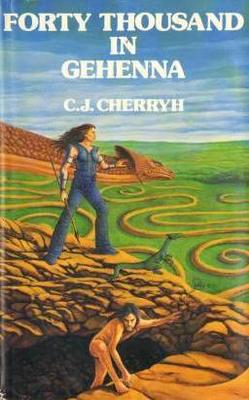
Forty Thousand in Gehenna by CJ Cherryh


1. Unlike Cherryh’s typical character focus, this novel discusses a situation over a long time-span of 305 years. The situation is a new colony on a habitable nut little understood planet. The book starts with it being founded, flourishing, and collapsing. Then being rediscovered, studied, and collapsing again. Then, between the on-screen scenes, being rebuilt and thriving. In Cherryh's universe, the science fiction theme clearly test-runs theories of first contact, and studies how azi and humans react to collapse. In this way, I think this is the most space operatic novel I’ve read by Cherryh, though her whole Alliance-Union universe tends towards this sub-genre as all the books are so interlocked.
From Section D: Mission Report by Dr. Cina Kendrick

Intelligence is not, as indicated above, a scientific term. [...]

Two considerations must be made. First, that an organism’s behaviors may be survival-positive in one environment and not in another, and second that its perceptive apparatus, its input devices, may be efficient for one environment but not for another. The quality imprecisely described as intelligence is commonly understood to describe the generalization of an organism, ie, its capacity to adapt by the use of analogy to a variety of situations and environments.

On the contrary, even the concept of analog is anthropocentric. Logic is another anthropocentric imprecision, the attempt to impose an order (binary, for instance, or sequential) on observations which themselves have been filtered through imprecise perceptive organs.

The only claim which may be made for generalization as a desirable trait is that it seems to permit survival in a multitude of environments. The same may be said of generalization as part of the definition of intelligence, particularly when intelligence is used as a criterion of the inherent value of an organism or its right to life or territory when faced with human intrusion. Generalization permits migration in the face of encroachment; and it permit one species to encroach on another, which adds another dimension to natural selection. But when extended to intrusion not over another mountain ridge within the same planetary ecology and the same genetic heritage, but instead to intrusion of one genetic heritage upon another across the boundaries of hitherto uncrossable space, this value judgment loses some credibility.

2. However, this novel isn’t all situational—well-developed characters still fill the pages. But it’s character by mindset more than specific individuals. Characters who take a non-interventionist policy oppose those who take a more helpful role, and both camps contain exploitative characters. These ideas are spread through the novel: from Union’s first contact with the Calibans, to Alliance's first contact with the Gehennans, to Gehenna's first contact with the Unioners, to Farsider’s first contact with a Gehennan.
—First, the Union colonists’ ignorance leads them to assume that the Calibans are stupid. This allows catastrophic destruction of the Union mission—both in the slow trickle of children away from their control, and the base being physically undermined and collapsing.
—Second, the Alliance comes in slow and indecisive—non-interventionist in word, but not so much in deed. Their base is way too close for comfort and their observation post changes what they observe. Their confidence in their space-based surveillance is similarly poorly placed—they can see the whole, but no details and are just as ignorant as to the meaning of the whole. Like when McGee heals Elai’s leg, it’s half-assed through indecision: in her own misplaced confidence and self-conflicted desire to save a child’s life, she doesn’t search for or get out the near-fatal bone-spur. This fumble sets her mission back fifteen years, until Elai’s mother dies. The Alliance's indecision as a whole leads to war, death, and the destruction of half the Gehennan culture. Finally, both the Alliance and Gehennans decide to educate and put their pride aside enough to be educated, and that seems the right track. (I read McGee’s pattern as a clear step in this direction.)
—Third, the Union comes in hungry for knowledge and offering trade. Elai rightly recognizes that the Union needs nothing from her, and calls their bluff. This is entirely the wrong foot to start out on for the Union: the wary reaction of the Calibans—leading to the Unioners further fear-based reaction—illustrates this. The Union is still ignorant to the point of not knowing how to engage their potential teacher, and this ultimately loses them their final influence over the colony.
—Fourth, the Farsiders appear to find the Gehennan curious, but the knowledge they do have—from videos and reports—allows even the rough docksiders to avoid an incident. Similarly, the Gehennan and Caliban pair chosen for the visit are appropriate for the high number of strangers they expect to run into.
—McGee, Genley, Elai, Pia, Jin, Jin Younger, Jin Elder, and Scar are the main characters, but the mindsets clearly steal the show from the people. These are well constructed, interesting characters; but they are not as important to the novel as the mindsets.
—And I find this discussion of the mindsets of First Contact to be the theme of the novel. First Contact here is a metaphor for the other. In our day-to-day lives we are consistently pushed outside of our normal comfort zones to deal with unfamiliar people, opinions, situations, etc. There are two ways this typically goes: fear or understanding. Education and embracing the unknown—quite literally in McGee’s case—leads to an inclusion that grows knowledge and culture. Fear leads to death. That’s Cherryh’s point and she makes it well throughout the novel by focusing on the mindsets—though she doesn’t lose sight of the individual characters in a way that shows how small acts have large consequences. Humanity will survive because it has generalization, but that's not always a good thing when the situation or environment pushes us, even on an easy, habitable, fruitful planet like Gehenna.


3. Cherryh set herself a hard task in the various writing tactics of this novel. She includes memos and portions of scientific papers to show the affect actions have on the whole.
I propose that, instead of arguing old theories which have considerable cultural content, we consider this possibility: that humanity develops a multiplicity of answers to the environment, and that if there must be a system of polarities to explain the structure around which these answers are organized, that the polarity does not in and of itself involve gender, but the relative success of the population in curbing those individuals with the tendency to coerce their neighbors. Some cultures solve this problem. Some do not, and fall into a pattern which exalts this tendency and elevates it, again by the principle that survivors and rulers write the histories, to the guiding virtue of the culture. It is not that the Cloud River culture is unnatural. It is fully natural.
Another aspect is researchers’ notes:
Is even childhood one of our illusions? Or is this forced adulthood what’s been done to us out here?

Us. Humans. They are still human; their genes say so. But how much do genes tell us and how much is in our culture, that precious package we brought from old Earth?

What will we become?

Or what have they already begun to be?

They look like us. But this researcher is losing perspective.
And memos also fill the pages, at least one going through draft after draft showing McGee’s mindset and final words, exposing much about her character and her dissatisfaction with the powers over her. Further, the Union, Alliance, Styxside, and Cloud River cultures all have their own voices, and the latter two communicate also via hand gestures and drawing patterns. It’s a plethora of writing tactics, causing Cherryh to switch gears consistently in a way that keeps the writing all fresh and exciting. It’s not all one voice, though Cherryh’s typical tightly focused voice is on display fully.


4. Many of these memos and papers take the place of actions and interior monologue in a way that makes the novel seem a little slow. There’s a lot that happens over these three hundred and five years, but most of the novel is people reacting to those changes and settling in as best they can. The action is usually fast—a couple of pages—and decisive, leaving the bulk of the novel to unraveling the meaning of those actions and what they signify. This isn’t necessarily a negative as I was enthralled throughout, but covers that show a human riding on a dragon-like creature mislead and that first edition cover (at the top) is the most informative as to what the novels feels like. Not sedentary, but also not rollicking, despite what the following cover wants you to believe:


5. This is a good novel. I wanted a bit more action and a bit more psychological depth—Jin Elder and McGee are really the only two who have any depth. But then, maybe that is me projecting on the novel too much of Cherryh’s other works, kind of like how Union and Alliance project on the Gehennans too much of their empirical data. I like seeing Cherryh trying a new method of storytelling with the time span that disallows her usual deep individual psychology, but I think her strengths primarily rest in the other way she writes. That’s not to say this isn’t a wonderful novel, because I really enjoyed it. It’s certainly better than other situational novels I’ve read, like The Plague by Albert Camus.